5.3 - Wage determination and labour mobility
Wages differ because employers' demand and workers' available alternatives differ. This part of 5.3 explains competitive wage determination, changes in demand and supply, and the benefits and costs of making labour more mobile and flexible. Monopsony, unions and bilateral bargaining are developed in the other 5.3 lesson.
Competitive wages and employment
A highly competitive labour market brings together many employers and workers who cannot individually control the market wage.
The model assumes comparable labour within the specified market, information about opportunities, and enough mobility for workers to consider alternatives. Industry demand slopes downward because higher wages make fewer units of labour worth employing. Industry supply generally slopes upward as higher relative pay attracts more suitable labour. Their intersection sets the equilibrium wage and employment.
At a wage above equilibrium, labour supplied exceeds labour demanded. Workers seeking employment and employers able to recruit more cheaply create downward wage pressure, if wages are flexible. Below equilibrium, employers compete for scarce workers and create upward pressure. At the intersection, planned supply and demand match; this does not imply everyone in the economy has a job, since other skill markets can have different conditions.
In an illustrative market, demand is and supply is , where W is pounds per hour and L suitable workers. Equating them gives , so employment is 100 and the wage £20. At £25, demand is 75 and supply 150: excess supply is 75 workers. At £15, demand is 125 and supply 50: excess demand is 75.
An individual wage-taking employer faces a horizontal supply line at £20 and hires where its MRP matches that wage. Do not give the single firm the upward-sloping industry supply curve while still assuming it can hire any number at unchanged pay. At the market level, the combined decisions of many firms and workers determine the wage.
Changes in labour demand and supply
A shift in one side of a competitive market changes both the wage and the quantity employed.
When stronger product demand raises MRP, labour demand shifts right. At the old wage employers now want more workers than are available; pay rises, drawing additional suitable labour along supply. Both equilibrium wage and employment rise, other conditions unchanged. The extra employment is larger when supply can respond readily; with very inelastic supply, the main effect can be higher pay.
When training or inward migration expands suitable labour supply, supply shifts right. At the old wage labour supplied exceeds demand; downward wage pressure increases employment along demand. Equilibrium wage falls and employment rises in this model. The wage reduction is smaller where demand is more elastic. This prediction holds output demand and other determinants fixed: extra workers can also spend income, complement other skills or raise productivity, potentially changing demand.
[DIAGRAM: asset_slug: h460-competitive-shifts; caption: Higher labour demand raises wage and employment, while higher supply lowers wage and raises employment; description: Two common-scale illustrative industry graphs starting at 100 workers and 20 pounds per hour; demand expansion gives 120 workers at 22 pounds and supply expansion gives 120 workers at 16 pounds.]
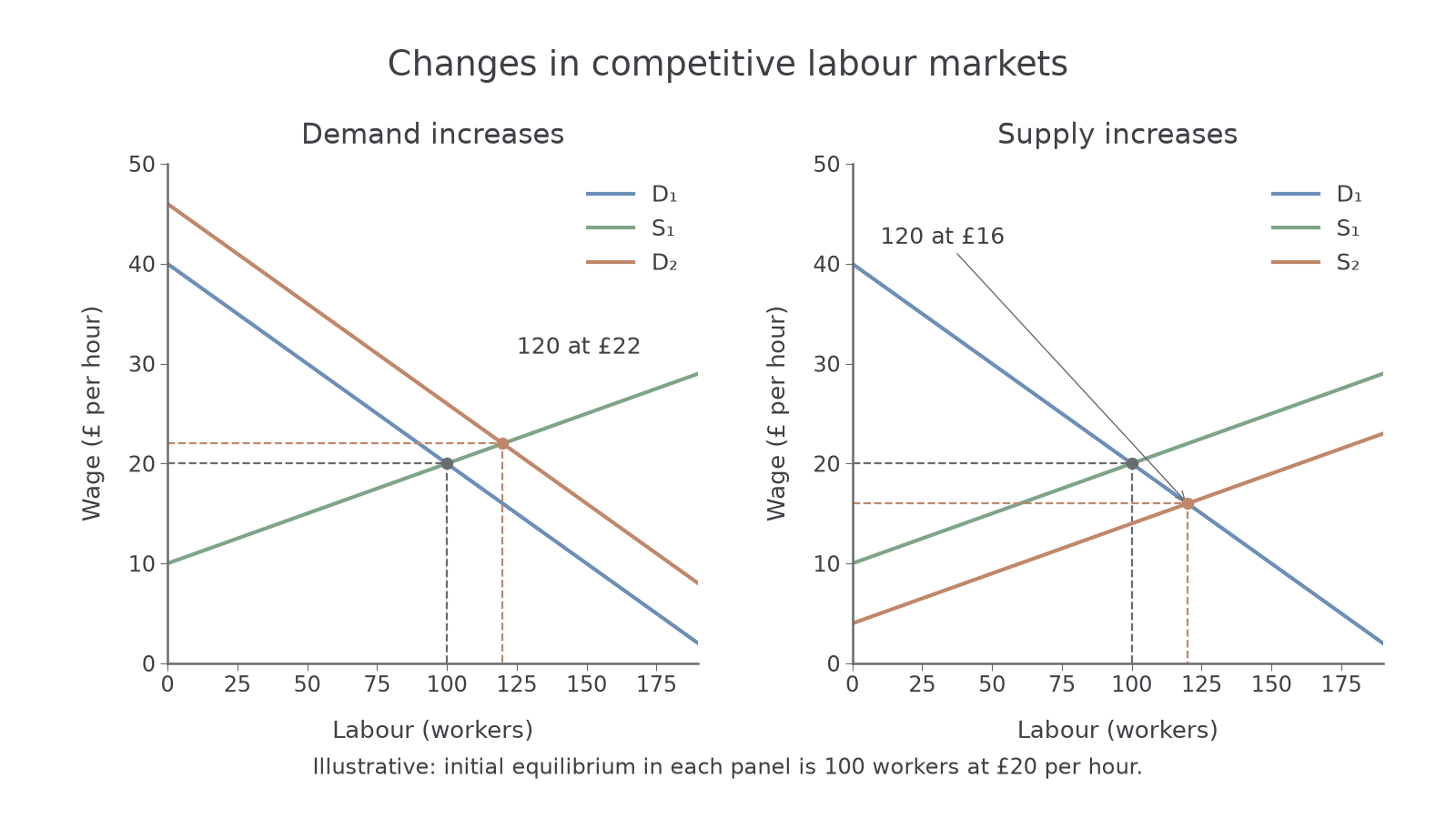
The left panel shifts demand from to , holding supply fixed. The right panel instead shifts supply to , holding initial demand fixed. Both new employment levels are 120, but the wages differ. An unchanged curve has a movement along it; the changed curve shifts.
If demand and supply both increase, employment normally rises but the wage direction depends on the relative changes and responsiveness. Do not conclude that more workers necessarily lower pay without considering employer demand. In a contracting industry, declining demand can reduce wages and employment, but wages may adjust slowly because of contracts or bargaining.
Notebook practice (ungraded): draw the initial D and S, mark the intersection and axis projections, then change only the specified curve. Label D1/D2 or S1/S2, distinguish old and new equilibria, and check the direction before adding numbers.
Why wages differ
Wage differentials are differences in pay between workers, occupations, employers or locations.
Differences in MRP can raise labour demand and equilibrium pay. A specialist whose work enables high-value output may earn more when their contribution raises marginal revenue. Skills, training, experience, complementary capital and output demand all affect this contribution. A worker's personal effort is only one influence; expensive machinery and team organisation can raise productivity too.
Continue this lesson.
You’re previewing NovaLearn without an account. Create a free account to read the rest.
Create free account