5.3 - Monopsony, unions and bargaining
A labour market can contain a powerful employer, organised workers, or both. This part of 5.3 explains how employer buying power changes the hiring decision and how unions can change wages and employment. It then evaluates bargaining between the two sides without assuming that one wage follows automatically from the diagram.
Employer buying power
Monopsony is market power on the buying side of a market.
A monopsony is a market with a single buyer; in a labour market that means one employer buying the relevant labour. Employers can also have some monopsony power without being literally the only employer when workers have few effective alternatives because of location, specialised skills, search costs or difficult mobility. Define the relevant occupation and area before calling an employer dominant.
For instance, an illustrative specialist plant may be the only local employer using a particular skill. A worker could theoretically move far away, but housing and family costs can make that option unattractive. The plant therefore faces upward-sloping supply: to obtain more suitable workers it must offer a higher wage. In the standard model below it pays the same wage to all comparable workers.
This differs from a wage-taking firm, which can recruit extra labour at the market wage and has MCL equal to that wage. An employer with buying power considers how recruiting more affects the wage bill for existing workers as well as the new recruit. Buyer power in labour is distinct from monopoly power in selling output: a company can have one, both or neither.
The strength of the power depends on genuine alternatives. Better transport, remote work where feasible, new employers or transferable skills can make the firm's labour supply more elastic and limit its ability to hold down pay. A large employer is not necessarily a monopsonist if workers can readily switch to comparable jobs.
Monopsony hiring and wages
A uniform-wage monopsonist chooses employment where MRP equals marginal labour cost, then finds the wage on labour supply.
Suppose employing four workers requires £100 each per day, giving a £400 wage bill. Hiring five requires £110 each, giving £550. The fifth worker adds £150 to the bill: £110 for that worker plus £10 for each of the four existing workers. MCL is £150, above the £110 wage. The model assumes the employer raises all comparable workers' pay to recruit more; different pay arrangements can alter the result.
[DIAGRAM: asset_slug: h460-monopsony-choice; caption: The monopsonist chooses employment at MRP equals MCL and reads its wage from supply; description: Illustrative MRP W equals 40 minus 0.2L, labour supply and average cost W equals 10 plus 0.1L, MCL equals 10 plus 0.2L; monopsony employs 75 at 17.50 pounds and competitive benchmark is 100 at 20 pounds.]
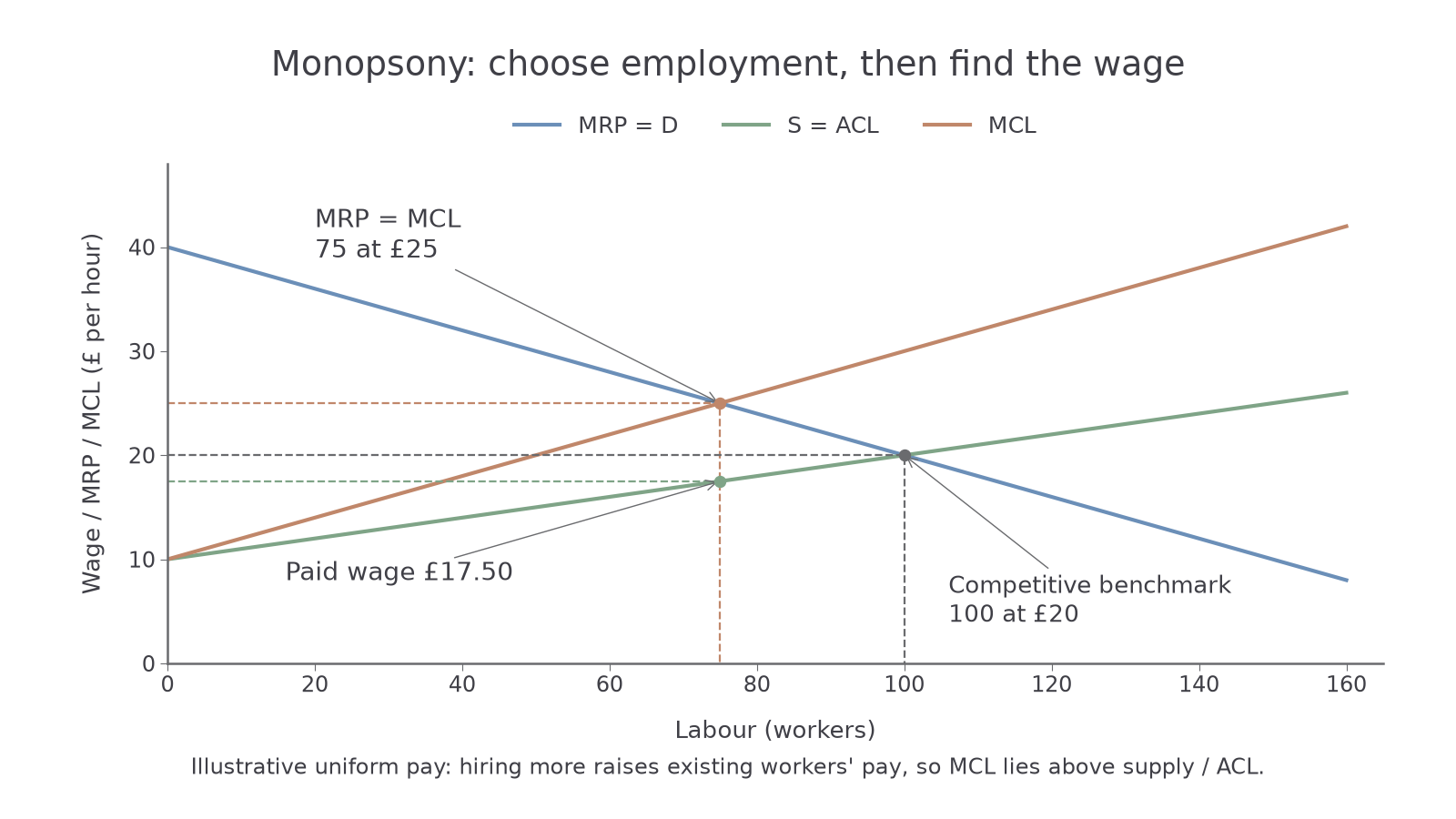
Supply is also average labour cost (ACL) when every worker receives the same wage. For , total labour cost is ; its marginal cost curve is . MRP is . MRP intersects MCL at 75 workers and £25, but £25 is not the wage paid. Moving down to supply at 75 gives £17.50. In the competitive benchmark, MRP intersects supply at 100 workers and £20.
The monopsonist restricts employment and pays less than the competitive benchmark in this model. At 75, MRP is £25 while the wage is £17.50. That gap is not all additional profit from hiring another worker: expanding recruitment also raises existing workers' pay, which is why MCL matters. Some mutually beneficial employment between 75 and 100 is lost because MRP exceeds the workers' minimum supply price there.
The effect on workers can include lower earnings, fewer opportunities and weaker bargaining power. Restricted employment also prevents some workers whose contribution exceeds their minimum required payment from being hired. In that sense the unregulated outcome sacrifices potential gains from exchange compared with the competitive benchmark. The size depends on how limited workers' alternatives are, rather than merely the employer's size.
A large employer may nevertheless invest in training, provide stable jobs or introduce productive capital, raising MRP and creating work that otherwise would not exist locally. Lower labour costs may help it retain price-sensitive contracts, although that does not prove its chosen employment is efficient or that workers share the gains. Low pay can also weaken retention and effort where alternatives become available. A comparison with a productive plant facing effective competition is therefore different from a comparison with no local plant at all. These wider effects qualify the overall judgement without removing the model's buying-power distortion. With easy mobility and competing employers, the wage and employment gap tends to be smaller.
Notebook practice (ungraded): draw MRP, supply/ACL and MCL; project the MRP–MCL intersection to employment, then use supply at that employment to find the wage. Mark the competitive MRP–supply intersection separately. Do not project the MCL intersection directly to the wage axis as the paid wage.
Unions in a competitive labour market
A trade union is an organisation representing workers' interests through collective action and bargaining.
A trade union can negotiate pay, hours, safety, training and employment conditions. Collective bargaining gives workers a stronger negotiating position than bargaining separately. Industrial action is one possible tool, but a union is not defined only by strikes. Union objectives may include members' wages, employment and security, and these can conflict.
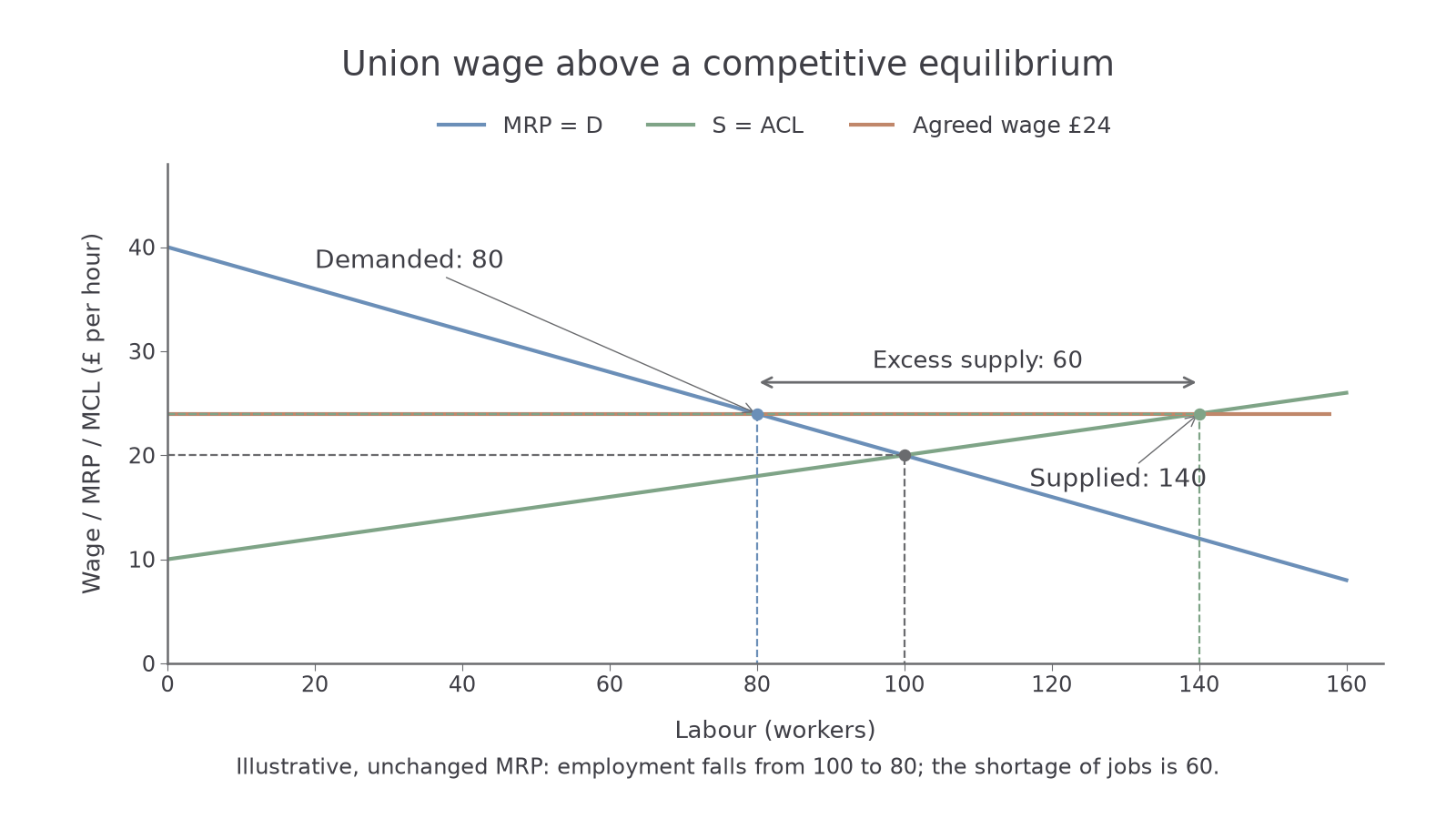
In a competitive market, a union-negotiated wage above equilibrium can raise members' pay but reduce employment demanded if MRP is unchanged. Labour supplied at the higher wage exceeds labour demanded, leaving some workers unable to obtain jobs. A union cannot create employer demand merely by declaring a higher wage.
[DIAGRAM: asset_slug: h460-union-competitive; caption: A wage negotiated above the competitive equilibrium can reduce jobs and create excess labour supply; description: Illustrative competitive market at 100 workers and 20 pounds per hour; union wage 24 pounds gives demand 80, supply 140 and excess supply 60.]
Continue this lesson.
You’re previewing NovaLearn without an account. Create a free account to read the rest.
Create free account