3.3 - Supply-side policy and productive capacity
Supply-side policy aims to improve the economy's ability to produce, rather than relying only on higher spending. Connect changes in competition, investment and labour markets to costs and capacity, then judge whether their benefits arrive soon enough and outweigh their financial, social and environmental costs.
From productivity to capacity
Supply-side policy changes the quantity, quality or allocation of productive resources to improve economic performance.
Productivity is output per unit of input, such as output per worker-hour. Better machinery, skills, technology or organisation can enable a given workforce to produce more. An increase in available labour or capital can also increase potential output without increasing output per worker. Distinguish more resources from better use of each resource.
If firms produce more output for the same wage bill, labour cost per unit can fall. Lower unit costs can shift SRAS right/down, allowing more output at a given price level. Lasting improvements in resources or productivity can shift LRAS right, increasing potential output. A temporary subsidy that lowers current costs need not permanently increase capacity, and an increase in AD alone does not establish a supply improvement.
[DIAGRAM: asset_slug: ocr_h460_supply_capacity; caption: A lasting capacity improvement shifts LRAS right under a neo-classical model; description: Exact illustrative AD-LRAS graph with potential real-output index increasing from 100 to 120 and a lower equilibrium price index with AD unchanged.]
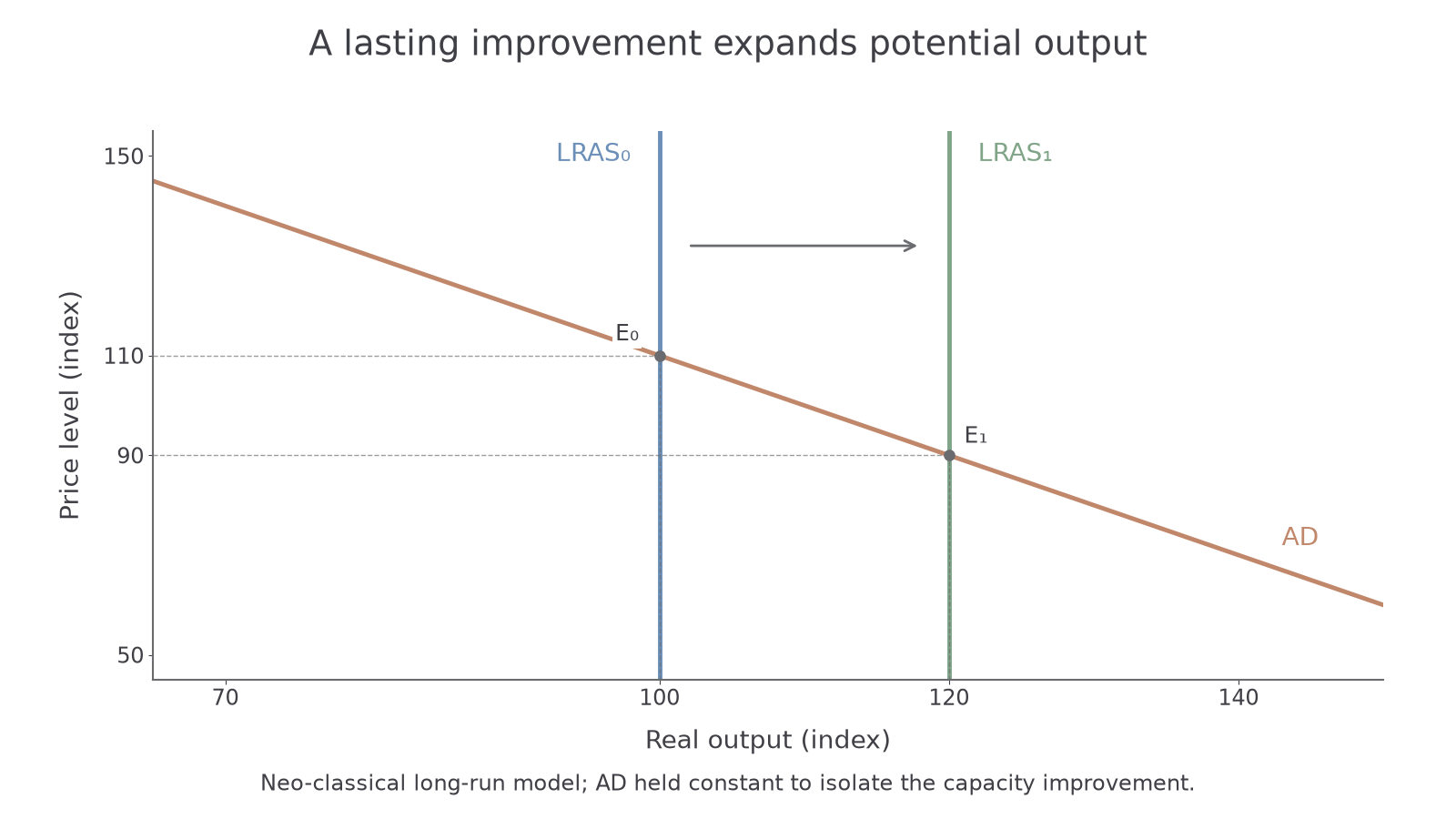
To construct this long-run model, put the price level on the vertical axis and real output on the horizontal axis. Draw a vertical LRAS at initial potential output and another to its right after the improvement. With the same downward-sloping AD curve, mark the old and new intersections and project to the axes. Under the model's price-adjustment assumptions, equilibrium real output rises and the price level is lower than otherwise. This is a comparison of price levels, not a prediction that observed annual inflation instantly becomes negative.
The capacity diagram is a framework for the policies that follow: explain what increases capacity before drawing a rightward shift. When demand is too weak to employ the improved resources, actual output may initially remain below potential. In the Keynesian account, shifting the capacity limit outward does not by itself guarantee sales or full employment. Supply and demand policies can therefore complement each other.
Ownership, competition and subsidies
Market-oriented supply measures seek stronger incentives and competitive pressure, but their effectiveness depends on market structure.
Privatisation transfers an enterprise from public to private ownership. Private owners seeking returns may reduce waste, improve management or invest in better production. If this raises productivity and lowers unit costs, SRAS can shift right; sustained investment or efficiency gains may raise capacity and shift LRAS right. However, selling a public monopoly without creating competition may simply create a private monopoly. It can raise prices or cut service quality rather than improve economy-wide efficiency. The sale receipt is a financing consequence, not itself proof of a lasting supply gain.
Deregulation removes or relaxes restrictions. Reducing unnecessary entry barriers can let new firms challenge incumbents, lowering costs or encouraging innovation. Competition can reduce X-inefficiency, avoidable waste within a firm, and pressure firms to improve products. Removing rules that address safety, information failure or pollution can instead raise social costs, so the nature of the rule matters.
Competition policy seeks to prevent anti-competitive conduct and protect effective competition, for example by addressing collusion, abuse of market power or a merger that would substantially weaken rivalry. It can preserve entry and efficiency incentives. A merger might also create economies of scale, so policy needs to compare those efficiencies with the loss of competition. Competitive pressure does not guarantee every firm invests more; uncertain profits can limit innovation finance.
Subsidies lower a recipient's costs or support a chosen activity. A per-unit production subsidy can reduce current private costs and shift supply right. A targeted research or training subsidy may address spillovers that cause firms to invest less than socially desirable, increasing future productivity and capacity. Poor targeting may subsidise activity that would occur anyway, preserve inefficient firms or encourage lobbying. Funding the subsidy has an opportunity cost and may affect AD through taxes or borrowing.
[DIAGRAM: asset_slug: ocr_h460_supply_unit_costs; caption: Lower unit costs shift SRAS right, with aggregate demand held constant; description: Exact illustrative AD-SRAS graph moving from real-output index 100 and price index 100 to output 110 and price index 90 after a cost reduction.]
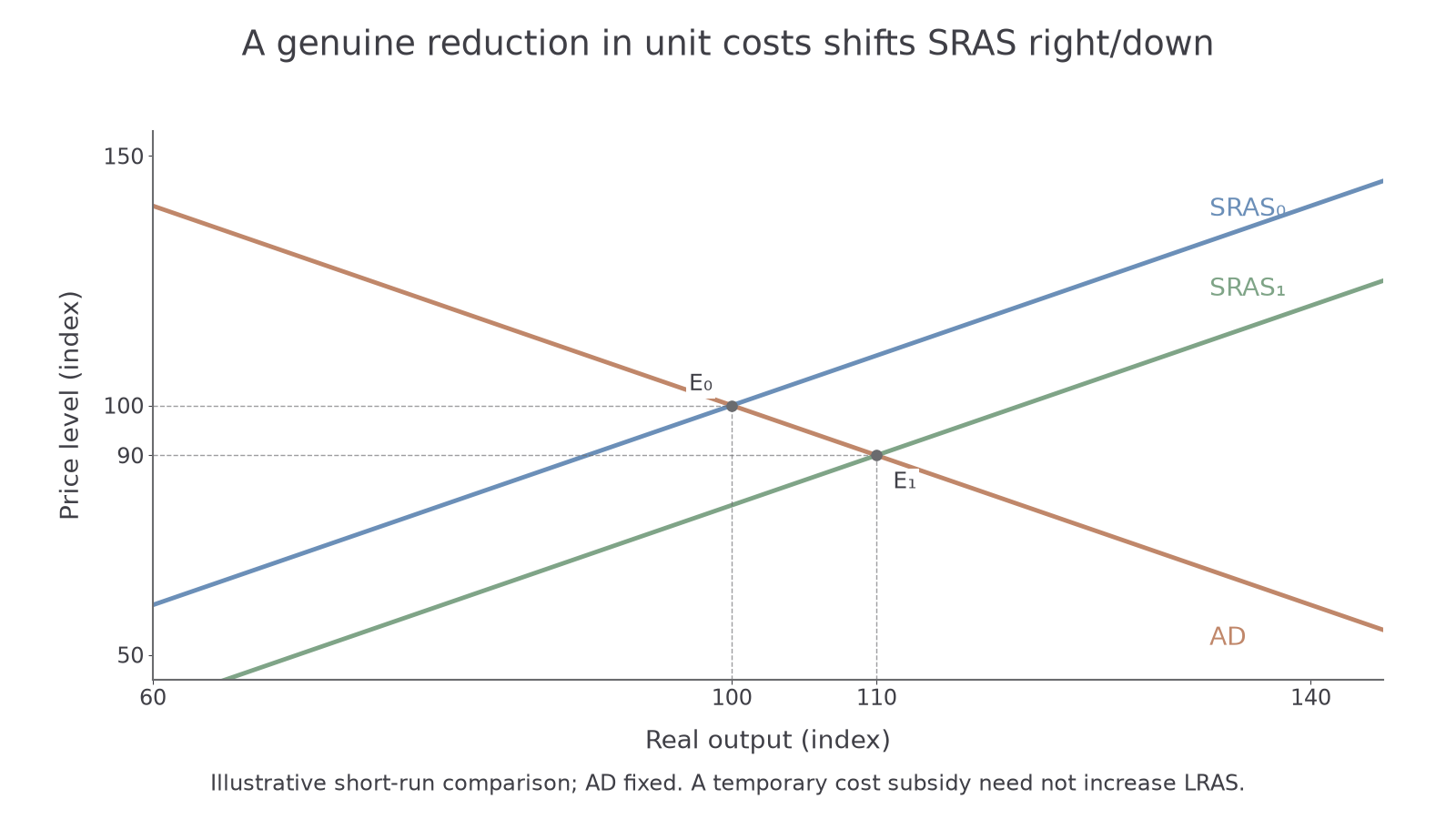
Draw this short-run graph with price level and real output axes, upward-sloping SRAS and downward-sloping AD. Shift SRAS right/down after a genuine cost improvement, keeping AD fixed to isolate it. The new intersection has higher output and a lower price level than otherwise. Privatisation, deregulation, competition policy or a subsidy can fit this route only if the stated mechanism actually lowers costs. For a lasting productivity gain, also use the rightward LRAS shift in the earlier diagram; do not equate a temporary cost payment with permanent capacity.
Infrastructure, skills and innovation
Public investment can improve supply where useful resources or positive spillovers are underprovided by private decisions.
Infrastructure includes transport, communications, water and energy systems that support production. A reliable electricity grid can reduce interruptions and delivery costs, improving firms' productivity and incentives to invest. Additional capacity allows more output without the previous bottleneck. In the cost diagram, fewer interruptions can shift SRAS right; in the capacity diagram, a lasting improvement can shift LRAS right. The project first uses labour and materials and may raise AD during construction, so its immediate demand effect and later supply effect should be separated.
Education develops broad knowledge and skills; training develops capabilities for particular work. More skilled workers may produce more per hour, make fewer errors and adapt to new technologies. Training can reduce occupational immobility and structural unemployment by matching skills to vacancies. An empty training course without employer demand does not create productive jobs. Health, access, quality and whether skills are retained affect the payoff.
Research and development creates and applies new knowledge, processes and products. Firms may underinvest when other firms can benefit from discoveries without paying the full research cost. Public research, grants or collaboration can help capture these positive spillovers. Successful innovation may lower costs or create new productive possibilities; failed projects still use scarce resources. Government information about future technologies is incomplete, so support needs a reason rather than assuming officials always select the best project.
[DIAGRAM: asset_slug: ocr_h460_supply_capacity; caption: Useful infrastructure, skills and innovation can move the capacity limit outward; description: The same exact long-run capacity diagram, used to connect successful investment mechanisms to a rightward LRAS shift, with unchanged AD as an isolating assumption.]
For example, an invented region has frequent grid outages and firms postpone automated equipment because production stops unpredictably. A successful grid upgrade can reduce downtime and encourage those investments, shifting capacity right. If planning and construction take three years, it is not a complete answer to an immediate inflation surge. If equipment is imported, costs and exchange-rate exposure matter. A low-benefit project can increase debt without increasing potential output enough to cover its cost.
Longer-run capacity improvements can support growth and employment, reduce cost pressure and improve export competitiveness. Their effect on the current account depends on export/import responses and imported investment equipment; their distributional effect depends on who receives the opportunities and services. Public spending on skills can be current expenditure yet yield lasting supply gains: the budget classification is not a test of economic usefulness.
Continue this lesson.
You’re previewing NovaLearn without an account. Create a free account to read the rest.
Create free account