2.9 - Information failure and merit goods
Markets work less well when buyers or sellers misunderstand the costs and benefits of their choices. In 2.9, distinguish missing from asymmetric information, explain moral hazard, and use merit- and demerit-good models to judge how better information could change consumption and production.
Missing and misleading information
Information failure occurs when decision-makers lack accurate relevant information about a good's benefits, costs or risks, so their choices can misallocate resources.
Consumers might underestimate the long-term benefit of a preventive health check or underestimate the risk of excessive alcohol consumption. Producers might misunderstand demand for a new product or fail to recognise a production risk. Imperfect information can affect both sides equally: neither buyer nor seller may know the consequences. Asymmetric information, taught next, means one side knows more than the other. A high price or an unpopular choice is not sufficient evidence of either failure.
In a model without externalities, a consumer may have a perceived marginal benefit lower than their fully informed private marginal benefit. Their demand is then too low relative to what they would choose if informed, so the market produces too little of the good. Conversely overestimating benefit, or failing to recognise a private cost, can produce excessive demand. A preference that an observer dislikes is not automatically misinformation; distinguish a false belief from an informed choice.
The relevant comparison is a credible informed decision. If better information reveals a genuinely dangerous product, consumption may fall; if it corrects an exaggerated fear, it may rise. Information can improve allocative decisions without requiring the government to dictate one uniform quantity for every person.
Asymmetry and moral hazard
Asymmetric information means one participant in an exchange has relevant information that the other lacks.
A used-car seller may know that a vehicle has a recurring fault while a buyer cannot observe it before purchase. If buyers offer a price based on average quality, owners of reliable vehicles may withdraw because the price is too low for them. Average quality can then fall further: this is adverse selection, a useful application of asymmetric information before an agreement. Inspections, credible warranties or repeated dealing can make quality more observable, but cost money and may not remove every uncertainty.
Moral hazard arises when protection from some consequences changes behaviour after an agreement, particularly where that behaviour is hard for the other party to observe. A fully insured driver might take less care because an insurer pays much of the accident cost. This is a possibility, not a claim that every insured person becomes careless. Excess payments and conditions can preserve incentives, although they also weaken protection for genuine losses. Information asymmetry concerns what can be observed; insurance concerns how consequences are shared. Both help explain this example.
In production, a contractor paid a fixed fee for a public project may reduce hidden quality to cut costs when the purchaser cannot monitor it. Alternatively a contract reimbursing every cost can weaken incentives to control spending. The failure depends on the terms and monitoring; private and public organisations can both face it. Moral hazard is not simply any risky or unethical action, and it is different from consumers being unaware of a product's health consequences.
Merit goods and underconsumption
A merit good is considered underconsumed because consumers undervalue its benefits, often through imperfect information.
Education and preventive healthcare are common applications, but classification requires an argument about benefit and informed choice. A merit good can also create positive external benefits, such as fewer infections spreading to others, yet merit status and an externality are distinct explanations. Information failure concerns the consumer misperceiving their own benefit; an external benefit concerns a third party. Neither being publicly funded nor having a positive price defines a merit good.
The following merit-good model deliberately isolates information failure: no externality is assumed. On a price/marginal-benefit axis and quantity per period axis, draw perceived demand below fully informed private demand and upward supply representing marginal cost. Their intersections give perceived-market quantity and informed quantity . The gap between informed marginal benefit and marginal cost for units from to is the potential net benefit forgone through misinformation. It is not an external-benefit area.
[DIAGRAM: asset_slug: information-failure; caption: Underconsumption and overconsumption caused by inaccurate private benefit perceptions; description: Separate merit and demerit cases with informed and perceived demand, unchanged marginal cost, distinct equilibria and welfare triangles, assuming no externalities.]
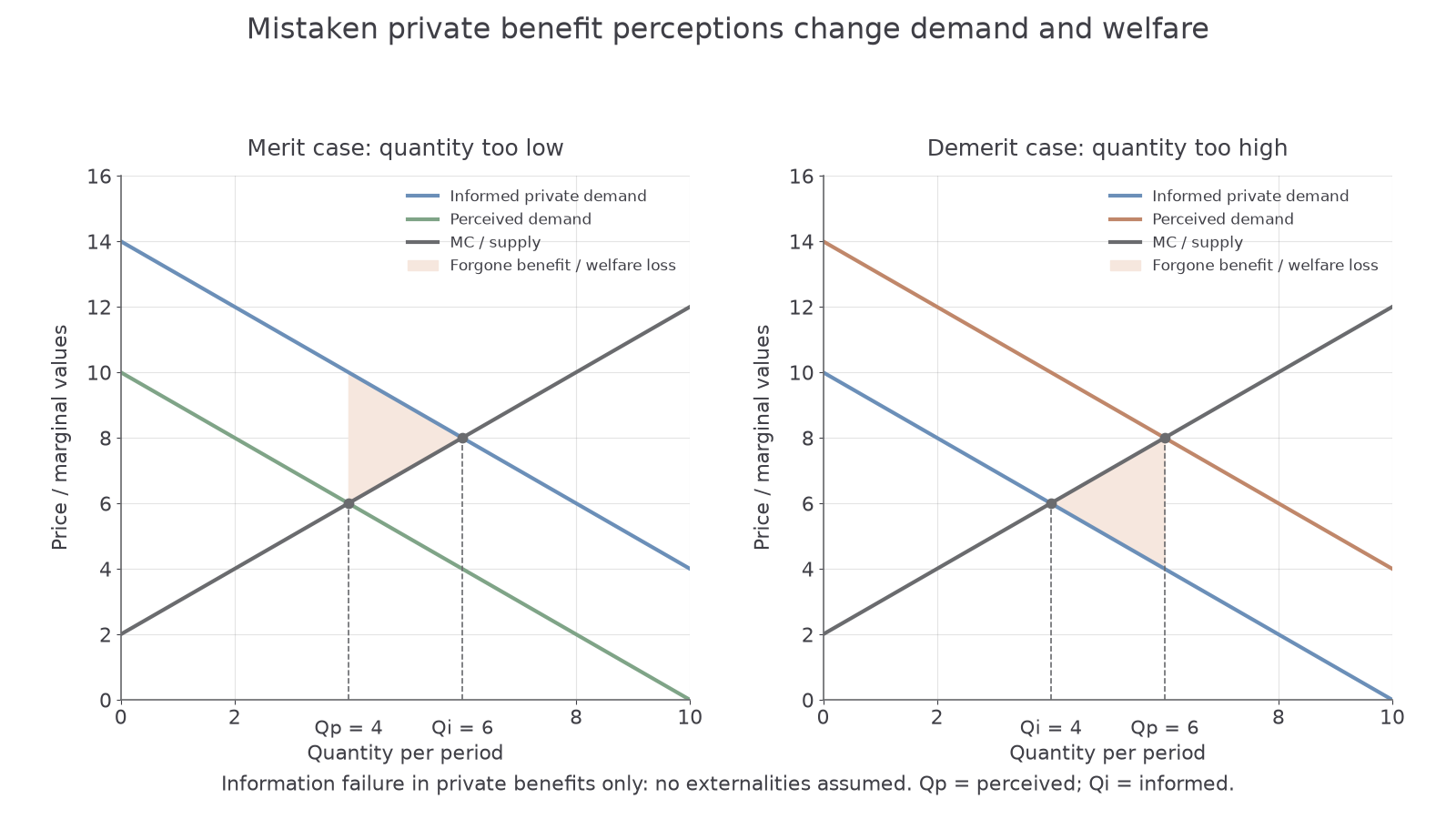
In the illustrative left panel, , informed demand is , and perceived demand is . Quantity is 4 under the false perception rather than 6 if informed. At quantity 4 the informed benefit is 10 while cost is 6; the forgone net-benefit triangle is in the diagram's compatible quantity×money units.
Better information can shift perceived demand towards informed demand, encouraging output where benefit exceeds cost. However, access, low income and uncertainty about the benefit may still restrict consumption. Public production can improve availability but does not automatically identify the right services or avoid queues and cost inefficiency. More production is justified where its additional benefit exceeds its opportunity cost, not simply because a good is labelled meritorious.
Demerit goods and overconsumption
A demerit good is considered overconsumed because consumers underestimate its harmful consequences or overestimate its net benefits.
Excessive tobacco or alcohol consumption can illustrate unrecognised private health costs. There can also be negative externalities, such as harm to others, but a private health loss is not automatically an external cost. An informed adult may value consumption despite a known risk; a case for information failure requires that relevant risk or benefit is misunderstood. Judgements of merit and demerit also involve social values and uncertainty about future outcomes.
The right panel of the information-failure diagram keeps externalities absent. Perceived demand lies above informed demand, while marginal cost is unchanged. Here informed demand is , perceived demand , and . Misperceived quantity is 6 rather than informed quantity 4. For units 4–6, marginal cost exceeds informed benefit, causing a welfare loss represented by the shaded triangle. Lower informed demand is a shift after beliefs change, not a price-induced movement along the original curve.
Production responds to these purchases: high perceived demand makes additional production privately profitable even where informed benefit would not cover the resource cost. Information disclosure can reduce that incentive by reducing demand. Yet firms may market selectively, and consumers facing habit or addiction may respond slowly to knowledge. Restricting production can reduce availability but may create illicit substitutes with worse information or quality. Evaluation should compare the severity of the misunderstanding and the practical response, not assume every reduction in supply raises welfare.
Judging better information
Information improves choices most effectively when it corrects a specific important misunderstanding and consumers can act on it.
Consider a preventive vaccination service with an illustrative survey showing many eligible people mistakenly think the vaccine itself causes the disease. Credible accessible information can correct that belief, raise perceived personal benefit and increase uptake. If the service has spare capacity, producers can meet the extra demand without long delays. Better health can increase the consumer's welfare; any reduced transmission creates an additional separate external benefit.
The same campaign may have little effect if the main barriers are inconvenient appointments, transport costs or distrust of the messenger. A survey measures stated beliefs, not proof that corrected beliefs alone change purchases. Advertising can attract relatively healthy people who already use the service, while scarce staff divert from another valuable treatment. Compare its opportunity cost with targeted access improvements. For a demerit good, warnings may change perceived costs but existing addiction or misleading counterclaims may weaken response; understandable credible information and support can be complementary.
Use evidence about knowledge, behavioural response, capacity and costs to judge consumption and production. The most effective choice may be targeted information with improved access, rather than either universal publicity or simply producing more. A valid opposite judgement can follow if the supplied evidence shows misinformation is the dominant barrier and capacity is ample. The criterion is whether the intervention improves informed choices and net benefits relative to a feasible alternative.
Quick recap
Missing information and asymmetric information are distinct. Moral hazard concerns changed incentives after protection. Merit and demerit models can isolate mistaken private benefits; externalities, affordability and informed preferences must be considered separately.