2.1 - Growth, capacity and the economic cycle
Output fluctuates around a changing sustainable capacity, rather than growing at a constant pace. Learn to identify cycle stages, distinguish recovery from capacity expansion on AD–AS and PPC diagrams, and weigh the causes and consequences of short-run and long-run growth.
Stages of the economic cycle
The economic cycle describes fluctuations in actual real output and its growth around the economy's longer-run path.
An expansion raises actual output; a recovery is expansion following weak activity. A boom usually describes high activity with strong demand and pressure on capacity. At a peak, output stops rising before a contraction. A contraction reduces output, reaching a trough before recovery. A common statistical convention calls two successive quarters of falling real GDP a technical recession, but broader recession judgements consider duration, severity and other activity indicators. No particular interval or precise quarterly rule is a law of the cycle.
During recovery, firms' sales and labour demand can rise, but output may still be below potential. As capacity is used more fully, recruitment difficulties and costs can grow. In contraction, weaker sales may lead firms to cut hours, jobs and investment. Employment often reacts with a lag; firms can retain staff through a temporary slowdown. Inflation also depends on supply costs, so recession does not rule out rising prices.
[DIAGRAM: asset_slug: ocr_h460_economic_cycle; caption: Actual output fluctuates around a rising potential-output path through expansion, peak, contraction and recovery; description: Exact illustrative annual real-output series with rising potential, a labelled peak/trough and gaps, axes time and real output, not an inflation or growth-rate graph.]
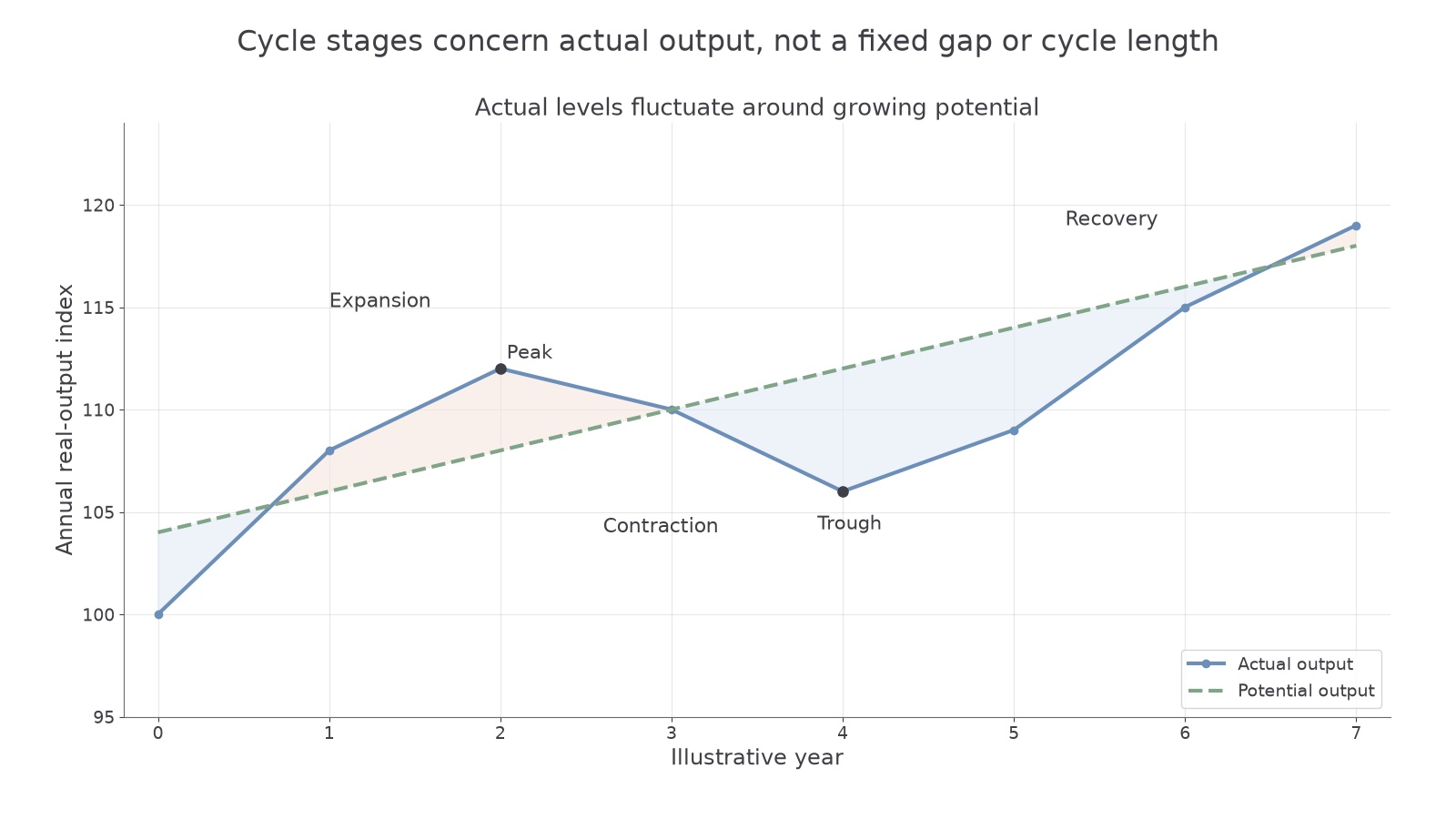
The diagram plots output levels, not growth rates. Actual output rises from 100 to 108 and then112 before falling to 110 and106. The first rise is8%, the second about3.70%: growth slows but output still expands. From112 to 110 is approximately−1.79%, an actual contraction. Potential continues to rise in this illustrative model, so the gap is determined by both paths. A turning point in growth is not necessarily a peak in the output level.
Short-run demand-led growth
Short-run actual growth can occur when spending rises and firms use previously idle productive resources.
An increase in consumption, investment, government purchases or net exports shifts AD right. With usable spare labour and capital, firms expand production and employment; increased incomes can support further consumption through the multiplier. Stronger expected sales can also induce investment through the accelerator. Prices may rise only modestly while supply is responsive. Near capacity, the same spending increase produces more price pressure and less additional real output.
On AD–AS, draw an initial equilibrium below potential and shift AD right with capacity unchanged; a new intersection closer to LRAS shows actual growth closing a negative gap. On a PPC, move the production point from inside towards the same frontier. Neither drawing alone shows potential growth. If additional spending is largely imported, domestic real output receives less support; if firms cannot obtain required skills or inputs, aggregate unemployment does not imply effortless expansion.
Demand recovery can improve incomes and tax receipts quickly without immediately building new capacity. It can also reduce the long-term harm from unemployment and postponed investment. However, a spending rise which firms expect to reverse may not induce useful capacity expansion. A one-off increase in the output level is different from a permanently higher annual growth rate. Diagnose the starting gap and the persistence of spending before claiming sustained demand-led growth.
Long-run capacity growth
Long-run potential growth requires more productive resources or better use of resources, rather than spending alone.
Physical capital accumulation supplies more or better machinery, buildings and infrastructure. Investment must exceed depreciation for the productive stock to rise. Human capital improves through education, training and health, enabling workers to produce more or undertake more complex tasks. Technological progress can increase output from the same inputs. A larger usable labour force, improved resource discovery or better organisation can also expand sustainable output. Population growth is not automatically productive growth if jobs, skills and complementary capital are absent.
Investment has both a demand and a supply role. Purchasing a new railway initially adds to AD and uses resources; once operational, reduced travel costs and reliable access can raise productivity and capacity. Delays, unsuitable routes and poor maintenance can weaken this later benefit. Research spending has uncertain outcomes, while education effects depend on relevant skills and opportunities to use them.
Continue this lesson.
You’re previewing NovaLearn without an account. Create a free account to read the rest.
Create free account