5.1 - Labour demand and productivity
An employer wants workers because their work helps produce something customers will buy. This lesson develops that derived demand into a hiring decision, then explains how productivity, output demand and substitution change demand for labour. It also shows why a wage rise can cause very different employment responses in different industries.
Derived demand for labour
Demand for labour comes from the output that labour helps to produce.
Derived demand is demand for a factor of production arising from demand for the goods and services it produces. A bakery demands bakers because customers demand bread. More demand for bread can make additional bakers worth employing; a fall in orders can have the opposite effect. Consumers need not buy the worker's service directly for the link to exist.
The relevant quantity might be workers, full-time-equivalent jobs or hours worked. State which is used. An employer can increase hours without increasing headcount, so a fall in jobs does not necessarily equal the same proportional fall in labour input.
A firm's hiring decision compares the additional revenue made possible by labour with its additional cost. A profitable firm does not hire every available worker: an extra employee may add too little saleable output to cover the wage. Conversely, an employee's contribution is not measured simply by the selling price of one item, since a worker can produce several items and production may require other inputs.
This is a model of a profit-seeking employer. Public services, charities and employers with other objectives may also value service quality or social outcomes. The revenue comparison is still useful for explaining commercial demand, but it does not claim that a worker's pay measures their social worth.
Marginal revenue product and hiring
Marginal revenue product measures the extra revenue attributable to an additional unit of labour.
Marginal physical product of labour (MPP) is the extra output produced by one additional unit of labour, holding the relevant other inputs constant. Marginal revenue product (MRP) is that extra output multiplied by the marginal revenue earned from it:
Use compatible periods and units: output per extra worker per day multiplied by pounds per extra unit gives pounds per extra worker per day. When the firm sells in a perfectly competitive product market, its marginal revenue equals the given product price. With product-market power, extra sales can require a lower price and MR can differ from price; use MR rather than automatically substituting price.
Consider an illustrative packing firm with fixed equipment. Extra workers add 18, 15, 12, 9 and 6 boxes per day respectively. Each extra box earns £10 of marginal revenue, giving MRP of £180, £150, £120, £90 and £60. At a daily wage of £100, with no other additional employment costs, the first three workers add more revenue than cost; the fourth does not. The firm hires three. Total output and average output are different from these marginal contributions.
For smoothly divisible labour, profit maximisation occurs where MRP equals the marginal cost of labour (MCL). A wage-taking employer can hire extra labour at the same wage, so MCL equals the wage. It hires up to the intersection of the wage line and the downward-sloping MRP curve. With whole workers, employ each additional worker whose MRP covers MCL; exact equality need not occur.
[DIAGRAM: asset_slug: h460-labour-demand; caption: A wage-taking firm hires where daily MRP equals the daily wage; description: Illustrative MRP equals 220 minus 2L, with wage lines at 100 and 140 pounds per worker per day and employment at 60 and 40 workers.]
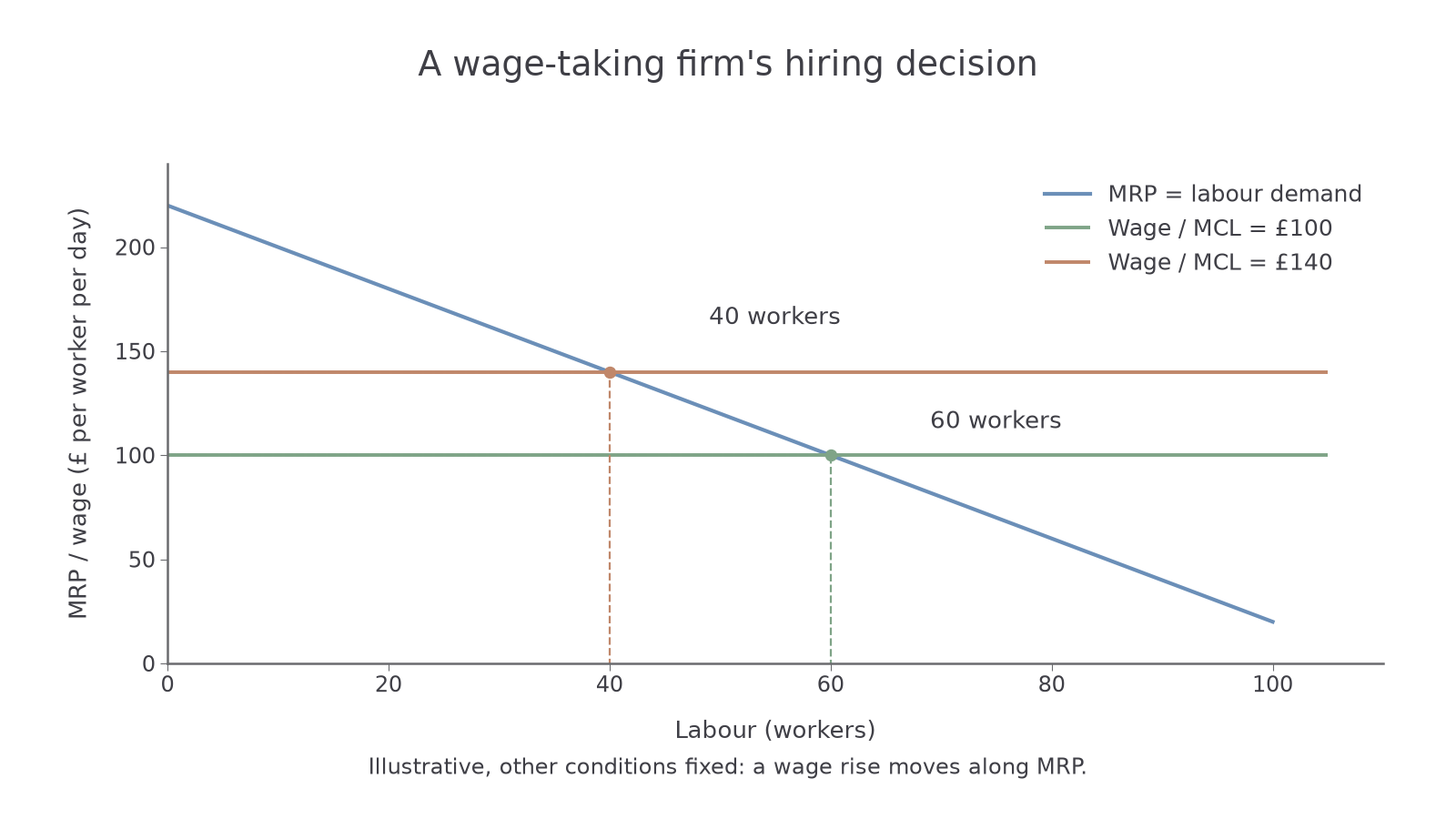
The graph measures workers per day horizontally and pounds per worker per day vertically. At £100, employment is 60; a rise to £140 reduces employment to 40, a movement along unchanged MRP. Each wage line is the firm's horizontal labour-supply/MCL line, not the upward-sloping supply curve of the whole industry.
MRP commonly falls in the short run because additional labour shares fixed capital and eventually has diminishing marginal product. If selling extra output also lowers MR, this reinforces the decline. Team production, uncertain future sales and non-wage costs make real contributions harder to measure. Where a firm must raise existing workers' pay to attract another worker, MCL exceeds the new worker's wage: the monopsony lesson develops that case.
Notebook practice (ungraded): plot MRP using (0, £220) and (100, £20), draw both horizontal wages, and mark each intersection and employment projection. Label variables and periods. Reading this supplied graph is different from being assessed on a drawing.
Productivity and unit labour costs
Labour productivity compares output with labour input, while unit labour cost compares the wage bill with output.
Labour productivity is output per unit of labour input, such as boxes per worker per day or units per hour worked. It is an average measure. MPP instead measures the extra output from an additional worker. Unit labour cost (ULC) is labour cost per unit of output:
Continue this lesson.
You’re previewing NovaLearn without an account. Create a free account to read the rest.
Create free account