H460/03 - Competition, trade and industrial change
An expanding industry can gain lower costs and export opportunities while becoming more concentrated. Connect firms' scale and competitive behaviour to comparative advantage and trade, then judge whether industrial support creates lasting benefits or protects inefficient producers.
Scale and unit costs
Economies of scale lower long-run average cost as a firm's output scale increases, but expansion need not keep lowering costs indefinitely.
In the long run all factors can be varied; a firm can change factory size, machinery and workforce together. Internal economies of scale arise within the expanding firm, such as specialised equipment, purchasing economies or dividing specialist tasks across more output. External economies arise from the growth of the industry or cluster, such as a pool of trained suppliers available to several firms. Spreading the cost of an existing machine over more short-run output is not by itself proof that changing all inputs produces long-run economies.
The original illustrative schedule below is for an industry's representative plant, with all inputs adjustable. Costs include labour, materials and capital costs; the values describe feasible efficient methods at each output, not the short-run cost of one fixed factory.
| Annual output, thousand identical units | 100 | 200 | 400 | 600 | 800 |
|---|---|---|---|---|---|
| Long-run average cost, £ per unit | 30 | 22 | 18 | 18 | 21 |
Average cost falls from £30 to £18 between 100,000 and 400,000 units, a 40% reduction. It stays at its minimum through 600,000 units, then rises: management delays or coordination problems could generate diseconomies of scale. The minimum efficient scale is the lowest output at which minimum long-run average cost is achieved: 400,000 units in this supplied schedule. It is not the largest possible output or the firm's profit-maximising output, which also depends on revenue.
[DIAGRAM: asset_slug: themes-unit-costs; caption: Illustrative long-run unit costs reach their minimum at 400 thousand units; description: Exact original-data cost schedule plotting output 100, 200, 400, 600, 800 thousand units against long-run average cost 30, 22, 18, 18, 21 pounds per unit.]
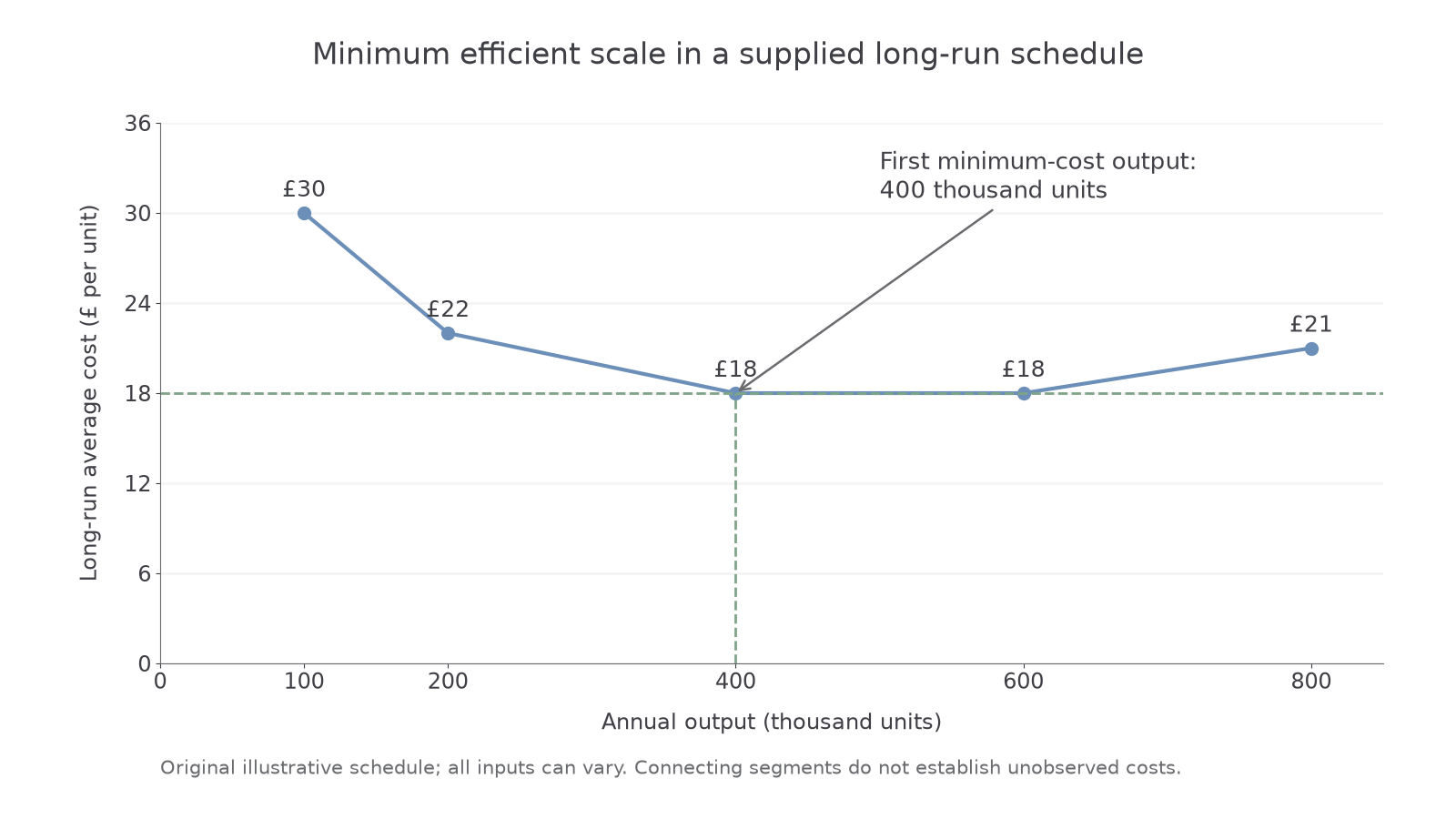
To construct the cost graph, label annual output horizontally and pounds per unit vertically, plot the schedule and identify its lowest-cost range. The connecting segments show the supplied schedule; they do not establish costs at every unobserved output. A large minimum efficient scale relative to market demand can favour a small number of plants. Selling overseas can enlarge the accessible market and allow firms to reach scale that domestic demand alone would not support.
Concentration and competition
A market's concentration shows how sales are distributed across firms, while competitive pressure also depends on firms' behaviour and the threat of entry.
An oligopoly contains a few dominant firms whose decisions are interdependent: each considers rivals' likely responses. In an original illustrative market the five firms' sales shares are 42%, 28%, 12%, 10% and 8%. The three-firm concentration ratio is . It is a share of the stated market, not a measure of the number of firms or a direct measure of pricing power. Including imports in the market definition may reduce the apparent dominance of domestic producers.
Large firms can finance research, achieve scale and compete through quality, service or innovation. Those benefits are not guaranteed merely by size. Interdependence can encourage aggressive competition but can also facilitate collusion, where firms coordinate to restrict competition. If firms raise prices above competitive levels or weaken pressure to improve, consumers may lose and resources can be misallocated. Whether the benefits outweigh the costs depends on conduct and alternatives, not just the ratio.
Contestability is the extent to which potential entry and exit discipline incumbents. Low barriers and limited sunk costs, expenditure that cannot be recovered on exit, make a credible entry threat more likely. Specialist machinery with little resale value, exclusive distribution contracts or restricted access to essential inputs can weaken it. A high-concentration market with credible overseas entrants can be more competitive than its ratio suggests; many nominal firms need not compete effectively if customers cannot switch.
If trade opens the market to new suppliers, incumbents may lower prices or improve quality to retain customers. Entry may still be limited by transport costs, standards or access to sales networks. Evaluate the observed price, quality and entry response alongside concentration, rather than labelling all industrial consolidation beneficial or harmful.
Comparative advantage and change
Trade specialisation depends on relative opportunity costs, so an industry's technical improvement can alter a country's trade opportunities.
Absolute advantage means producing more with a given resource input. Comparative advantage means producing at a lower opportunity cost. Use the same resource period in the following original illustrative production possibilities; each worker-day can produce either product, and the simple model assumes constant opportunity costs.
| Output per worker-day | Components | Textile units |
|---|---|---|
| Auron | 4 | 2 |
| Boreal | 1 | 1 |
Auron has an absolute advantage in both. Making one component costs Auron textile units, but costs Boreal one textile unit. Auron has comparative advantage in components. One textile unit costs Auron two components and Boreal one, so Boreal has comparative advantage in textiles. At a trade rate of one component for 0.75 textile units, Auron receives more textiles than its 0.5 opportunity cost, while Boreal gives fewer than the one textile unit it would sacrifice producing a component itself. Both can gain in this model; a mutually beneficial rate lies strictly between the two opportunity costs.
Continue this lesson.
You’re previewing NovaLearn without an account. Create a free account to read the rest.
Create free account