5.2 - Labour supply, rent and transfer earnings
Workers compare pay with the alternatives available to them and the conditions of a job. This lesson explains supply to an industry, why its response changes over time, and how earnings divide into the minimum needed to retain labour and economic rent. The distinction helps explain why equally paid workers may have very different incentives to leave.
Supply to an industry
The supply of labour to an industry is the quantity of suitable labour willing and able to work there at different wages over a stated period.
An industry supply curve generally slopes upward: higher relative pay attracts workers from other occupations, encourages some people to enter employment, and can make additional hours worthwhile. This describes a market for a defined skill or occupation, not every worker's identical response. At sufficiently high pay an individual may choose more leisure, but an industry's supply can still rise as people move in from elsewhere.
Other influences shift the curve. Population and working-age participation affect the pool of workers; migration can expand it where entrants possess the relevant skills and permission to work. Education, training and recognised qualifications determine who is able to enter. Retirement decisions, childcare, transport and health can alter willingness or ability to participate.
Non-wage conditions also matter: risk, hours, security, location, promotion and job satisfaction change a job's attractiveness. If a care provider improves predictable scheduling at a given wage, more qualified carers may be willing to work for it. A hazardous or isolated workplace may need higher pay to attract the same labour. Higher pay in an alternative industry can shift supply away from the first industry because the opportunity cost of remaining rises.
Distinguish a movement along supply caused by this industry's own wage from a shift caused by another influence. A pay rise attracting nurses to nursing is a movement along the given curve. A larger trained cohort willing to work at each wage shifts nursing supply right. Labour supply is willingness and ability; applications from people without the necessary qualification do not automatically supply qualified labour.
Wage elasticity of labour supply
Wage elasticity of labour supply measures the proportional quantity response to a proportional wage change.
If an illustrative 10% wage rise increases hours offered from 1,000 to 1,200 weekly, quantity supplied rises 20%, so elasticity is 2. Supply is elastic. If it increases hours to 1,050, elasticity is 0.5, so supply is inelastic. Use the initial hours and wage as bases unless another convention is stated; the usual industry response has a positive sign.
Supply tends to be more elastic when potential entrants already have transferable skills, many suitable people are available and workers can change employer or location easily. An occupation requiring years of specialised training has fewer immediate substitutes on the worker side, so a wage rise may attract interest without quickly creating qualified entrants. Professional licensing or entry restrictions can reinforce this constraint.
Mobility changes responsiveness. Occupational mobility is the ability to move between types of job; geographical mobility is the ability to move between locations. A worker may have the right skills but be unable to relocate because of housing costs or family commitments. Lower moving costs or recognised transferable credentials can make a wage rise more effective in attracting labour.
Curve steepness alone is not a measure of elasticity: units and the initial wage and quantity matter. An elasticity is a ratio of percentage changes and has no currency unit. A vertical supply curve represents no quantity response over the modelled range; a horizontal curve represents labour available at a given wage in a limiting model. Neither extreme claims every real occupation behaves that way.
Supply in the short and long run
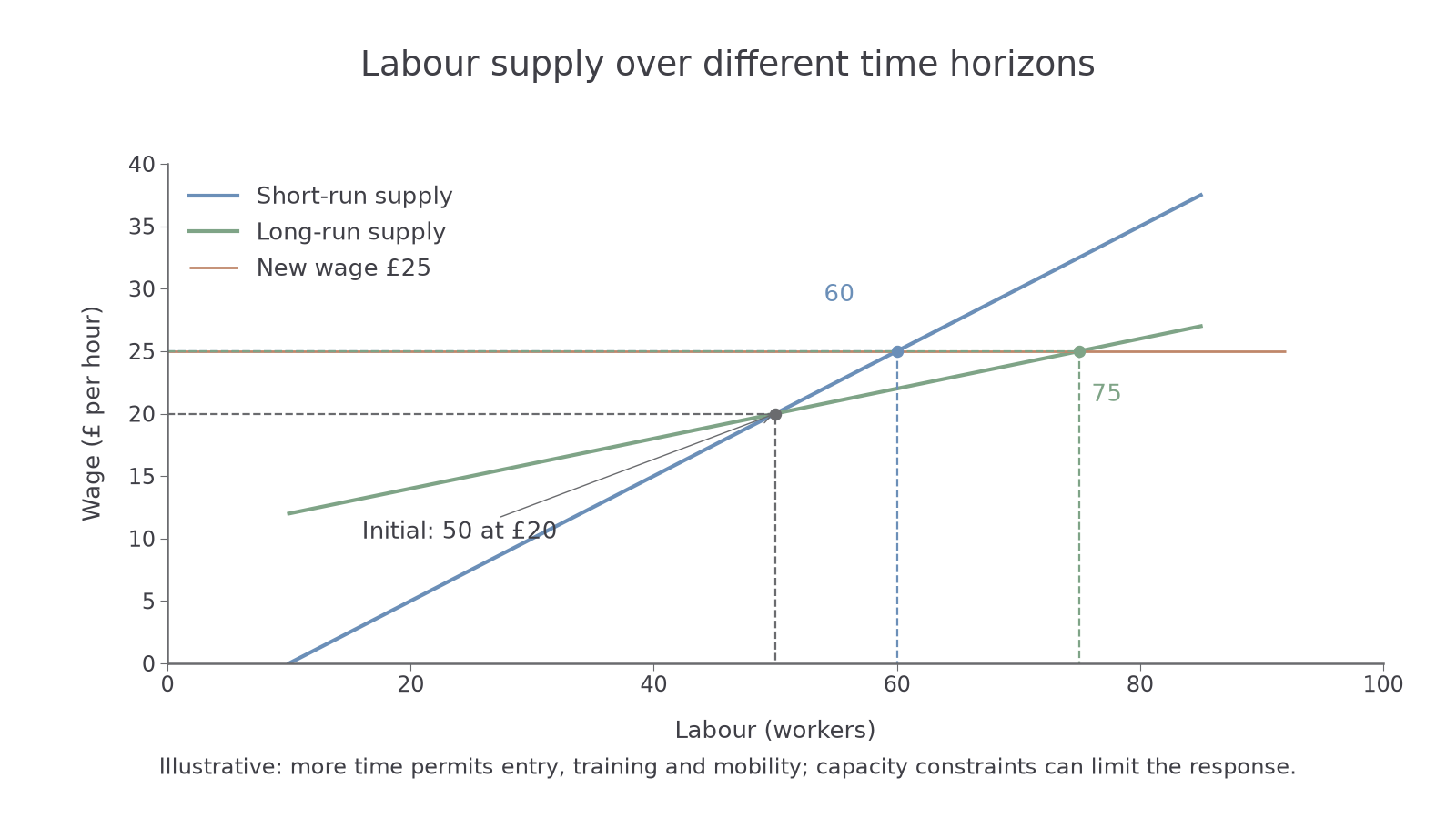
Time gives workers and training institutions more ways to respond to an industry's pay.
In the short run, the number of qualified surgeons is largely fixed. Existing surgeons may offer some extra hours or return from inactivity, but education cannot produce fully qualified replacements immediately. A sustained relative wage rise can attract students, encourage training places, alter migration and influence retention over a longer period. Long-run supply is therefore often more elastic.
[DIAGRAM: asset_slug: h460-supply-time; caption: Supply responds more strongly over time from the same initial wage and employment; description: Short-run and long-run illustrative labour supply curves through 50 workers at 20 pounds per hour; a rise to 25 pounds attracts 10 extra workers in the short run and 25 in the long run.]
Continue this lesson.
You’re previewing NovaLearn without an account. Create a free account to read the rest.
Create free account