1.3 - Short-run and long-run aggregate supply
Aggregate supply explains how firms respond to spending and why higher demand sometimes raises output and sometimes mainly raises prices. Compare short-run costs with long-run productive capacity, then use the Keynesian and neo-classical models to make conditional predictions.
Output and costs in the short run
Aggregate supply is the total real output that producers are willing and able to supply at each price level over a stated period.
The vertical axis of an AS diagram is the general price level; the horizontal axis is real national output. Short-run aggregate supply (SRAS) holds relevant input prices and productive capacity sufficiently fixed to examine firms' output response. The economic short run is defined by these conditions, not by a fixed number of months.
If selling prices rise while money wages and some other input prices have not yet adjusted, producing extra output may become more profitable. Firms hire additional workers or use existing equipment more intensively. As production approaches capacity, overtime, bottlenecks and less efficient use of resources can raise the cost of extra output. SRAS therefore usually slopes upward: more real output is supplied at a higher price level, other things equal.
A rise in the price level alone is a movement along SRAS. A rise in money wages, energy prices or other costs at every output level changes willingness to supply and shifts SRAS. Keep the two explanations separate: rising selling prices with unchanged input costs improves margins; rising input costs with unchanged selling prices reduces them.
Shifts caused by production costs
A cost shock changes how much output firms are willing to supply at each price level.
More expensive imported energy can raise production and transport costs across many industries. With demand unchanged, firms supply less at each price level, shifting SRAS left/up. The intersection with AD moves to a higher price level and lower real output. The combination can produce cost-push inflation and weaker employment: fewer orders and lower production reduce derived demand for labour. Stagflation refers to inflation together with stagnation or weak economic activity, often accompanied by high unemployment.
[DIAGRAM: asset_slug: ocr_h460_sras_cost_shift; caption: Higher production costs shift SRAS left, raising the price index and reducing real output; description: Exact illustrative AD-SRAS graph with E0 at output 100 and price index 100 and E1 at output 88 and price index 112 after a leftward SRAS shift.]
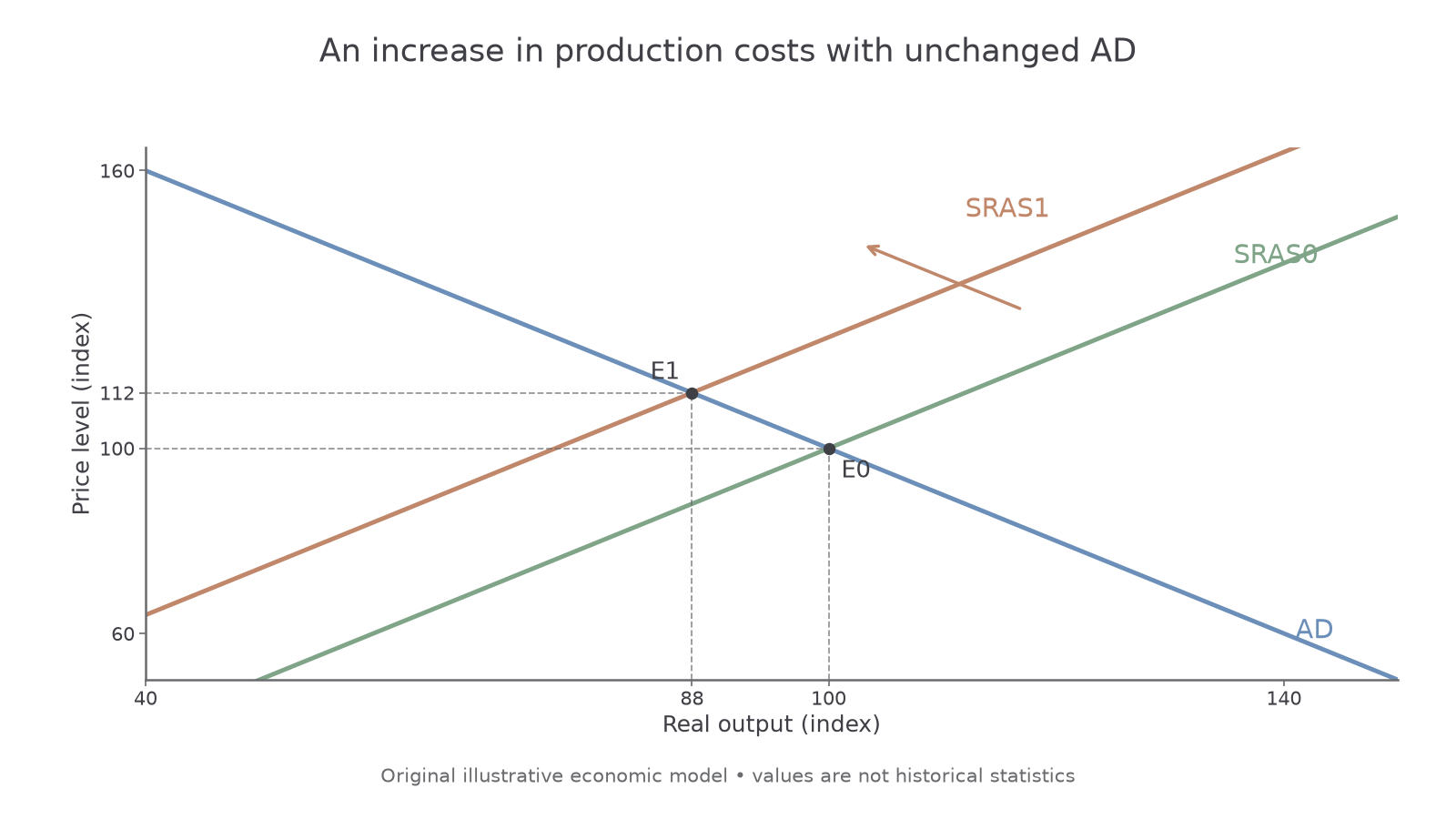
The graph is illustrative rather than historical data. The initial equilibrium is E0; increased costs move it to E1. It shows a one-off comparison of price levels. Whether inflation persists depends on repeated cost increases and subsequent wage, price and policy responses.
A fall in energy costs, a reduction in a production tax or an increase in productivity can shift SRAS right/down. Productivity means output per unit of input: if the same labour and fuel produce more output, unit costs fall. Insulation in an industrial building can reduce energy needed per unit of output once installed. This can increase SRAS without reducing AD. Its macroeconomic effect depends on coverage and energy savings; a small household programme does not automatically transform economy-wide productivity.
Do not treat every SRAS shift as a permanent capacity change. A temporary increase in imported fuel prices can raise current costs without destroying factories or skills. A prolonged disruption that makes capacity unusable can also reduce long-run supply. Identify the mechanism and time horizon before moving another curve.
Long-run productive capacity
Long-run aggregate supply concerns the output an economy can sustain when relevant input prices and production decisions have adjusted.
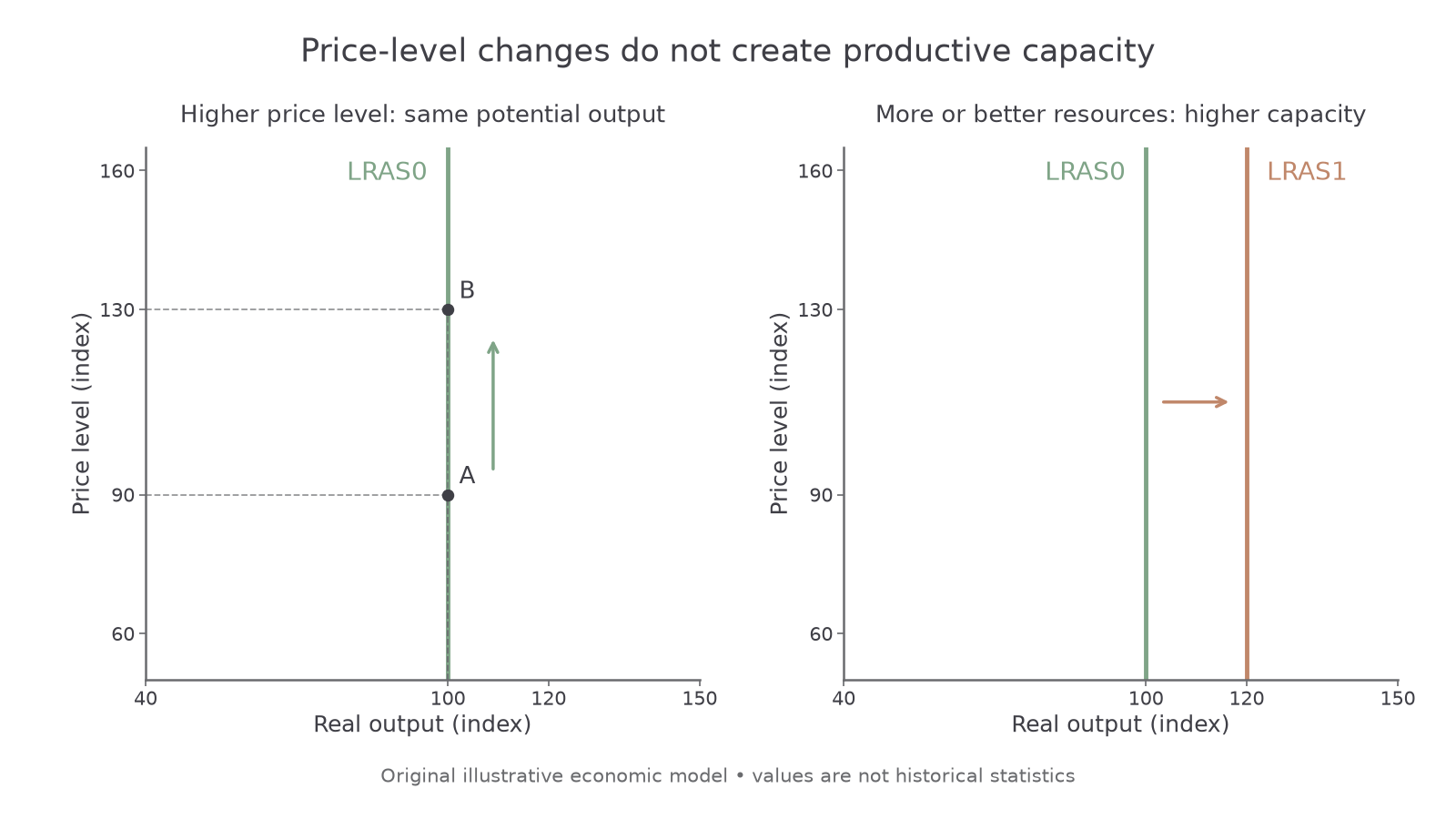
In the neo-classical model, LRAS is vertical at potential output, . Potential output depends on the quantity and productivity of labour, capital, land and enterprise and on institutions that affect how efficiently they are used. It is not unlimited maximum production at any cost. Nor does it mean zero unemployment: workers can be changing jobs or lack the skills needed for vacancies even when demand is sufficient to use sustainable capacity.
Why vertical? A rise in the general price level does not permanently increase the quantity or quality of productive resources. If nominal wages and other input prices eventually rise too, the initial profit incentive to produce above potential disappears. In this model, a sustained rise in AD can raise output in the short run, but cannot by itself raise long-run real output beyond .
[DIAGRAM: asset_slug: ocr_h460_lras_capacity_shift; caption: More productive resources shift vertical LRAS from potential output 100 to 120; description: Exact illustrative two-panel graph comparing a change in price level along vertical LRAS with a rightward LRAS capacity shift.]
Continue this lesson.
You’re previewing NovaLearn without an account. Create a free account to read the rest.
Create free account