4.5 - Contestability and competitive pressure
An incumbent can face pressure even before a rival enters. This lesson distinguishes competition from contestability and explains how the threat of entry can affect price, cost and quality. It also tests the demanding assumptions behind perfectly contestable outcomes.
Credible entry and sunk costs
A contestable market is one in which potential entry can discipline the behaviour of existing firms.
Competition describes rivalry among firms already supplying the market; contestability concerns the ease and credibility of entry and exit. A market with one supplier can face strong potential entry, while a market with several firms may be protected by high barriers. Count suppliers separately from assessing entrants' opportunities.
Perfect contestability assumes that entrants can access the same technology and inputs on comparable terms, face no significant entry barriers, and can leave without losing sunk investment. In the classic hit-and-run model they can enter, make sales and exit before incumbents retaliate effectively. These are strong assumptions, particularly where customers need time to trust a new provider or incumbents can change prices quickly.
A sunk cost is a cost that cannot be recovered on exit. It differs from a fixed cost, which does not vary with current output. A rented vehicle may create a fixed monthly payment but permit low-cost exit when the contract ends; an advertising campaign paid for to establish an unknown brand may be irrecoverable. A machine bought for £100,000 and resold for £80,000 leaves a £20,000 unrecoverable loss before other costs. The entire purchase price is not necessarily sunk.
Legal access, network compatibility, brand loyalty, exclusive contracts, customer switching costs and control of essential inputs can obstruct entry. Even if equipment can be leased, an entrant may still need irrecoverable marketing or certification costs. Judge the complete entry and exit process rather than one cost label.
How the entry threat disciplines price
An incumbent's supernormal profit can attract entry even when it currently has no active rival.
In hit-and-run entry, a rival enters while the incumbent's price is high, offers a lower price, makes profitable sales and exits before effective retaliation. Low sunk costs reduce the risk that the incumbent will cut price after the entrant commits irrecoverable resources. If this threat is credible, the incumbent may choose a lower price in advance, making entry unprofitable.
[DIAGRAM: asset_slug: h460-contestability-entry; caption: A credible entrant at the same constant cost can discipline monopoly price towards cost; description: Exact illustrative AR 16 minus Q, MR 16 minus 2Q and horizontal MC equals AC 4 show an unconstrained monopoly choice Q 6 and price 10 compared with a zero-profit benchmark Q 12 and price 4 under perfectly credible entry.]
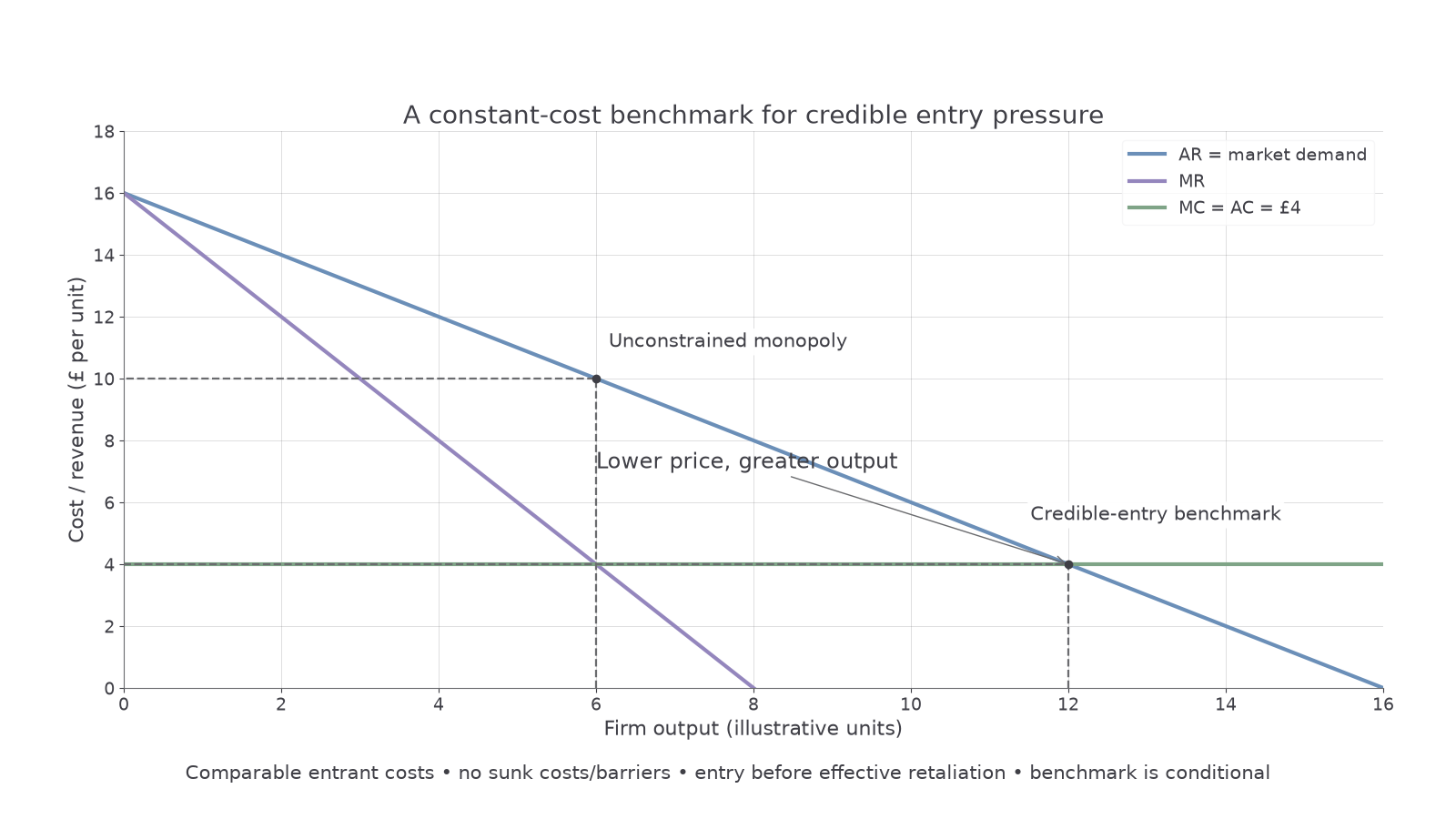
In this simplified graph the incumbent and entrant have constant MC=AC=£4, no sunk costs and no advantage in technology. An unconstrained single-price monopolist chooses MR=MC at Q=6 and P=£10. That margin creates an opportunity for a rival able to sell the same product below £10 while covering £4 cost. Perfectly credible entry disciplines the incumbent towards the £4 zero-economic-profit benchmark, where Q=12.
This is an explicit constant-cost benchmark, not a universal prediction that every contestable firm's AR becomes horizontal. The incumbent's market demand remains downward. Its constrained price differs because charging more invites entry. For a notebook diagram, label the unconstrained price/output, the cost line and the entry-disciplined price/output; explain the assumptions that connect them.
Actual entrants may need time, reputation, committed capacity or access rights. An incumbent able to retaliate immediately can make a short profitable visit unrealistic. Partial contestability can still constrain prices, quality or profit, but the effect depends on the entrant's credible costs, speed and access, not merely the theoretical possibility of registering a new business.
Continue this lesson.
You’re previewing NovaLearn without an account. Create a free account to read the rest.
Create free account