4.3 - Monopolistic competition
Many cafés can compete without selling exactly the same experience. This lesson explains how differentiated products give each firm some pricing power while entry limits persistent profit. It uses short- and long-run diagrams to compare cost efficiency with the value of choice and innovation.
Differentiation and firm demand
Monopolistic competition combines many firms and relatively easy entry with differentiated products.
Product differentiation means buyers perceive differences in quality, location, design, service or reputation. Some differences are physical; others depend on information and branding. Each firm faces close substitutes but not a perfectly identical product, so it has a downward-sloping demand or AR curve. A modest price rise may lose some customers while retaining buyers who value its particular offer.
This distinguishes it from perfect competition's horizontal firm demand and monopoly's protected single supplier. Entry and exit are relatively easy in the long run, and no firm normally dominates industry supply. Real cafés, hairdressers or independent restaurants provide possible illustrations, but the model fits only to the extent that demand, differentiation and barriers actually match these assumptions.
Suppose an illustrative café is next to a station and sells a distinctive breakfast. Commuters may accept a higher price for its location, while others switch to nearby cafés. Better service or a new menu can shift its demand outwards; changing its own price moves along its existing demand. Advertising may inform buyers about useful differences or build loyalty around similar products. Neither its presence nor its cost proves a welfare gain.
Because a single price applies to all sales, MR lies below AR: a lower price on an extra unit also applies to existing sales. The firm uses MC=MR to choose output, then AR to read the price. Its demand is constrained by substitutes even though it is not a price-taker.
Short-run output and profit
A monopolistically competitive firm can earn supernormal profit or make a loss in the short run.
At rising MC=MR, find Q, read price on AR and AC at the same Q. If P>AC the firm earns ; if P<AC it makes a loss. Do not infer a positive profit from downward demand or from the existence of pricing power. Demand may be too weak to cover costs even at the best output.
[DIAGRAM: asset_slug: h460-monopolistic-short-run; caption: Differentiated firms can earn profit or make losses at MC equals MR in the short run; description: Two cost-consistent diagrams use the same AC and MC but different AR and MR, with shaded profit and loss rectangles.]
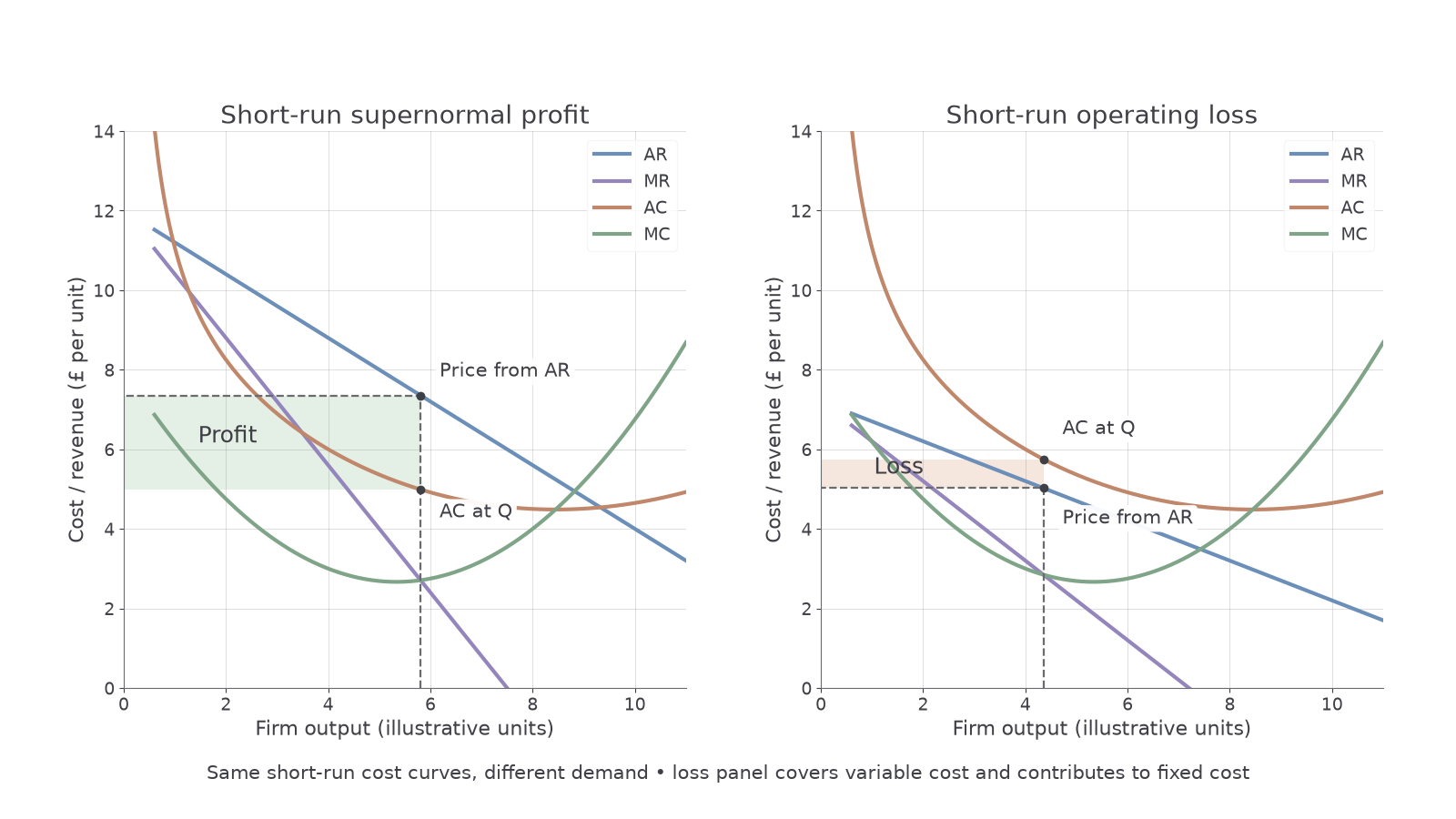
The profit panel shows demand strong enough to place price above AC at the chosen quantity. The loss panel has lower AR and MR, so the best output and price are smaller, and price is below AC. Output is never chosen by the AR–AC crossing. The firm may operate temporarily during a loss if revenue covers avoidable variable costs, but continued failure to cover total economic costs encourages long-run exit.
An illustrative café sells 500 meals per week at £10 with AC £8. TR is £5,000, TC £4,000 and economic profit £1,000. Another sells 400 at £7 with AC £8 and loses £400. These figures demonstrate the profit calculation; a complete output decision would additionally need marginal revenue and marginal cost information.
To draw the short-run model, put cost/revenue per unit on the vertical axis and the firm's quantity on the horizontal. Draw downward AR with MR below it, then rising MC through MR. Carry Q up to AR for P and to AC for unit cost. Shade only the P–AC gap multiplied by Q and name it correctly as profit or loss.
Entry and excess capacity
Entry shares customers among more differentiated suppliers, reducing the demand received by an incumbent.
Continue this lesson.
You’re previewing NovaLearn without an account. Create a free account to read the rest.
Create free account