3.1 - Business objectives and agency
A business can sell more without earning more profit, and its managers may want something different from its owners. Learn how maximising and non-maximising objectives change decisions, and how ownership, incentives and constraints affect the objective a firm actually pursues.
What firms try to maximise
An objective is a goal used to choose between feasible actions. Profit maximisation means seeking the greatest difference between total revenue and total economic cost, rather than simply the largest sales figure. Economic cost includes the opportunity cost of resources supplied by the owner. Precise cost and revenue calculations follow in the next lessons; here the important distinction is between the goals.
Sales revenue maximisation seeks the largest money receipts from sales: price multiplied by quantity. Sales volume maximisation seeks the greatest number of units sold. Lowering price can increase volume while reducing revenue if the extra sales do not offset the lower price. Selling more can also reduce profit if the extra cost exceeds the extra revenue.
Growth maximisation seeks expansion, for example of assets, output, customers or market share over time. State which measure is meant: a larger market share is not necessarily a higher growth rate of total sales. A firm might reinvest today's earnings in a new factory and accept a lower current profit to grow. Growth can support future profit through lower costs or customer loyalty, but these gains are uncertain.
Utility maximisation means seeking the greatest satisfaction of the decision-maker. A manager's utility may come from pay, status, influence, job security or leisure. A larger workforce may increase status even if hiring the last workers adds little profit. This is a theory of choice, not a claim that every manager ignores shareholders. Utility can include pride in good service and ethical conduct.
Consider illustrative alternatives for a bakery:
| Daily plan | Loaves sold | Revenue | Economic cost | Profit |
|---|---|---|---|---|
| Premium | 100 | £400 | £220 | £180 |
| Standard | 160 | £480 | £350 | £130 |
| Discount | 220 | £440 | £420 | £20 |
Among these three alternatives, Premium maximises profit, Standard maximises revenue and Discount maximises volume. The table alone cannot identify the fastest long-run growth or greatest managerial utility: these need further evidence. Nor does it establish a global maximum among plans not shown.
Different goals, different output
A graph makes the distinction between revenue and profit visible. The horizontal axis measures output per period, while the vertical axis measures total money values per period. The illustrative total revenue curve first rises and then falls: to sell extra units the firm lowers the price on all units. Total cost rises with output. At any output, profit is the vertical distance from total cost to total revenue.
[DIAGRAM: asset_slug: objectives-choices; caption: Total revenue and cost with three objective outputs; description: Illustrative total revenue and total cost curves show profit-maximising output, revenue-maximising output and the greatest output consistent with non-negative economic profit.]
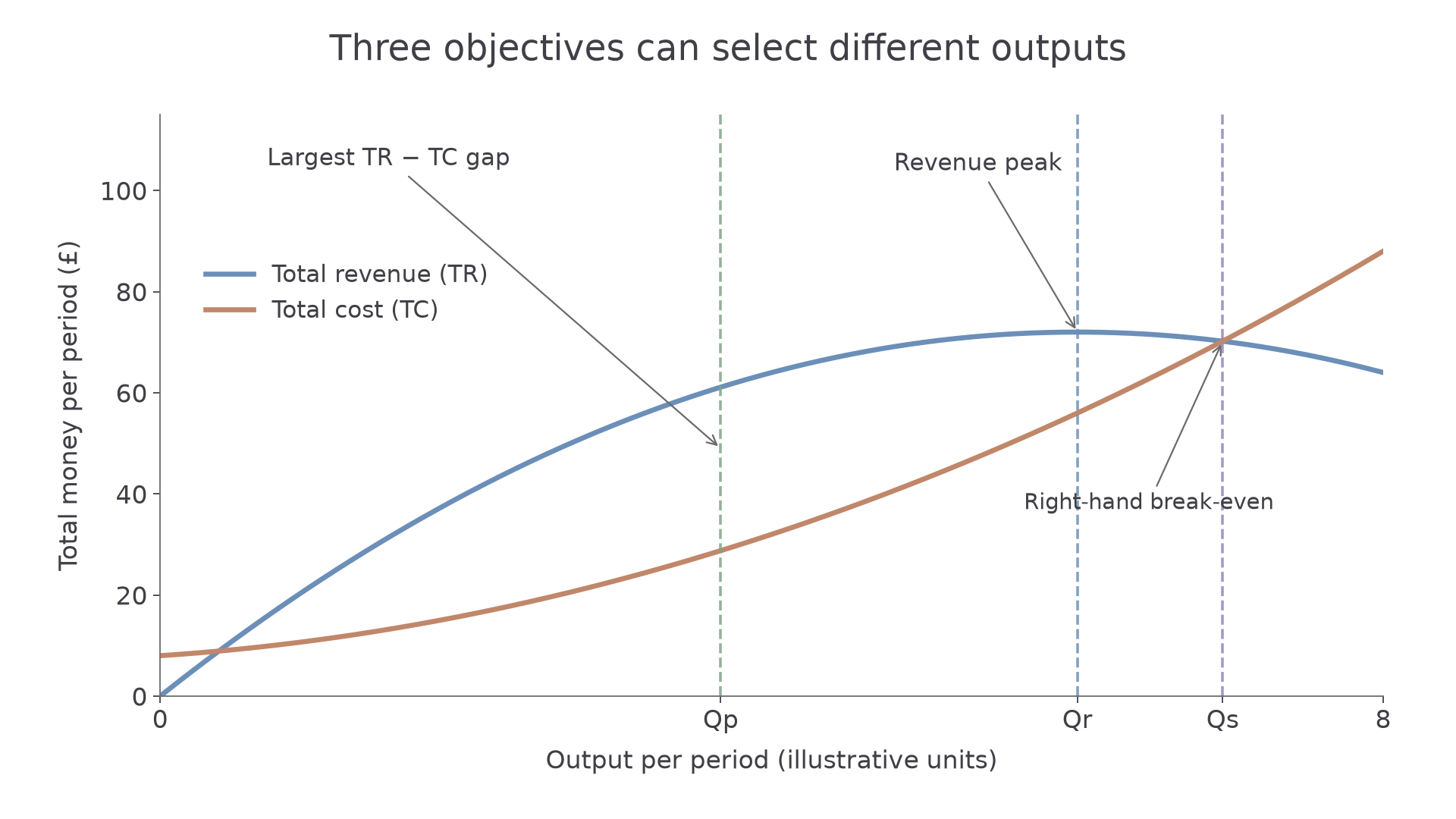
Profit is greatest at the output with the largest vertical gap, labelled Qp. Revenue is greatest at the peak of total revenue, Qr. If a volume-maximising firm must at least cover its economic costs, its largest feasible sales volume is Qs, the right-hand break-even output. Here Qp is less than Qr, which is less than Qs. This order follows this model; the financial constraint is essential. Without a cost-covering or funding constraint, “maximise sales” does not uniquely select that break-even point.
To sketch the model in a notebook, label both axes and their units, draw a rising cost curve and a revenue curve with a peak, then locate Qp by the largest gap, Qr by the peak and Qs by the right-hand intersection. Do not place Qp at the revenue peak by habit. A graph of total profit against output would instead have its own peak at Qp. The marginal conditions behind these positions are developed in the revenue lesson.
Higher output under a revenue objective can improve access and spread overheads across customers. But it may sacrifice returns that finance investment. A profit objective can reward cost control, yet maximising this year's measured profit can encourage cuts to training whose benefits arrive later. A firm maximising the present value of long-run profit could rationally invest now; profit maximisation does not inherently mean short-termism.
Satisficing and social aims
Profit satisficing means achieving an acceptable profit rather than the largest possible profit. An owner might set a £60,000 annual target, then prefer a plan meeting it with shorter opening hours. A manager might satisfy shareholders' required return and use the remaining discretion to improve job security. The target is a constraint or threshold, not evidence that profit has been maximised. It can be sensible when finding the exact maximum is costly or demand is uncertain, although a comfortable target may permit avoidable waste.
Social welfare concerns benefits and costs to society, including people outside the transaction. A community transport enterprise might prioritise reliable access for isolated residents, considering their benefits alongside the resource cost. Serving a low-revenue route can improve welfare if social benefits exceed social costs. Serving every route regardless of costs does not necessarily maximise welfare, and funding constraints can prevent socially beneficial services being supplied.
Corporate social responsibility (CSR) means accepting responsibilities to stakeholders and society beyond simply meeting the minimum legal obligation. Examples include improving workers' conditions or reducing harmful production impacts. CSR can be a genuine ethical aim, a response to customer pressure, or a means of protecting reputation and future profit. These motives can coexist. A statement of responsibility is weaker evidence than verifiable changes in practices and outcomes.
Continue this lesson.
You’re previewing NovaLearn without an account. Create a free account to read the rest.
Create free account