4.2 - Exchange rates and currency systems
An exchange rate links prices expressed in different currencies, so its movement can change spending, costs and investment. You will calculate conversions, explain how floating and fixed rates are determined, and judge the consequences of currency changes and the choice of exchange-rate system.
Quotes and currency conversions
An exchange rate is the price of one currency in another. Always establish the quotation before calculating. If £1 = US$1.25, the rate is dollars per pound. Converting £200 to dollars means multiplying by US$1.25 per pound: £200 buys US$250. Converting US$500 to pounds means dividing by 1.25: it buys £400. These examples ignore fees and different buying and selling rates.
The reciprocal quotation is £0.80 per dollar because . A £1 = US$1.25 quote and a US$1 = £0.80 quote describe the same rate, not two independent prices. Writing the currency units beside the operation helps reveal a reversed calculation.
An appreciation is a rise in a currency's value in a floating system; a depreciation is a fall. If £1 rises from US$1.25 to US$1.50, the pound appreciates by against the dollar. The dollar's pound price falls from £0.80 to approximately £0.667, a fall of about 16.7%. Reciprocal percentage changes are not identical because they use different initial bases.
A UK product priced at £100 costs a US buyer US$125 before and US$150 after the appreciation if its sterling price stays unchanged. A US$600 imported product falls from £480 to £400 for a UK buyer if the dollar price stays unchanged. Actual firms may change margins, hedge currency risks or invoice in the buyer's currency, delaying or reducing this price transmission.
Floating exchange-rate determination
In a floating exchange-rate system, demand and supply in the foreign-exchange market determine the currency's price. For a market for pounds, put dollars per pound on the vertical axis and the quantity of pounds exchanged per period on the horizontal axis. Foreign buyers demand pounds to purchase UK exports or pound-denominated assets. UK residents supply pounds when exchanging them to buy imports or foreign assets.
In the standard model, demand for pounds slopes down: a cheaper pound makes UK products and assets cheaper in foreign currency, other things equal. Supply slopes up: a more valuable pound makes foreign purchases cheaper to UK residents, encouraging currency sales. These are simplified behavioural schedules, not a claim that every financial transaction follows a stable price response.
To construct the diagram, label D₁ and S, mark their intersection E₁ and project the initial rate to the vertical axis. An increase in demand for pounds shifts D₁ right to D₂. Mark E₂ where D₂ meets the unchanged S, then project the higher rate. A rise along S is a movement caused by the currency-price change, not an extra supply shift. If supply instead rises, shift S right and the pound depreciates, holding demand constant.
[DIAGRAM: asset_slug: floating-pound; caption: Increased demand for pounds raises the floating dollar price of a pound; description: A market for pounds with dollars per pound vertically, quantity of pounds horizontally, unchanged upward supply and demand shifting right from D1 to D2, raising equilibrium from E1 to E2.]
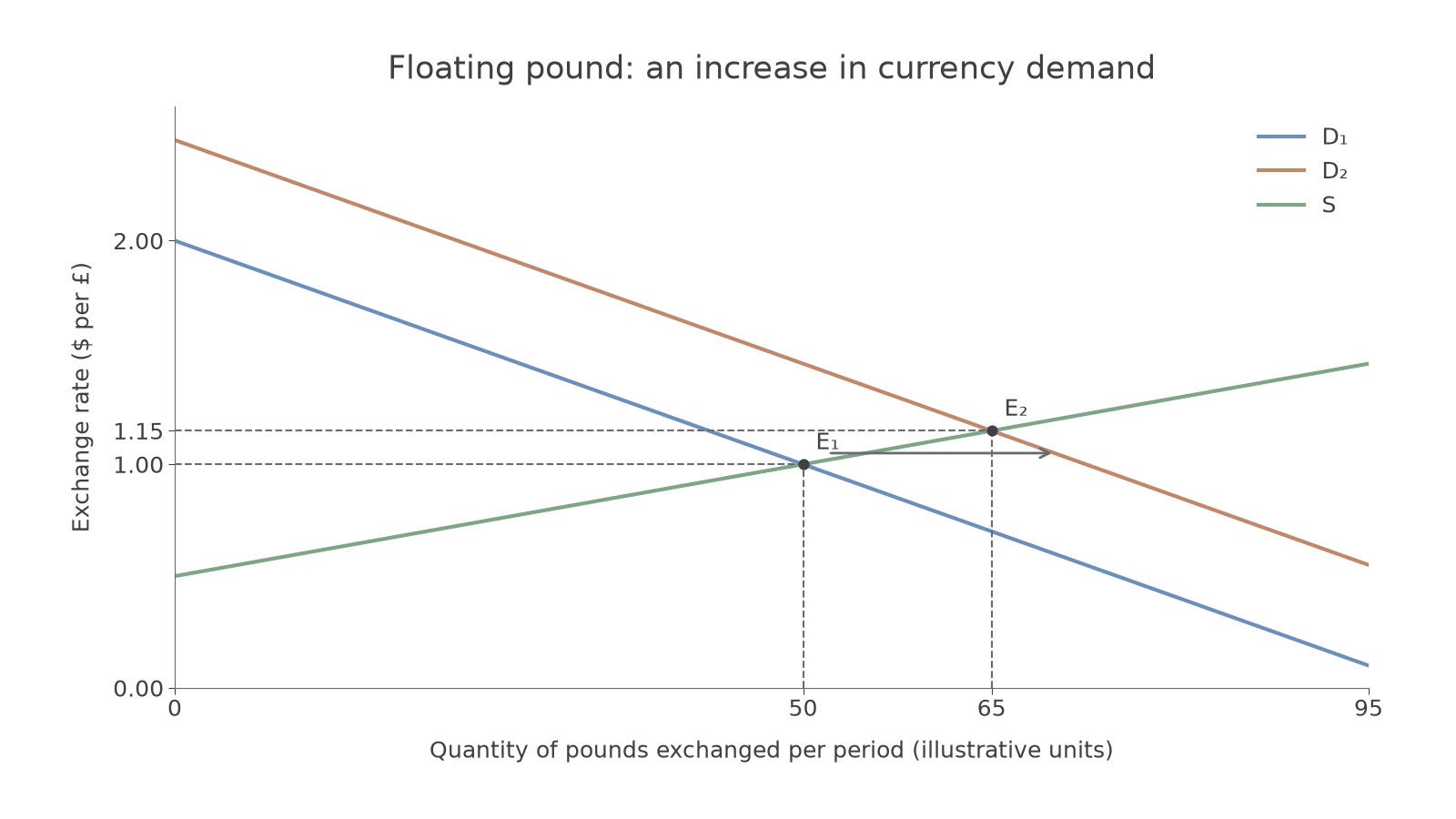
Higher UK interest rates relative to overseas rates may attract funds into sterling assets and increase demand for pounds. Expectations of future appreciation can do the same. However, investors also consider risk and expected inflation; a rate rise associated with a crisis need not strengthen the currency. Stronger foreign demand for UK exports can increase demand for pounds, while higher domestic import spending can increase its supply. Several curves can shift together, so identify the dominant change in the particular case.
Fixed rates and intervention
In a fixed exchange-rate system, the authorities maintain the currency at an announced rate or within a narrow band against another currency or basket. Private demand and supply still exist. The authority must offset pressure that would otherwise move the rate; announcing a target alone does not make the market clear.
Suppose an illustrative currency is fixed at US$1.20 per unit but the private market would clear at US$1.00. At US$1.20, private supply exceeds private demand. To defend the rate, the central bank buys the excess domestic currency and pays with foreign-currency reserves. Buying its own currency adds demand. Raising interest rates may also attract funds and reduce downward pressure, but can weaken domestic spending. Controls on currency transactions are another possible intervention with costs to trade and investment.
Continue this lesson.
You’re previewing NovaLearn without an account. Create a free account to read the rest.
Create free account