5.2 - Finance, saving and development
The financial sector helps households and firms make payments, manage risk and fund investment. Learn why better financial access can support development, and why more lending or more saving is not sufficient by itself to improve living standards.
The services finance provides
The financial sector organises payments and financial claims so that resources can move between people, places and periods.
Banks provide accounts and payment services, assess borrowers and make loans. Insurance pools specified risks across policyholders: a firm can pay a premium to reduce exposure to an uncertain insured loss. Pension funds and investment funds manage portfolios, while markets allow debt and ownership claims to be issued and traded. Foreign-exchange services support international transactions. These services can reduce the cost of making exchanges and managing uncertainty, rather than simply produce more financial transactions for their own sake.
Financial intermediation connects holders of funds and borrowers through an institution. A bank screens applications because an entrepreneur knows more about their own project than an outside lender does. Monitoring repayment and requiring collateral can reduce information problems. Pooling many customers' funds permits larger loans and spreads idiosyncratic risk. It does not remove economy-wide risk: borrowers may fail together in a recession.
Maturity transformation lets customers hold accessible deposits while borrowers fund long-lived projects. It benefits savers and investors, but creates liquidity risk if many customers withdraw at once. A bank must therefore manage liquid assets, stable funding and loss-absorbing capital. As the money lesson showed, deposit creation means the bank is not merely passing a fixed pot of existing deposits from one person to another. Its ability to extend credit still depends on funding, settlement, risk and regulation.
For example, a small food processor may know how to cut wastage but lack the funds for refrigeration. A lender's local information helps distinguish that viable project from a poor one; a reliable payment service also lets the firm receive sales safely. The financial service improves resource allocation only if the equipment is useful and the business can repay.
Debt, shares and their returns
Firms can raise finance by borrowing or by selling ownership claims, and these choices distribute risk differently.
A bond is a debt claim with specified payment terms. A conventional fixed-coupon bond pays a fixed nominal coupon and repays its face value at maturity, subject to issuer default. A share is part ownership of a company. Dividends depend on decisions and profits, and the market price can rise or fall; shareholders are residual claimants and can lose their investment. A bank loan is also debt, but its rate and repayment terms may differ from a tradable bond's.
New shares or bonds sold in a primary market raise funds for the issuer. Trading an existing share in a secondary market transfers a claim between investors; it does not itself buy a new machine or add to GDP investment. A liquid secondary market can nevertheless make investors more willing to buy new issues because they expect to resell their claims if needed. Financial investment means acquiring assets; real investment means spending on productive capital or inventories.
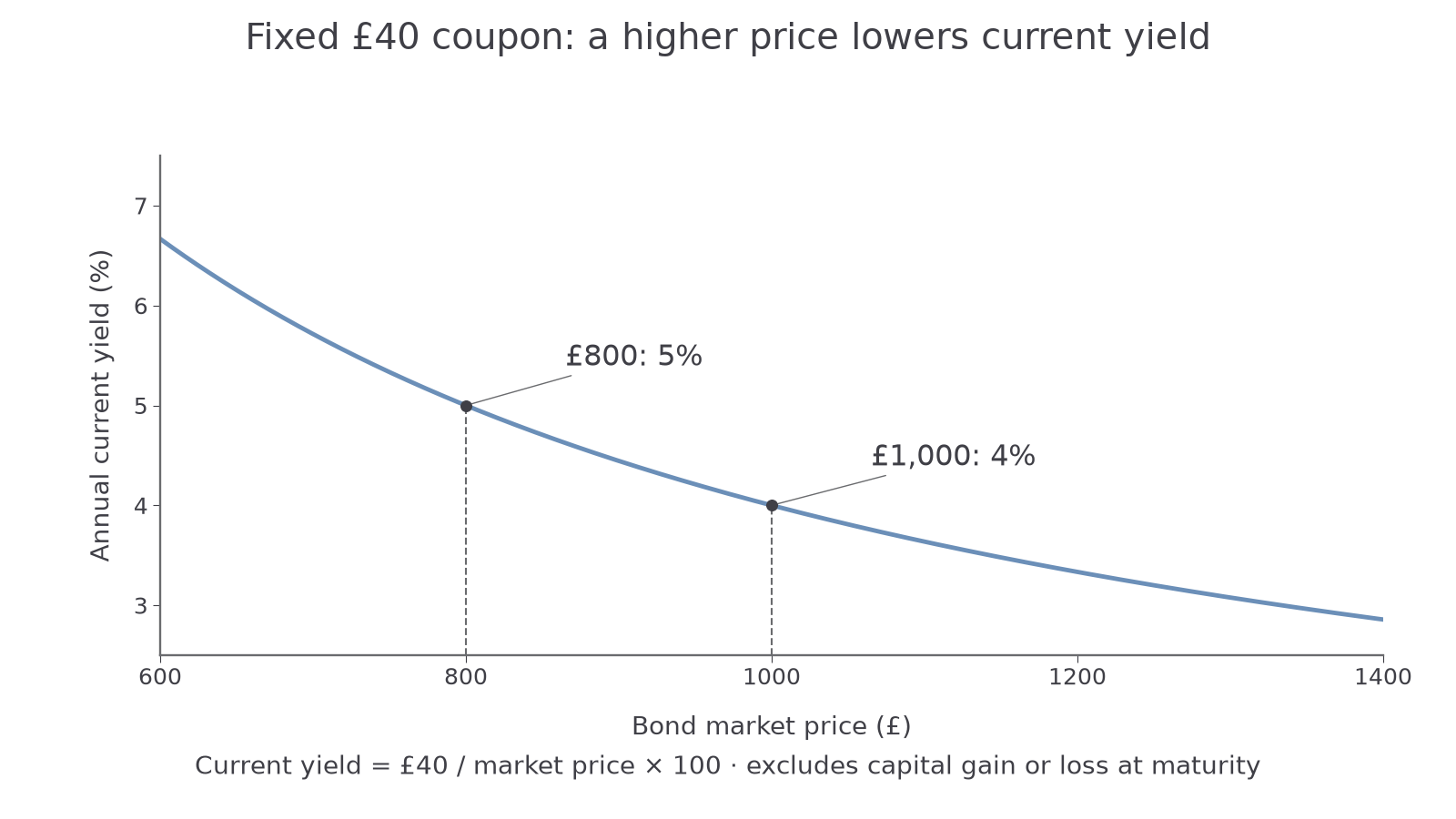
For a fixed annual coupon, current yield is annual coupon divided by current bond price. An illustrative bond paying £40 each year has a current yield of at a price of £800, but 4% at £1,000. The coupon has not changed. A higher market price lowers this yield. Current yield excludes the gain or loss between purchase price and maturity repayment, so it is not the bond's complete yield to maturity.
[DIAGRAM: asset_slug: ocr_h460_bond_current_yield; caption: The current yield on a £40 fixed-coupon bond falls as its market price rises; description: Exact current-yield curve, 40 divided by price times 100, with bond price in pounds on the horizontal axis and annual current yield percent on the vertical axis; points at £800 and 5% and £1,000 and 4%.]
Interest rates help price borrowing across the economy. A loan's rate includes compensation for time, expected inflation and risk; riskier borrowers may pay more than the government or lose access to credit altogether. Falling safe bond yields do not guarantee every small firm's borrowing cost falls equally. Financing choice affects both the firm's cost and who bears losses.
Saving and capital formation
Saving is income not consumed, while investment is expenditure on additional or replacement productive capital and inventories.
Households may save through deposits, pensions or securities. Firms may retain profits to finance investment. The saving ratio expresses saving relative to the stated income measure. For an illustrative household, disposable income is £40,000 and consumption is £36,000. Saving is £4,000 and the household saving ratio is . The denominator must be disposable income if that is the ratio requested. A national saving rate uses its own stated aggregate, often GDP; it is not automatically the household ratio.
In a closed economy, total realised saving and investment are equal in the national accounts, including inventory changes. This is an accounting result, not proof that every household's extra planned saving instantly becomes a firm's desired machine purchase. If households cut spending and firms see weaker sales, output and income can fall, so realised saving may not rise as intended: the paradox of thrift. At full employment, reduced consumption can release real resources for investment, provided businesses or government actually use them.
Continue this lesson.
You’re previewing NovaLearn without an account. Create a free account to read the rest.
Create free account