2.11 - Regulation, permits and public provision
Government can address market failures through provision, rules, tradable rights and better information as well as prices. This part of 2.11 explains those mechanisms, including buffer stocks and competition policy, and judges when each can improve outcomes under real capacity, monitoring and information constraints.
Public spending and partnerships
Government expenditure directs resources towards goods and services that markets may underprovide, but buying a service does not guarantee that its benefits exceed its costs.
Public spending can fund a non-excludable service, expand access to a merit good, or purchase infrastructure with wider benefits. Funding vaccination appointments, for example, can ease an access barrier and support additional provision. The effect depends on staff and facilities: a larger budget may initially raise supplier payments rather than expand appointments if capacity is fixed. Opportunity cost matters because the same workers and money could supply other valuable services.
A public/private partnership (PPP) is an arrangement in which public and private organisations share roles in financing, building or operating a public service. For example, a public authority specifies a clinic and a private partner builds and maintains it under a long-term contract. Private expertise and responsibility for agreed risks can encourage timely delivery and maintenance. The public authority still pays, perhaps over many years; private finance is not a free resource or a way to make the underlying cost disappear.
A partnership's effectiveness depends on competition for the contract, clear service standards and allocating risk to whoever can manage it. If building quality is hard to monitor or renegotiation is unavoidable, a private partner may cut hidden quality or demand expensive revisions. Long contracts can reduce flexibility when needs change. Compare the whole expected lifetime cost and service quality with feasible public procurement; a low initial public payment alone does not establish better value.
Legislation, regulation and enforcement
Legislation establishes legal rules, while regulation uses rules, standards and supervision to influence how markets operate.
A law can ban a harmful activity, require disclosure or set rights. Regulation can specify an emissions limit, minimum safety standard, licensing condition or inspection process within a legal framework. A binding limit on harmful production can directly restrict external costs without needing to know the exact tax that would induce the desired quantity. Safety standards can improve information and protect users from hidden risks.
The causal mechanism requires compliance: a lower legal emissions limit reduces actual pollution only if firms change behaviour and breaches are detected and discouraged. Monitoring, credible penalties and administrative capacity therefore matter. An illustrative reusable-container requirement may cut discarded packaging when alternatives are available and businesses comply. If alternatives use more energy to manufacture or are rarely reused, some environmental gains may be offset; compare total lifecycle costs, not just visible litter.
Uniform rules can force firms with very different abatement costs to make the same reduction, raising the cost of achieving a target. They can also discourage improvements beyond the minimum if no incentive remains to go further. However, a clear ban can be preferable where harm is severe, uncertain or irreversible and price incentives would allow dangerous activity to continue. A well-designed standard can be predictable and enforceable. Judge severity, substitutes, compliance and cost variation rather than claiming regulation is always stronger or weaker than a tax.
Tradable pollution permits
Tradable pollution permits combine a limit on total permitted emissions with a market that can reallocate permission between polluters.
Government sets a cap, issues allowances defining how much emissions each permits, and requires covered emitters to surrender allowances for their measured emissions. Firms can trade them. A firm whose cost of avoiding a tonne is below the permit price has an incentive to abate and sell or avoid buying a permit; a firm with a higher abatement cost can buy one. Trading can achieve the cap at a lower cost than forcing identical reductions on firms with different costs.
In an illustrative two-firm case, each would emit 5 tonnes, but the cap is 8 and each receives 4 allowances. Firm A can abate either of the next two tonnes for £20 each, while B would pay £60 each. At a permit price £35, A reduces to 3 tonnes and sells one allowance to B, which emits 5. Total emissions remain 8. The resource cost of A's two reductions is £40, rather than £80 for one reduction at each firm. The permit payment transfers money; it is not itself an extra abatement resource cost. The example assumes reliable measurement, trade and those specified marginal costs.
Construct the permit-market graph with permit price per tonne vertically and allowances per period horizontally. Supply is vertical at the cap, while demand slopes down because firms' willingness to pay reflects avoided abatement costs. The illustrative graph tightens the cap from 8 to 6; with unchanged demand, the permit price rises from £8 to £10. Auctioning rather than freely allocating allowances changes who receives permit revenue, but does not by itself change the cap.
[DIAGRAM: asset_slug: permit-market; caption: Tightening an emissions cap reduces permit supply and raises permit price; description: Permit demand P=16−Q with vertical caps 8 and 6, correctly labelled price 8 and 10 intersections.]
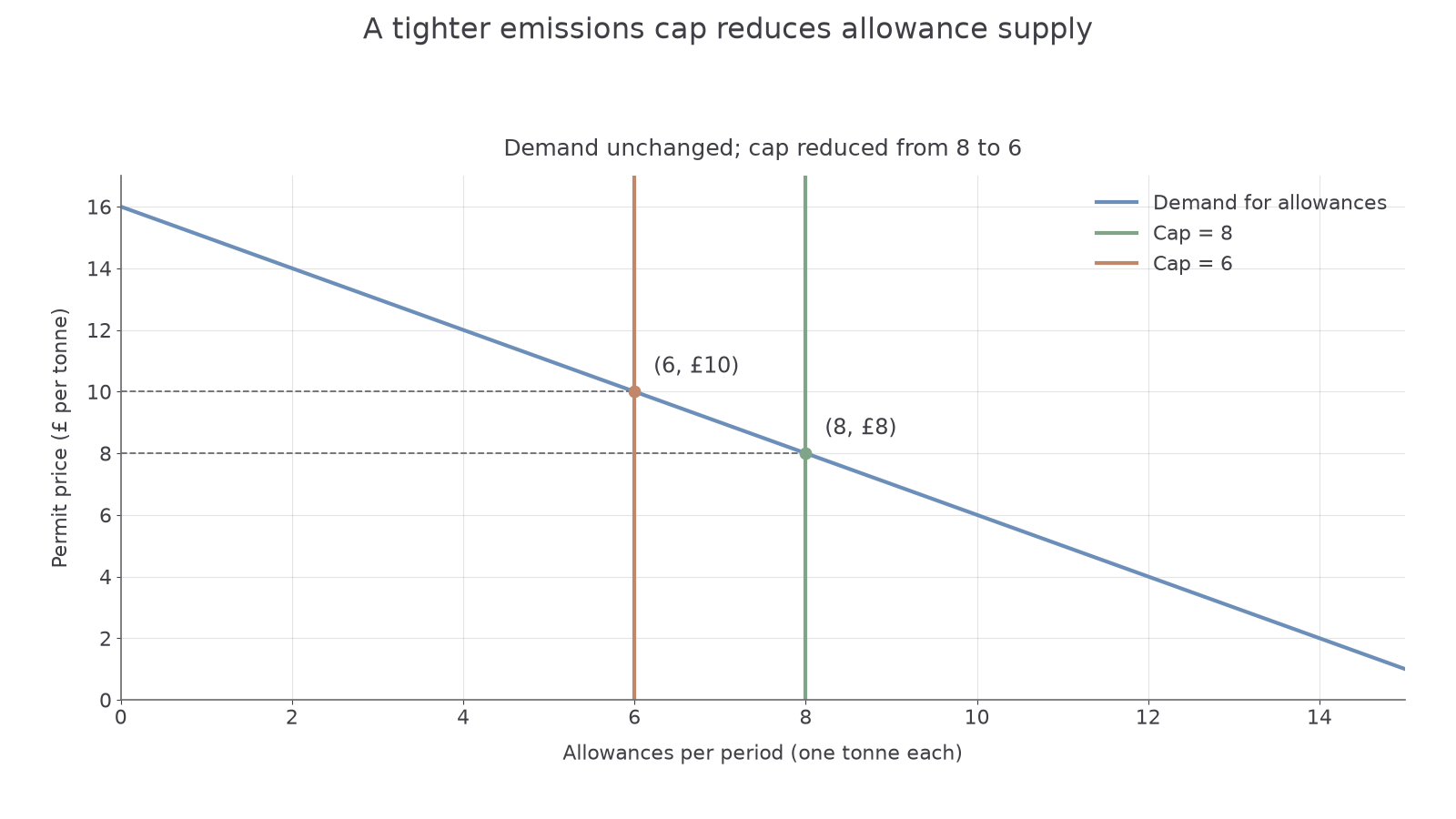
The cap must reflect the environmental target, cover relevant polluters and be enforced. Too many allowances leave little incentive to abate; weak monitoring permits breaches; emissions may move to uncovered places. Volatile permit prices complicate investment, while an initially credible cap can encourage cleaner technology. Different pollution locations can cause different damage even for the same emissions total, so unrestricted trading may be inappropriate for a local toxic pollutant. The market lowers costs within its rules; it does not prove the chosen cap is optimal.
Buffer stocks and price stability
A buffer stock authority buys a storable product when supply is high and sells accumulated stocks when supply is low to limit price fluctuations.
Set a lower intervention price and an upper intervention price. Below the lower bound, purchases add to demand and absorb the surplus; above the upper bound, releases add to supply and meet the shortage. The authority needs finance to buy, storage capacity and enough usable stock to sell. This is different from merely declaring a legal price floor or ceiling without purchasing or releasing anything.
Construct a price–quantity diagram with demand and the current supply curve, then mark the intervention price. At the lower bound, the horizontal gap between supply and private demand is the quantity purchased. At the upper bound, the gap between demand and current production is the stock release needed to maintain that price. The following illustrative panels use demand . After a good harvest supply is ; at the floor £8, demand is 12 and supply 14, so the authority buys 2 units. After a bad harvest supply is ; at the ceiling £12, demand is 8 and supply 6, so it sells 2 units.
[DIAGRAM: asset_slug: buffer-stock; caption: Buffer-stock purchases after a good harvest and releases after a bad harvest; description: Two exact demand–supply cases at lower 8 and upper 12 prices, with purchase gap 2 and release gap 2 quantity units.]
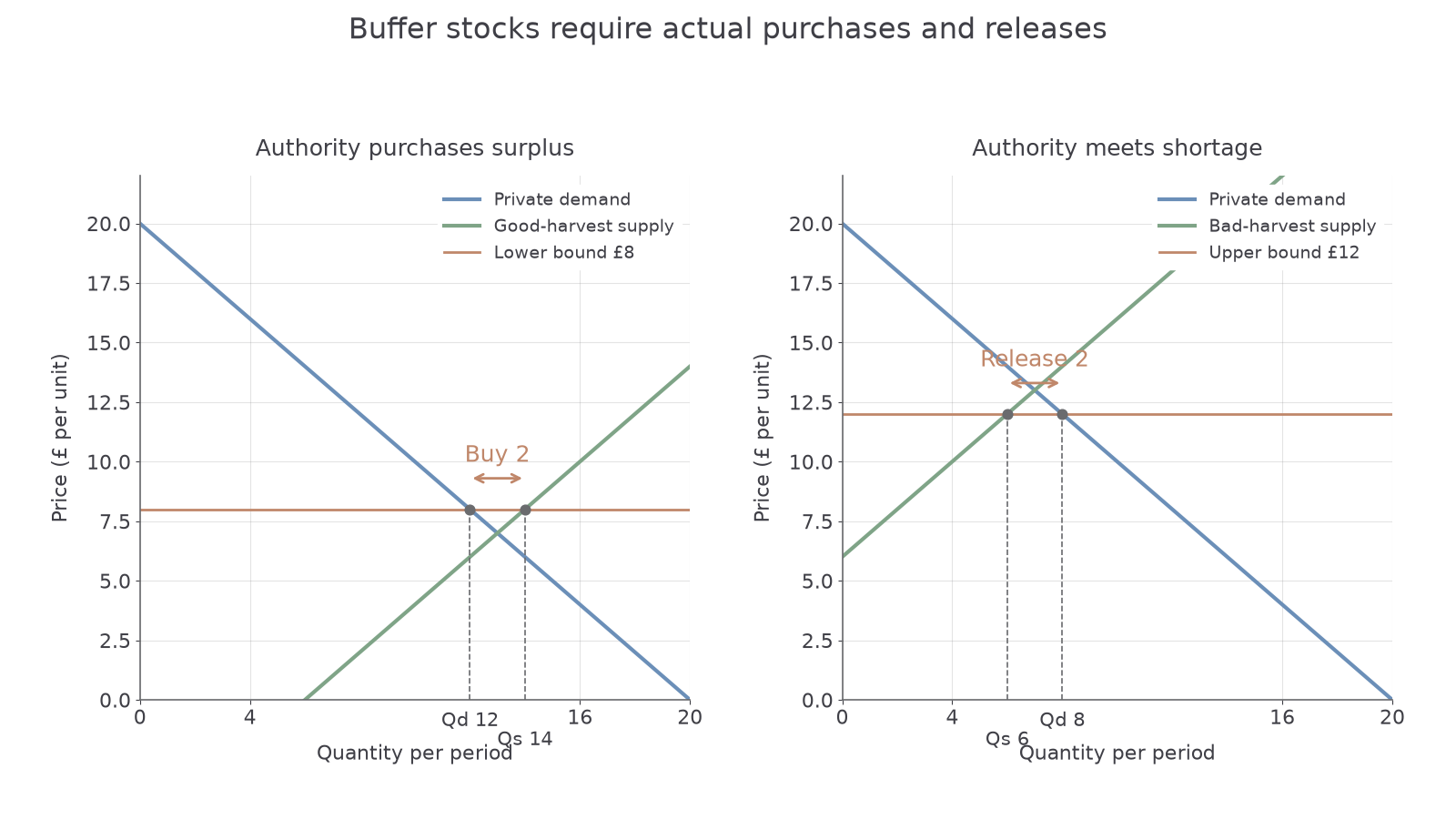
More stable prices can reduce uncertainty for producers and consumers and support investment. Yet storage, spoilage and administration cost resources. A floor above the long-run equilibrium may encourage persistent overproduction and ever-growing stocks. A ceiling below a sustained market price can exhaust stocks, making the promise impossible to maintain. Perishable products are harder to store, and the authority may misjudge the sustainable band. Buffer stocks are most credible for suitable storable goods and temporary fluctuations, with a realistic financing and replenishment plan.
Providing better information
Information provision changes choices by correcting beliefs rather than directly setting a quantity or price.
Clear risk labels, independent quality certification and public campaigns can reduce information failure. If consumers underestimate a harmful product's personal cost, credible information can reduce perceived net benefit and shift demand left. If they underestimate a preventive service's benefit, information can increase demand. Disclosure rules can also reduce an information advantage, such as requiring sellers to reveal known faults.
The response depends on accuracy, credibility, clarity and the ability to act. A long technical label may provide data without making it understandable. A person who knows a service is useful may still lack money, access or time; a dependent consumer may not change behaviour rapidly after a warning. Producing and checking information has costs, and biased or outdated guidance can worsen choices. Compare targeted communication with access improvements, regulation or prices according to the cause of the failure. Information is especially useful where mistaken beliefs are important and choices can change; it is less sufficient where the main problem is an unpriced external cost imposed on others.
Competition policy and incentives
Competition policy seeks to preserve effective rivalry and prevent firms using market power in ways that harm consumers or allocation.
Authorities can investigate anti-competitive agreements, review mergers, address abuse of dominance and remove unjustified barriers to entry. For example, action against a price-fixing agreement can restore pressure to lower prices and improve quality. Easier entry can challenge an incumbent's ability to restrict output. A large firm or a high price alone does not establish wrongdoing; costs, innovation and the actual competitive alternatives matter.
Preventing a merger may preserve rivalry, but it may also forgo economies of scale or a useful combination of technology. Breaking up a network with high fixed costs can duplicate infrastructure. Market definition, evidence of likely entry and information about efficiencies therefore affect the choice. Enforcement can be slow and costly, and a mistaken remedy can reduce innovation. Competition policy should target a demonstrated competitive problem and judge likely consumer and efficiency effects against the feasible alternative. Detailed market-structure models are developed in section 4; the mechanism here is the role of policy in supporting rivalry, not a complete monopoly essay.
Quick recap
Provision and partnerships address funding and delivery; rules depend on enforcement; permits use a cap and trading; buffer stocks require actual purchases and releases; information changes beliefs; competition policy supports rivalry. Effectiveness depends on the failure, incentives, resources and feasible alternatives.