3.1 - Fiscal transmission and public debt
Fiscal policy changes taxes and public expenditure to influence economic activity. Trace how discretionary decisions and automatic stabilisers affect demand, distinguish an annual deficit from accumulated debt, and judge when fiscal policy can achieve growth, employment and other objectives without unacceptable costs.
Cyclical and structural balances
The observed budget position reflects both the economic cycle and the underlying tax-and-spending arrangements.
During a recession, weaker employment, incomes and profits reduce tax receipts. More people may qualify for unemployment support, raising current expenditure. The deficit can therefore widen without a government deciding to change tax rates or benefit rules. In an upswing, higher receipts and lower unemployment payments tend to improve the balance.
The cyclical budget position is the part associated with activity above or below a sustainable normal level. The structural budget position is the estimated balance after allowing for the cycle: the balance that would remain if the economy operated at its potential level. A structural deficit can result from planned expenditure exceeding the receipts expected at that level. It is not simply any deficit that has existed for a long time.
In an illustrative recession, actual receipts are £280bn and expenditure £320bn: a £40bn deficit. Analysts estimate that, at potential output under the same rules, receipts would be £305bn and spending £315bn. The structural deficit is £10bn; the remaining £30bn is the estimated cyclical component. Use the same sign convention: actual balance −£40bn equals structural −£10bn plus cyclical −£30bn.
These estimates are uncertain because potential output cannot be directly observed. A recession that permanently damages skills or capital may reduce potential output, making the estimated structural deficit larger. One-off items also need careful treatment. Comparing headline balances alone cannot prove that one government chose more expansionary policy than another.
Automatic and discretionary policy
Automatic stabilisers change receipts and spending as activity changes, whereas discretionary policy requires a new decision.
Automatic stabilisers operate through existing tax and benefit rules. If income falls, income-tax payments usually fall, cushioning the fall in disposable income. Unemployment benefits support spending when people lose work. This limits the fall in C and AD relative to a system without these responses. In a boom, rising tax payments and reduced unemployment support moderate spending growth. They stabilise fluctuations; they do not eliminate every recession or supply shock.
Discretionary fiscal policy is a deliberate change in taxes or government expenditure. An expansionary decision might increase public purchases or reduce taxes to support AD. A contractionary decision might reduce public purchases or raise taxes to restrain it. The eventual balance depends on both policy and the cycle: a new tax rise need not eliminate a deficit if a recession simultaneously reduces the tax base.
For example, existing unemployment benefits increasing because job losses rise is automatic. Parliament approving a new transport investment programme is discretionary capital expenditure. A government deciding to raise the benefit payment per eligible person is discretionary current expenditure, even though later changes in claimant numbers remain automatic. The category depends on why the amount changes, not on whether the item appears in the budget.
Automatic responses avoid the delay of designing a new policy and can reverse as recovery proceeds. Their strength depends on tax responsiveness, coverage and how much recipients spend. Discretionary action can target a particular problem or region but needs recognition, decision and implementation time. A large project may become operational after the original downturn has ended.
Fiscal transmission and capacity
Fiscal policy affects demand through public purchases and through the spending decisions of households and firms.
An increase in G directly raises planned expenditure on domestic output. A cut in income tax can increase disposable income and consumption, but some of the gain may be saved or spent on imports. Transfers initially change recipients' income; they affect AD through subsequent spending rather than counting directly as G. A corporation-tax cut may improve expected after-tax returns and investment, but weak sales prospects can still deter projects.
The initial demand injection can have multiplied effects as one person's spending becomes another's income. Suppose an illustrative fixed-price model has a multiplier of 2.5. An additional £8bn of domestic government purchases gives an estimated increase in equilibrium income. This is conditional on the model's leakages, spare capacity and no offsetting policy or confidence changes. If prices rise or imports absorb more spending, the real-output effect is smaller.
[DIAGRAM: asset_slug: ocr_h460_fiscal_capacity; caption: The output and price effects of fiscal expansion depend on spare capacity; description: Exact two-panel AD-AS comparison: a flatter supply curve yields a larger real-output response than a steep supply curve to an equal illustrative AD shift.]
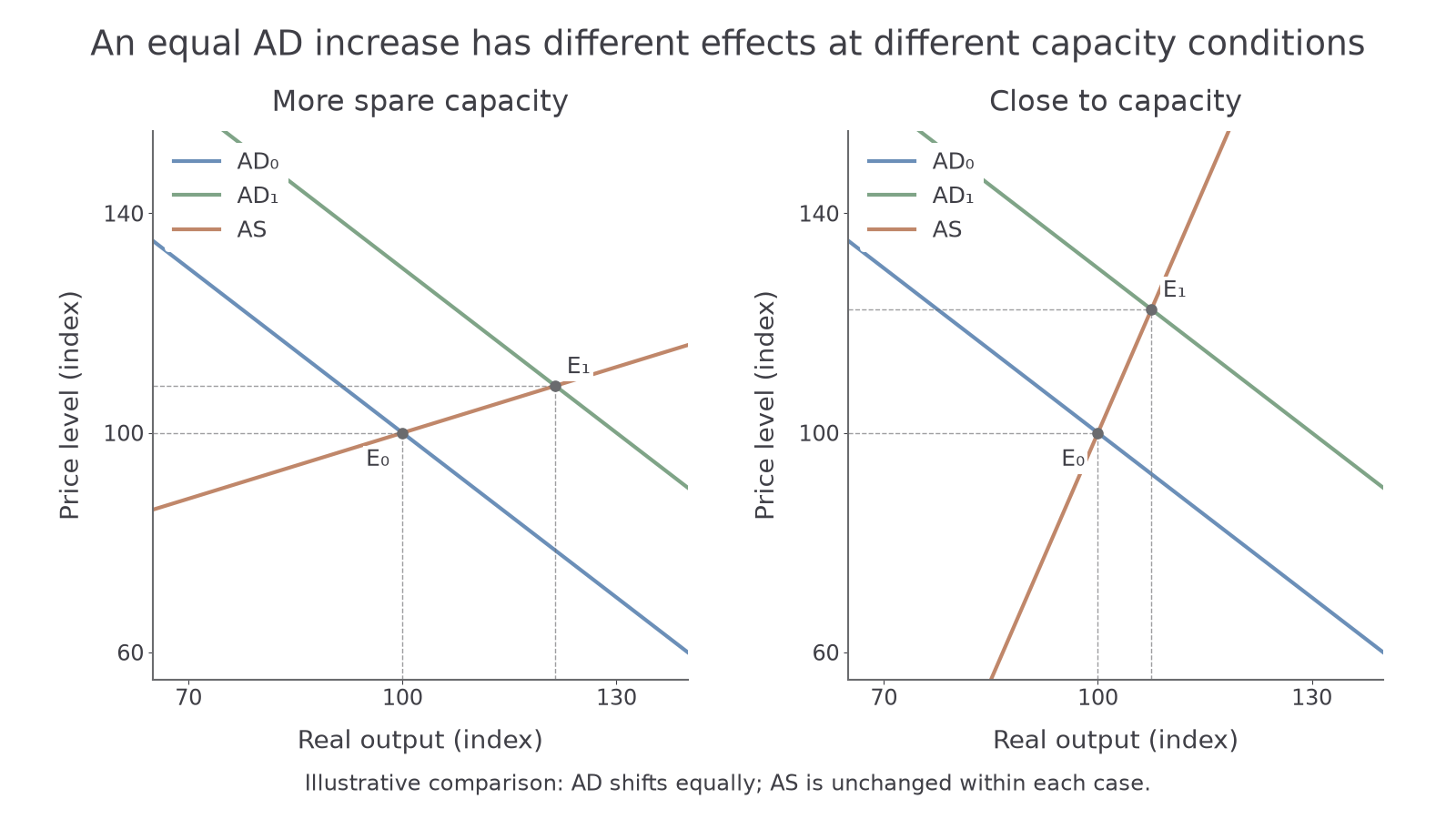
To construct the comparison, use the price level on the vertical axis and real output on the horizontal axis. Shift AD right for an effective spending increase. Keep AS fixed to isolate the demand channel, mark each intersection, and project to both axes. In the flatter-AS case, idle resources allow a larger increase in output and employment with a smaller price rise. Near capacity, scarce inputs and rising costs make a similar AD increase generate more price pressure and less additional real output. The graph compares price levels, not inflation rates; it explains inflationary pressure as prices respond over time.
Fiscal action can also affect supply. Capital investment in useful infrastructure may improve future transport or energy capacity, while current spending on education may improve skills. These effects require successful implementation and time; do not shift LRAS right merely because any spending is labelled government expenditure. A quick transfer and a long construction project can have quite different immediate and lasting effects.
Debt, interest and sustainability
Government debt is an outstanding stock of borrowing, while a budget deficit is a flow over a period.
Continue this lesson.
You’re previewing NovaLearn without an account. Create a free account to read the rest.
Create free account