3.2 - Economies of scale and efficient size
A larger factory can reduce cost per unit, yet a larger organisation can also become harder to coordinate. Learn how long-run cost curves represent these possibilities, how industry growth differs from firm growth, and why efficient size varies between activities.
Choosing the scale of production
In the long run, all factors of production can be varied. A firm can change its premises, equipment and workforce rather than adding workers to an unchanged plant. The length of time needed depends on the activity. The long-run average cost (LRAC) curve shows the lowest attainable average cost at each output when the firm can choose its scale, given input prices and technology.
Each possible plant has a short-run average cost (SRAC) curve. A small plant can be cheap at low output but costly when crowded; a large plant may spread its overheads effectively only at higher output. LRAC is the lower envelope of the available SRAC curves: choose the cheapest feasible plant for each output. With a continuous choice of plant sizes the envelope is smooth. With only a few indivisible sizes, it may instead have corners or jumps; a smooth diagram is a simplifying model.
[DIAGRAM: asset_slug: long-run-envelope; caption: Long-run average cost is the envelope of possible plant cost curves; description: Three illustrative SRAC curves lie above and touch a smooth LRAC curve; tangency away from the LRAC minimum does not have to occur at an SRAC minimum.]
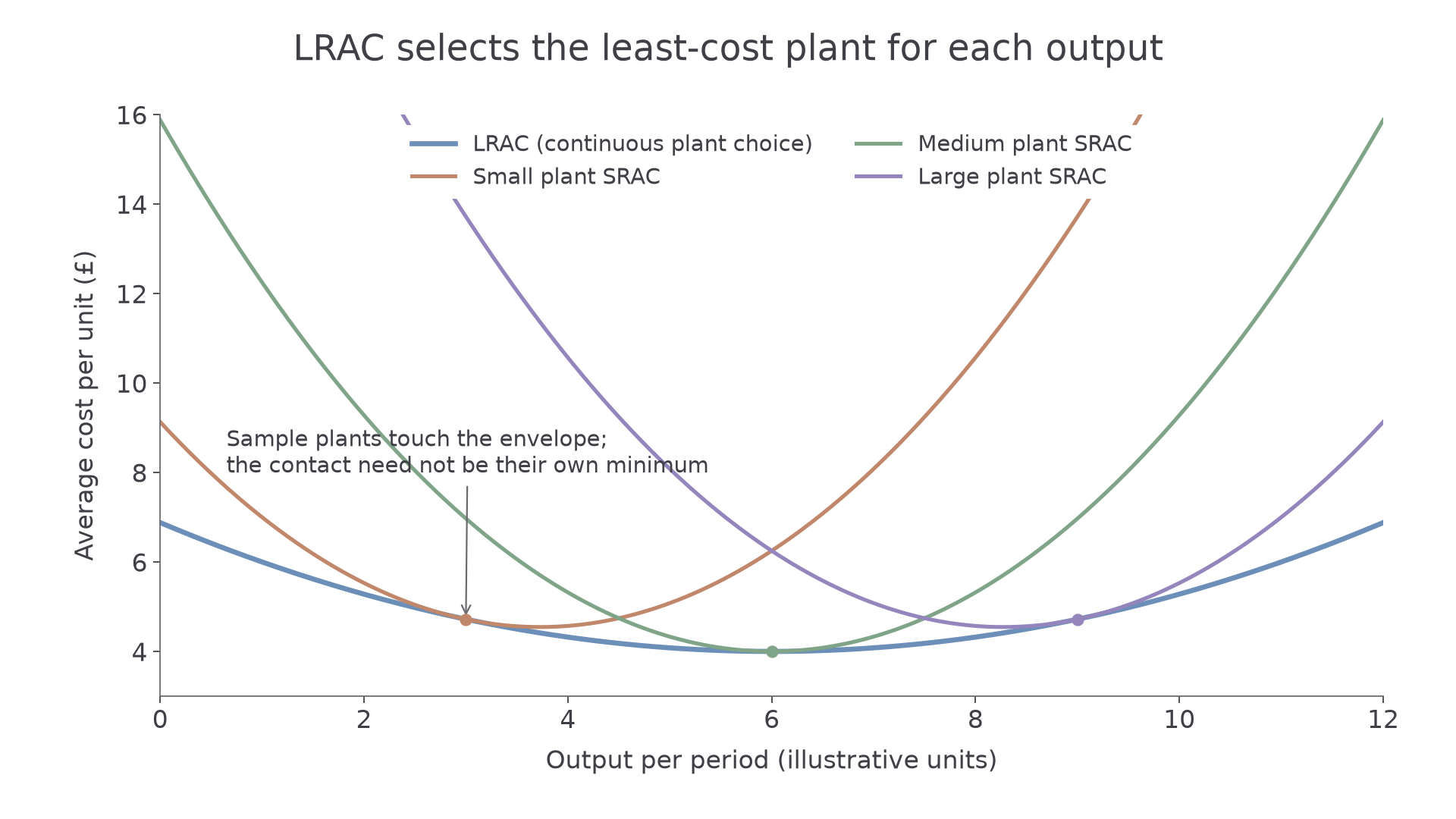
Both axes matter: output per period is horizontal, and average cost per unit is vertical. A movement along LRAC means selecting a different scale for a different output, with technology and input prices held constant. It is not the same as a movement along an existing plant's SRAC. A technological improvement can shift LRAC down; simply expanding output does not shift it down.
The chosen plant need not operate at the minimum of its own SRAC. On a falling LRAC, a plant can be optimal for that output while still having falling SRAC; a somewhat bigger plant may have too much overhead for the required output. To sketch the envelope, keep each possible SRAC on or above LRAC, touching it at the output where that plant is cheapest. Do not mechanically join every SRAC minimum.
Economies of scale occur when increasing the firm's scale lowers LRAC. Constant returns to scale in cost terms correspond to unchanged LRAC, while diseconomies of scale mean higher LRAC as scale rises. The cost definition assumes relevant input prices are accounted for; physical returns to scale describe how output changes when all inputs increase proportionally. Doubling all inputs and more than doubling output can reduce unit cost at unchanged input prices. This differs from diminishing returns, which holds at least one factor fixed.
Internal economies of scale
Internal economies of scale come from expansion of the individual firm. They explain movement down its LRAC curve, holding wider industry conditions constant. Name a mechanism and explain why it reduces cost per unit; “it is bigger” is not a mechanism.
Technical economies include more productive specialised machinery and spreading the cost of an indivisible installation over a larger output. An illustrative bottling line costs £100,000 a year to operate before per-bottle costs. At 100,000 bottles, that contribution is £1 per bottle; at 500,000 it is £0.20. This saving is a potential advantage of a larger scale, although simply producing more with an existing fixed line is also an AFC-spreading calculation in the short run. A long-run claim must involve the cost advantages of the chosen scale, not just relabel every short-run average-cost fall.
Managerial economies arise from specialist expertise. A large firm can employ a purchasing specialist whose knowledge reduces wastage or input costs across many units. Purchasing economies can reduce input prices through bulk orders, cheaper delivery per unit or greater bargaining power. Marketing economies spread campaign and distribution costs across greater sales. Financial economies may arise if lenders perceive a larger, diversified firm as less risky and charge a lower borrowing rate. They are conditional: a highly indebted large firm may be riskier than a small one.
Diversification can spread the risk of demand changes across products or markets, reducing disruption and possibly the cost of finance. It does not guarantee lower production cost; entering an unfamiliar activity can raise costs. Likewise, a bulk discount saves money only if storage, spoilage and finance costs do not offset it. Technical equipment offers a saving only with enough demand and suitable skills to use it.
For an illustrative food producer, a specialised packing machine may lower labour cost per box from £0.80 to £0.30 while adding £40,000 annual equipment cost. At 200,000 boxes, the labour saving is £100,000 and the net cost saving is £60,000, or £0.30 per box. At 50,000 boxes, the £25,000 labour saving is smaller than the added equipment cost. The same technology is therefore beneficial at one scale and costly at another, under these simplified assumptions.
Industry growth and external economies
External economies of scale reduce a firm's average costs because its industry or local cluster grows, rather than because that firm itself expands. A concentration of producers can attract specialist suppliers, support relevant training and create a pool of workers with useful skills. Knowledge may spread between firms, reducing the cost of adopting effective methods. The benefit can be available to a small firm without increasing its own output.
For example, an illustrative cluster of engineering firms attracts a tool-maintenance service. Shorter travel and quicker repairs reduce downtime costs for local firms at each of their output levels. This shifts each affected firm's LRAC down. By contrast, a firm employing its own maintenance team through expansion is an internal economy represented by movement along its LRAC under unchanged industry conditions.
Continue this lesson.
You’re previewing NovaLearn without an account. Create a free account to read the rest.
Create free account