Appendix 1 2(d)(ii) - Chi-squared and categorical association
Learn to compare observed category counts with a justified expected distribution and to test association between categorical variables. Calculate chi-squared, use the correct degrees of freedom and distinguish evidence of a pattern from proof of its cause.
Choosing categorical counts
An enquiry about orientations, land-use categories or travel modes often concerns numbers in groups rather than a difference between means.
Chi-squared test
A test comparing observed category counts with counts expected under a stated null model. A goodness-of-fit test examines one categorical distribution; a test of independence examines association between two categorical variables.
Use actual frequencies, not means, percentages alone or measurements such as channel depth. Percentages need a sample total to recover counts: 40% of 20 and 40% of 2,000 have very different sampling information. Categories must be mutually exclusive and exhaustive for the analysed population, so each unit enters exactly one category, or one cell in a two-way table. An expected count may be fractional even though an observed count is an integer.
For goodness of fit, define the expected category proportions under the null before using the observations to judge them. “No preferred orientation” may justify equal probabilities for equal-width compass sectors only if those sectors had equal opportunity to be represented. Different areas of available habitat could justify unequal expected proportions. “Random” does not automatically mean equal counts in unequal categories.
For a test of independence, the null says that the row and column variables are not associated. For example, settlement zone and travel mode are independent if the mode proportions are the same across zones. The expected counts are calculated using the observed margins under that independence model.
Both procedures require independent observations or a design that accounts for dependence. Asking the same commuter on several days and counting every reply as a new independent person exaggerates the sample information. Nearby land-use units may share planning decisions, and nearby cirques may share geological controls. A categorical test cannot repair clustered sampling by itself.
Testing goodness of fit
A goodness-of-fit calculation tests the specific expected distribution you have justified, so the expected values are part of the geographical argument.
Consider original illustrative orientation counts from 40 distinct cirques sampled from a fictional mapping inventory. Four equal-width 90° sectors are used. For this teaching calculation, stipulate independent selection and equal opportunity for all sectors. The null model assigns probability 0.25 to each sector, giving expected count E = 40 × 0.25 = 10 in each.
O is the observed frequency, E the expected frequency, N the total count and the null probability of category i. Add contributions for every category. The statistic is non-negative and dimensionless.
| Sector | North: 315°–<45° through 0° | East: 45°–<135° | South: 135°–<225° | West: 225°–<315° |
|---|---|---|---|---|
| Observed O | 18 | 10 | 8 | 4 |
| Expected E | 10 | 10 | 10 | 10 |
| 6.4 | 0 | 0.4 | 3.6 |
The sector boundaries avoid double-counting an orientation on a boundary. The north sector wraps across 0°; this is still one sector.
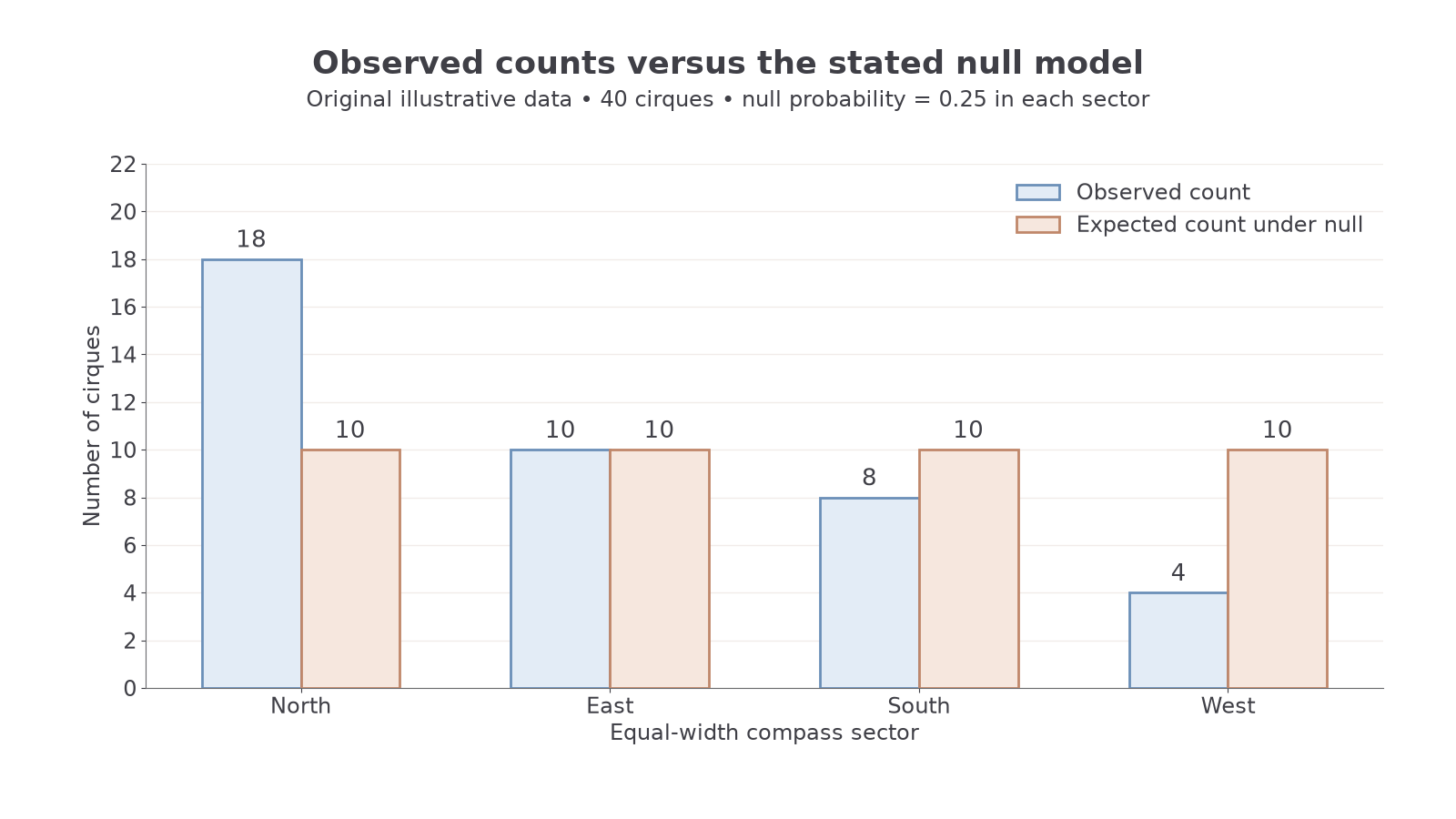
Original illustrative mapping counts. Expected values follow the stated null model and do not describe observed cirques.
For k categories with fixed null probabilities, degrees of freedom are k − 1. Once three counts and the total of 40 are fixed, the last count is constrained. Here df = 4 − 1 = 3. The upper-tail 5% critical value is 7.815. Since 10.4 > 7.815, reject the equal-probability null under the stated assumptions: the orientation distribution provides evidence against equal sector probabilities. North is over-represented and west under-represented in the sample, but the overall test alone does not give a separate significance decision for each sector.
Continue this lesson.
You’re previewing NovaLearn without an account. Create a free account to read the rest.
Create free account