3.1 - Global flows and a shrinking world
Learn how flows of goods, money, people and information connect places, why transport and communications have accelerated those connections, and how proportional flow lines reveal an uneven network.
Connections and interdependence
Globalisation changes the relationships between places as well as the amount that moves between them.
Globalisation
The widening and deepening of connections, interdependence and flows between places across the world.
Widening means that more places and people join a network: a retailer begins buying from a new country, for example. Deepening means that established connections become more frequent or important: the retailer increasingly depends on that supplier for essential components. A larger number of connections does not necessarily mean that everyone benefits equally from them.
Five important flows interact:
| Flow | What moves | How it connects places |
|---|---|---|
| Commodities | Raw materials, components and finished goods | A factory depends on inputs from other locations and consumers abroad. |
| Capital | Investment, loans and payments | An overseas investor finances a factory; profits may later flow back to the investor. |
| Information | Designs, prices, news, data and ideas | A design can be sent to a distant producer and an order tracked across borders. |
| Migrants | People changing their usual place of residence | Workers link labour markets, families and cultures, often sending remittances home. |
| Tourists | Temporary visitors | Visitor spending links a destination's hotels and transport to incomes and preferences elsewhere. |
A hypothetical phone producer illustrates interdependence. Its head office sends design information to a component supplier; capital funds production; components move to an assembly plant; finished phones move to consumers. Migrant technicians may help operate the plant, while tourist travel is another use of the same international airport. Interdependence means that a change in one place affects others: a port closure can interrupt assembly, delay sales and reduce workers' incomes elsewhere.
These links are two-way but often unequal. A buyer with many possible suppliers may switch location more easily than a town dependent on one factory can replace its employer. Count flows, but also ask who controls them, who captures their value and how dependent each place has become. Trade existed long before the present period; contemporary globalisation is distinguished by the scale, speed and organisation of these networks.
Transport and the shrinking world
Transport innovations reduce the effective separation between places by changing journey time, cost, capacity and reliability.
In the nineteenth century, railways connected inland production areas to ports and cities. Large, regular loads could move more rapidly than by horse-drawn transport, extending the area from which a port could draw goods. Steamships made ocean travel less dependent on wind and supported more predictable trading schedules. The telegraph separated the speed of a message from the speed of a ship: merchants could exchange prices and orders before a cargo arrived. Together, these changes allowed trade to be planned across greater distances. They also served colonial extraction, so expanding connections were shaped by political power rather than shared opportunity alone.
Twentieth-century jet aircraft reduced the time needed for long-distance passenger travel and for high-value, perishable or urgent goods. Business staff could visit overseas operations and tourists could reach distant destinations within a holiday. Air freight remains costly and energy-intensive; it did not replace shipping for large volumes of bulk commodities.
Containerisation standardises the load unit. A sealed container can be transferred between ship, rail and lorry without unloading every item. This reduces handling time, labour costs, damage and theft, while allowing mechanised ports to process large volumes. More reliable delivery makes it easier for firms to coordinate different stages of production in different countries. An inland factory can join an international network if it has an effective road or rail connection to a container port; a place lacking that connection may remain peripheral.
Time-space compression
The reduction in the time and cost needed to overcome distance, making places feel effectively closer without changing their physical distance.
The “shrinking world” is therefore uneven. Major airports and container ports become hubs, concentrating routes and attracting related firms. Travel between two hubs may be easier than travel over a much shorter distance to a remote settlement. Freight terminals, road congestion, border checks and shipping disruptions still matter: technology reduces some barriers without abolishing geography.
ICT and coordination across distance
Twenty-first-century information and communications technology allows many decisions and services to cross borders almost immediately.
Fibre-optic cables transmit large volumes of digital information through light signals. Together with the internet, they make it economical to exchange designs, video, financial instructions and stock information. A manufacturer can coordinate suppliers in several time zones, respond to a changing order and track a shipment remotely. Faster information reduces the time spent waiting for decisions and the risk of producing the wrong goods. Goods still require physical transport, but their movement can be coordinated more efficiently.
Mobile phones make communication portable and can extend access where fixed telephone networks are limited. A trader can check market prices before travelling, reducing uncertainty. Internet-enabled phones can support banking and payments, although coverage, electricity, affordability and skills determine who can use them. Electronic banking speeds international payments and investment transfers; a service contract can be paid without physically moving currency. This does not remove exchange-rate risk or legal restrictions on capital.
Social networking spreads ideas and consumer preferences rapidly through personal and commercial networks. A small business may reach overseas customers without opening an overseas shop; a tourism image may influence demand for a destination. Network effects matter: a platform becomes more useful as more buyers and sellers join, encouraging further participation. Large platforms can also concentrate control over access, advertising and data.
ICT enables services such as remote accounting or software support to be delivered to an overseas client. Lower communication costs make these activities less dependent on the worker and customer occupying the same place. Face-to-face work, language, data-security rules and time-zone differences can still limit the effect. An internet connection alone does not guarantee a successful service business.
The digital divide is visible in dated evidence. ITU's 2024 estimates put internet use at 68% of the world population, with about 2.6 billion people offline. These are 2024 estimates, not a current headcount. They show why worldwide time-space compression can coexist with exclusion: people without usable access cannot participate in many information flows at the same speed.
ICT reduces the cost of communication and coordination. Transport moves physical goods and people; the two systems reinforce one another, but their benefits depend on access and control.
Reading proportional flow networks
A proportional flow diagram represents connections by using arrow width to show the size of a clearly defined flow.
The diagram below is an original illustrative network, not measured trade data. Nodes represent broad global regions schematically; their placement and the routes are not a geographical scale map. Every arrow shows annual goods exports in the same invented year and the same unit, billions of US dollars. Arrowheads give direction and width is proportional to value.
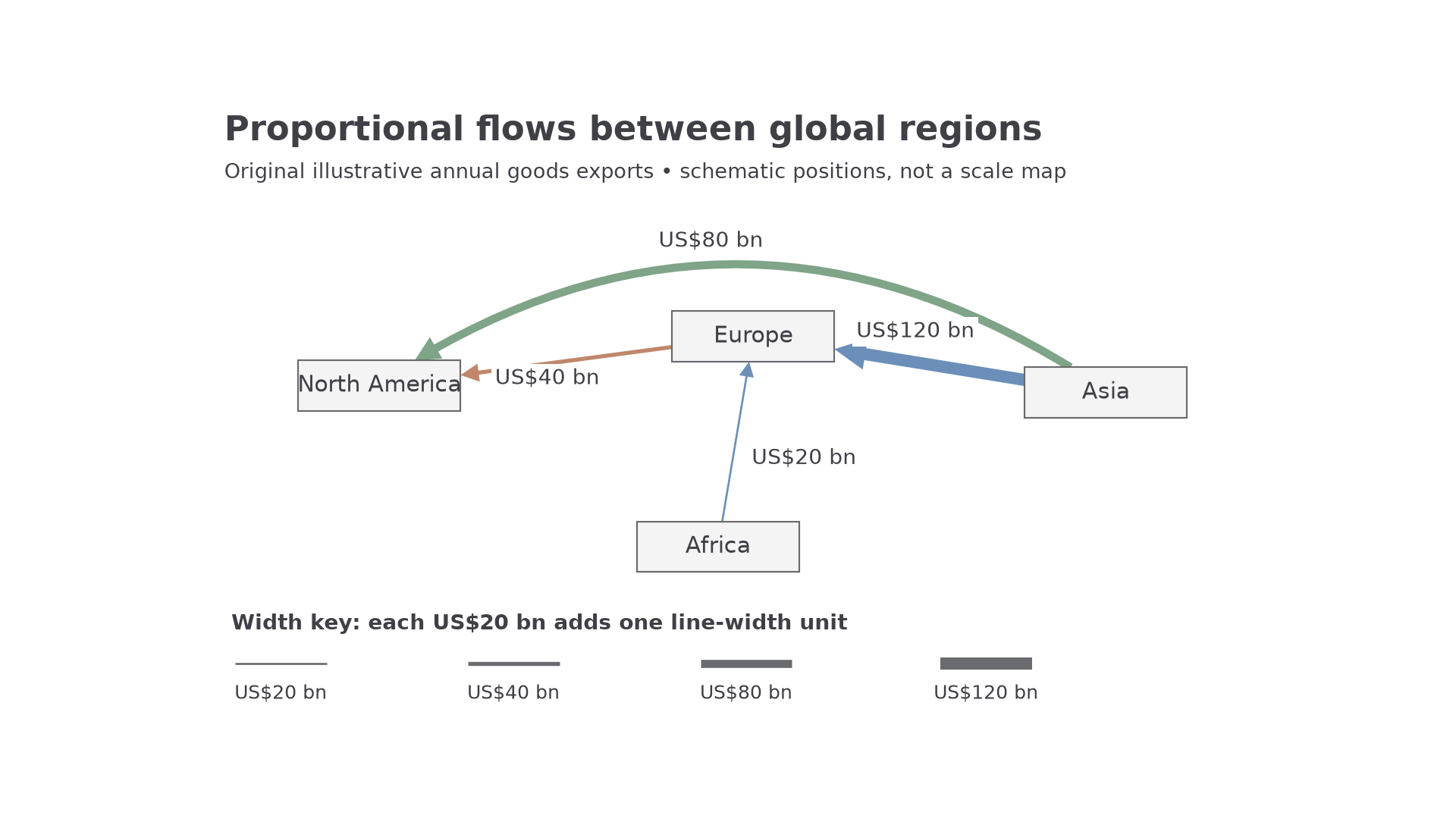
Original illustrative network. Line width is proportional to annual goods-export value; positions and routes are schematic.
| Export route | Annual value, US$ billion |
|---|---|
| Asia → Europe | 120 |
| Asia → North America | 80 |
| Europe → North America | 40 |
| Africa → Europe | 20 |
To construct this representation, define one width scale for all routes, draw each origin and destination, then multiply the width unit by the flow value. If US$20 billion uses a 1 mm line, the US$120 billion route needs 6 mm and the US$40 billion route 2 mm. Use a legend with at least one known width and arrowheads that remain visible. Keep routes distinct at crossings and never infer a connection from two lines merely crossing.
Read the network in three stages: identify the direction of the flow; compare widths or labelled values; then describe the pattern across the network. Asia supplies two of the four represented routes. Its total shown exports are US$200 billion, which is of the total represented value, to one decimal place. Europe is both a destination and an origin. This reveals a more complex network than a list of countries alone.
A thicker line indicates a larger measured flow, not necessarily more shipments, greater profit or more power. This diagram omits reverse flows, trade within regions, services and many destinations. An absent arrow means “not included here”, not “no trade”. Flow comparisons require consistent dates, currency values and definitions; inflation can raise monetary flows without an equivalent increase in physical volume.