6.5 - Fossil fuels, pathways and unconventional reserves
Learn why fossil-fuel deposits and energy demand are unevenly located, how transport routes turn this mismatch into interdependence, and why accessing harder reserves creates different benefits and risks for businesses, communities and environments.
Why supply and demand are separated
A country can need large amounts of energy without having accessible fossil-fuel deposits, because geological history does not follow today's population or industrial geography.
Oil and gas formed where organic matter accumulated, was buried and heated; conventional deposits also require suitable reservoir rocks, an impermeable seal and a trap. Coal formed from buried vegetation in former wetland environments. These conditions occurred unevenly over geological time. Large oil and gas reserves in sedimentary basins around the Persian Gulf therefore coexist with major consuming markets in East Asia and Europe. Coal is more widely distributed, including deposits in China, India, Australia and the USA, but its grade, depth and extraction cost differ.
Demand reflects population, income, industrial structure, transport and climate. Manufacturing and urban transport can concentrate consumption far from extraction. Supply and demand may overlap, as in coal-producing China, so the mismatch is a pattern rather than a rule that every consumer must import. A resource is the wider geological occurrence; a reserve is the portion judged recoverable under stated technical and economic conditions. Prices, technology and regulation can change reserves without creating new geological carbon.
Energy interdependence
Mutual reliance between places for energy supplies, markets, finance or transport infrastructure.
An importer needs reliable deliveries, while an exporter needs revenue and dependable buyers. National production can reduce direct import dependence, but oil prices remain connected through international markets. A country with domestic fuel is therefore not automatically insulated from global price rises.
Pathways and disruption
Energy security depends on the whole route from a deposit to the consumer, rather than on the size of the deposit alone.
Pipelines move oil and gas continuously but tie users to fixed corridors, terminals and transit states. Shipping routes connect oil and liquefied natural gas (LNG) exporters to more flexible markets, but require tankers, ports and, for LNG, liquefaction and regasification plants. Rail and road carry coal and petroleum products inland; derailments, floods, strikes or damaged bridges can interrupt the final link. Transmission lines move electricity rather than fossil fuel itself: generation may exist while a damaged line prevents delivery.
A chokepoint is a narrow route where many flows are concentrated and alternatives are limited. Hormuz connects the Persian Gulf to the Arabian Sea; Malacca connects the Indian Ocean with the South China Sea. A closure, attack or navigational accident can delay deliveries and raise insurance and transport costs. Rerouting around southern Africa can avoid some routes but adds distance and time; it cannot replace a landlocked pipeline or instantly enlarge port capacity. The US Energy Information Administration's dated 2024 report identifies Hormuz and Malacca as major oil-trade chokepoints. This is route evidence for that period, not a statement that every route is presently open or closed.
Russia's invasion of Ukraine in 2022, reductions in Russian supplies and European efforts to change suppliers exposed Europe's dependence on pipeline gas. LNG terminals and alternative pipelines improved flexibility but required investment and exposed buyers to competing global demand. The EU Council's account records Russian gas as 45% of EU gas imports in 2021 and 13% in 2025. These are shares of imports, not shares of all EU energy or gas consumption.
As accessible conventional fields deplete, replacements may be farther offshore or farther from consumers. Longer pathways add costs and additional failure points. However, depletion alone does not explain a particular disruption: war, contracts, weather and maintenance also matter. Diversified suppliers, storage, demand reduction and spare transport capacity strengthen resilience, but each has costs and lead times.
Reading energy-flow maps
An energy-flow map should be read as evidence about direction, connections and concentration, with its date and key checked before drawing a conclusion about security.
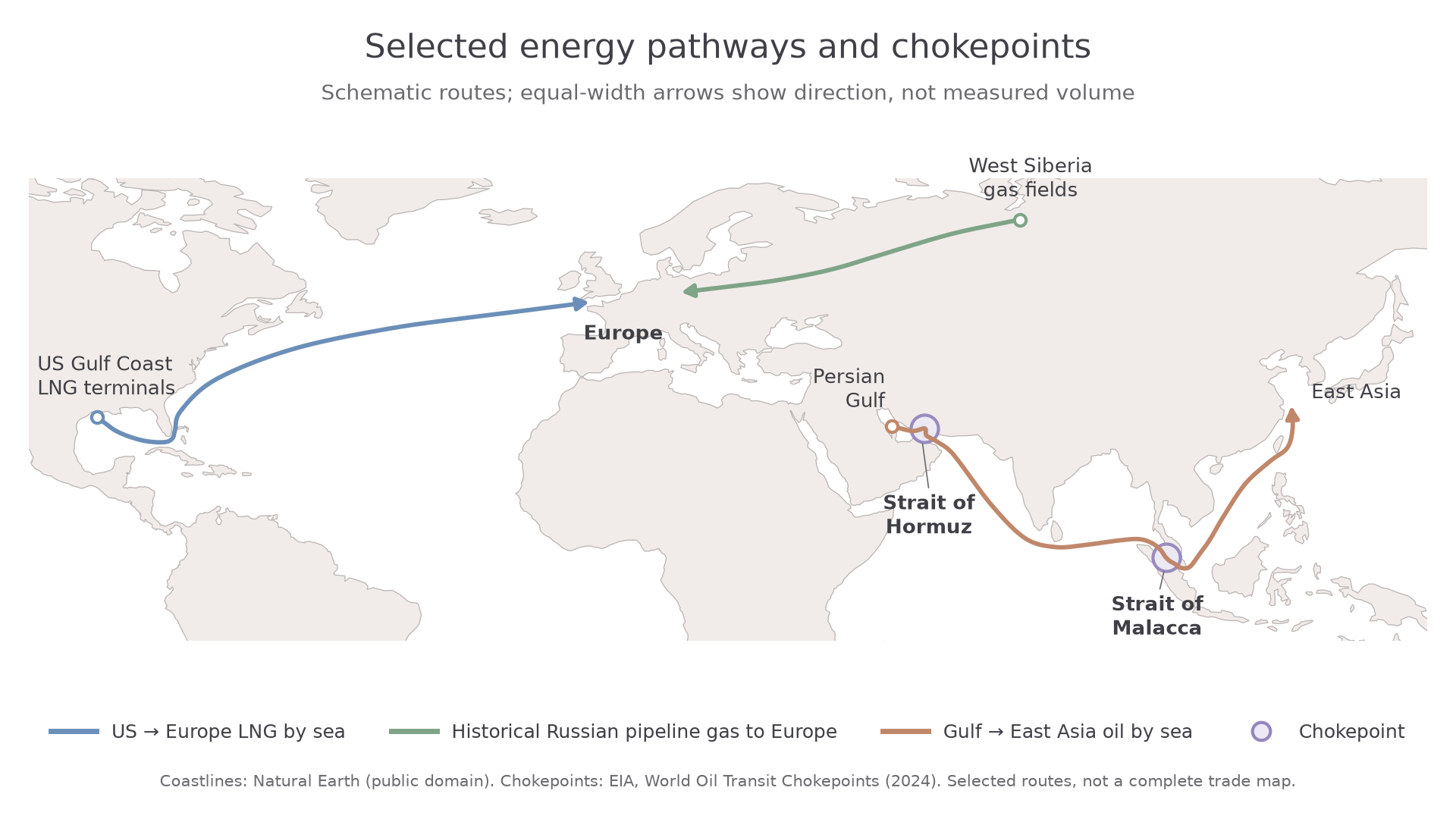
Selected routes only: an original schematic based on the locations discussed in EIA's 2024 chokepoint report. Coastlines and routes are simplified; arrows show direction, not measured volume or exact pipeline alignments.
Continue this lesson.
You’re previewing NovaLearn without an account. Create a free account to read the rest.
Create free account