8A.8 - Development aid and contested impacts
Learn how aid moves from donors to recipients, why its development and rights effects are disputed, and how to interpret evidence of environmental harm to minority communities.
Aid forms and delivery
Aid can meet an immediate survival need or finance a service whose benefits develop over years.
Development aid
External finance, goods or expertise intended to improve development outcomes. Humanitarian relief addresses urgent needs; longer-term development support builds services, capabilities or livelihoods.
A grant is not repaid, whereas a loan creates a repayment obligation. A concessional loan has more favourable terms than ordinary commercial borrowing, such as lower interest or a longer repayment period. Bilateral aid passes from one government to a recipient; multilateral aid is channelled through an IGO; charitable donations may fund NGOs. The source of money and the organisation delivering it are not necessarily the same: a government can fund an NGO-operated water project.
Following Haiti's 12 January 2010 earthquake, Oxfam's January 2011 progress report described emergency support funded by public donations and a planned transition from water tankers toward longer-term water and sanitation services with government authorities. This distinguishes rapid relief from restoring a durable public service. A tanker can save lives now but requires continuing deliveries; a functioning network requires capital, maintenance, governance and affordable access. Oxfam report.
Governments also supply relief, while the World Bank's International Development Association provides grants and concessional finance to eligible lower-income countries. A loan can fund a useful hospital or road before domestic revenue is sufficient, yet future repayments compete with other spending if the project underperforms. Grants avoid repayment but do not automatically remove donor conditions or ensure local accountability. IDA financing.
Reading global aid flow-lines
A flow-line map shows where a transfer starts, where it ends and how its amount compares with other transfers.
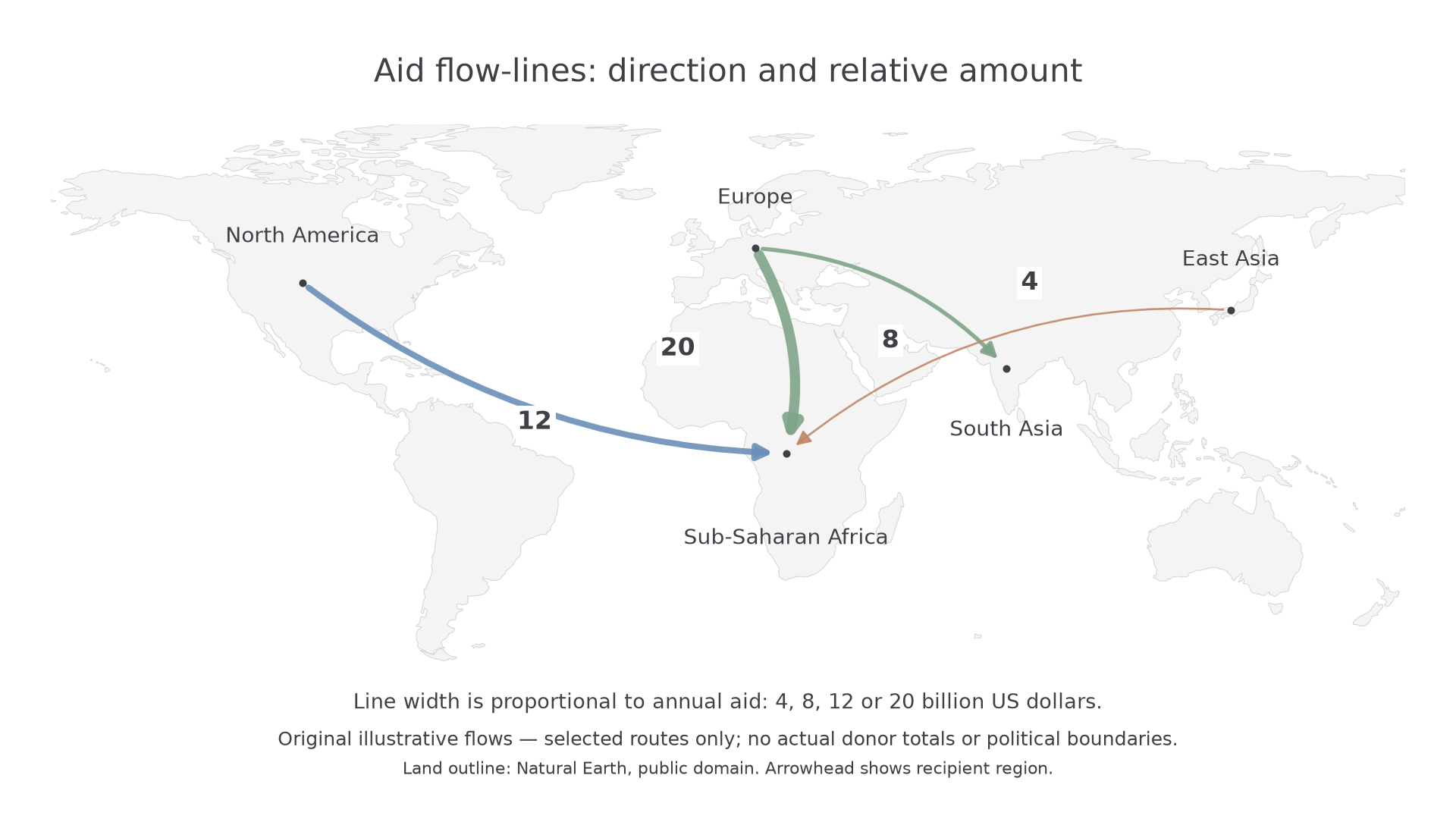
Four original illustrative aid flows, in billions of US dollars per year; these are not actual regional aid totals. Public-domain Natural Earth land outlines carry no political boundaries.
Read the arrowhead to identify the recipient, then read the line-width key and the value. A thick route does not mean a long journey or greater success: width encodes the amount transferred. In this example Europe sends 20 to sub-Saharan Africa and 8 to South Asia; the ratio is . The displayed European flows total 28 billion US dollars. Sub-Saharan Africa receives 12 + 20 + 4 = 36 across the displayed routes. These are selected flows, so their sum is not a complete aid budget.
To construct a comparable map, choose the same time interval, currency basis and definition of aid for every route, locate donor and recipient regions consistently, and make width proportional to amount. Avoid mixing commitments promised with money actually disbursed, or adding bilateral funds to their later multilateral disbursement and counting them twice. State whether a figure includes loans, grants, debt relief or spending on refugees within the donor country.
The pattern invites a question about allocation, not a conclusion about impact. A larger flow may reflect greater need, a strategic relationship or a large population. Compare aid per person and the share reaching intended services before inferring how much support each community receives. Flow maps reveal transfers between regions, while hiding differences within them.
Benefits, risks and source checks
Aid improves welfare when a funded input becomes an accessible and effective service, but the same process can be interrupted or diverted.
Continue this lesson.
You’re previewing NovaLearn without an account. Create a free account to read the rest.
Create free account