2B.4 - Waves, erosion and coastal landforms
Learn how wave conditions change beach profiles and how marine erosion exploits rock weaknesses to form cliffs, platforms, caves, arches, stacks and stumps.
Wave conditions change sediment movement
Waves transfer energy to the shore, and their effect depends on their height, period, breaking form and the beach they encounter.
Wind transfers energy to the sea surface. Greater wind speed, longer duration and a longer fetch, the distance wind blows across open water, generally allow larger waves to develop. In shallow water, waves slow and steepen until they break. Swash is the uprush of water on the beach; backwash returns downslope under gravity.
Constructive and destructive waves
Constructive conditions produce net onshore sediment movement and beach building. Destructive conditions produce net beach erosion and commonly move sediment offshore. These are descriptions of typical effects, not two permanently separate kinds of sea.
Relatively low, long-period waves often have strong onshore swash and enough time for water to infiltrate the beach before backwash. They can return sand from nearshore stores and build a berm, a ridge or nearly level bench on the upper beach. Steeper, higher, short-period storm waves arrive more frequently. Repeated breaking and strong return flows can remove upper-beach sediment and transfer it into nearshore bars.
Sediment and slope matter. Coarse shingle permits rapid infiltration and can support a steep beach face; fine sand often forms a gentler profile. A storm can cut a locally steep scarp into an upper beach while producing a flatter overall sandy profile and offshore bar. Thus “destructive waves make every beach steeper” is too simple. Wave period and height help classification, but observing net transport and swash/backwash behaviour tests it.
Beach morphology changes over hours during a storm, across daily tidal cycles, between calmer and stormier seasons, and over years as supply or exposure changes. “Summer” and “winter” profiles are useful idealisations; either condition can occur outside its usual season.
Comparing wave samples and beach profiles
Summary statistics describe typical conditions, but a convincing classification also uses variability and evidence of sediment movement.
For an original illustrative sample, five wave periods are 9, 10, 10, 11 and 10 seconds. The mean is ; the median is 10 s after ordering; the mode is also 10 s. Corresponding heights are 0.6, 0.7, 0.7, 0.8 and 0.7 m, giving a mean of 0.70 m. A second sample has periods 4, 5, 5, 6 and 5 s and heights 1.6, 1.8, 2.0, 1.8 and 1.8 m: mean period 5 s and mean height 1.80 m. The second sample is shorter-period and higher, consistent with more destructive conditions. Five waves are a small sample, so the conclusion needs a longer standardised record and beach-change observations.
The mean adds every observation and divides by the number observed. The median is the middle ordered value, or the average of the two central values for an even sample. The mode is the most frequent value; there may be none or more than one.
An exceptional wave affects the mean more than the median. Do not delete it merely because it is inconvenient: first check whether it is a genuine observation or a recording error. Record the sampling duration, instrument method and tidal state. Frequency and period are related: a typical 10 s period is approximately waves per minute; 5 s is approximately 12 waves per minute.
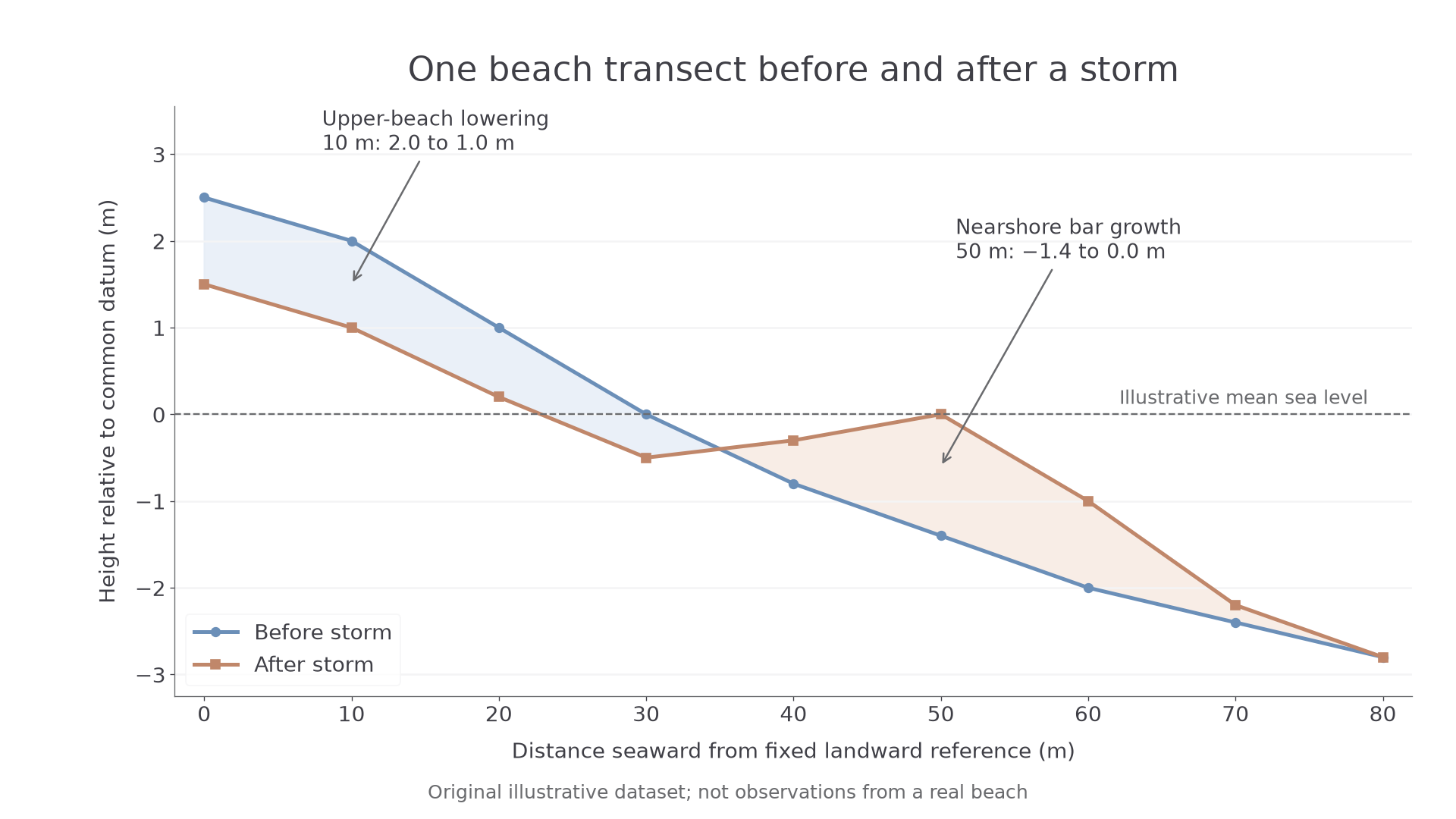
Original illustrative profiles along one fixed transect: upper-beach loss and growth of a nearshore bar can occur together. Heights use the same vertical datum.
The plotted profiles use the same fixed transect and vertical datum. At 10 m from the landward reference, height falls from 2.0 to 1.0 m: lowering of 1.0 m. At 50 m, the bed rises from −1.4 to 0.0 m: accretion of 1.4 m. Together these support transfer from upper beach to nearshore storage. They do not establish that all removed sand reached that bar: alongshore exchange and other stores may also matter.
How marine erosion removes rock
Marine erosion combines physical attack and chemical removal, with its effectiveness constrained by rock properties and available sediment.
Hydraulic action is the force of moving water against rock, including pressure changes as waves force water and trapped air into cracks. Repeated compression and release can widen joints and detach blocks. High-energy waves increase attack, but fractured rock supplies the routes that concentrate pressure.
Abrasion, also called corrasion, occurs when waves and currents use sand, pebbles or larger fragments to scrape and batter the shore. It requires sediment tools. A limited supply can reduce abrasion, whereas a thick beach can absorb wave energy and cover the cliff foot, protecting it. “More sediment means more erosion” is therefore not universally true.
Corrosion, or solution, is chemical dissolution of susceptible rock. Carbon dioxide dissolved in water forms a weak acid that can react with carbonate minerals in limestone. Chemistry and lithology matter more directly than simply labelling a wave destructive. Do not confuse corrosion with corrasion: one dissolves minerals; the other uses sediment to grind rock.
Attrition occurs when transported particles collide with one another and become smaller and rounder. It changes the sediment supply and particle properties; it does not directly mean the cliff is being scraped. Stronger wave movement can increase collisions, while harder fragments may resist breakdown longer.
The processes interact. Hydraulic action can release a jointed block; its fragments become abrasion tools; collisions reduce those tools through attrition. Lithology, joints, wave energy, duration of attack and beach cover determine how much change actually follows.
From weak points to cliffs and stacks
Erosional landforms develop where marine attack repeatedly exploits weaknesses, while gravity and weathering remove unsupported rock above.
At a cliff foot, hydraulic action and abrasion enlarge a wave-cut notch, commonly concentrated within the tidal zone. Undercutting leaves an overhang; weathering and gravity assist its collapse. Waves remove fallen debris, exposing the foot to renewed attack. Repeated retreat leaves a gently seaward-sloping wave-cut platform. Its width reflects past retreat, tides, geology and the duration of relatively stable sea level. As the platform widens, breaking waves can lose energy before reaching the cliff, so retreat may slow. A platform is not a pile of deposited fallen blocks, and changing sea level can interrupt this idealised cycle.
At a headland, a joint, fault or weaker bed can be enlarged into a cave. Continued erosion may connect caves from opposite sides or break through a narrow rock mass to form an arch. The roof becomes unsupported and weakened by weathering and fractures. Collapse leaves an isolated stack offshore. Wave attack at its base and further weathering eventually reduce it to a low stump, sometimes exposed only at low tide.
This is a causal sequence, not a timetable or an inevitable fate for every headland. A massive unfractured rock body, changing wave direction, resistant beds or temporary debris protection can alter the route and rate. Waves provide the marine attack, but an arch roof commonly fails under gravity; saying “the waves cut off its top” leaves out the failure mechanism.