6.1 - Carbon stores and the slow carbon cycle
Learn to distinguish a carbon store from a carbon transfer, interpret carbon budgets, and explain how weathering, sedimentation and tectonic activity move carbon through the geological cycle.
Stores, fluxes and timescales
The carbon cycle moves the same element between living organisms, water, air and rocks, but the amount held and the speed of transfer are different measurements.
Carbon store and carbon flux
A store is the quantity of carbon held in a reservoir at a particular time. A flux is a transfer of carbon between stores per unit time. A store is measured in Gt C or Pg C; an annual flux is measured in Gt C per year or Pg C per year.
One gigatonne (Gt) is one billion metric tonnes. One petagram (Pg) is grams, so 1 Pg C = 1 Gt C. The C matters: a mass of carbon is different from a mass of carbon dioxide. Carbon is 12 of the 44 mass units in a carbon dioxide molecule, so 1 Gt C corresponds to approximately 3.67 Gt CO₂. Always check what the unit counts before comparing figures.
Terrestrial stores include vegetation, soils, peat and geological rocks beneath land. The ocean store is mainly dissolved carbon, with smaller amounts in organisms and particles. The atmospheric store contains carbon principally in carbon dioxide and methane. Geological carbon also occurs beneath the oceans: “terrestrial” in a simple three-store model must not be read as meaning that all rocks lie above sea level. Boundaries determine what a diagram includes.
The geological store is overwhelmingly the largest. The ocean holds much more carbon than the atmosphere or living vegetation. A large store need not have a large annual net addition, and a small store can exchange carbon rapidly. Photosynthesis and respiration operate over days, seasons and lifetimes; soil carbon can persist for years to centuries or longer; deep-ocean exchange can take centuries to millennia; rock formation and tectonic recycling commonly take millions of years. Fast and slow describe connected pathways, not two sealed cycles with one universal residence time.
An approximate residence time is store size divided by a relevant outflow, assuming that store and flow remain steady. For an illustrative store of 600 Gt C with an outflow of 60 Gt C per year, years. It is a bulk average, not a promise that every carbon atom leaves after ten years.
Reading proportional flows and budgets
A proportional flow diagram uses arrow width to show the magnitude of a transfer, while arrow direction identifies the receiving store.
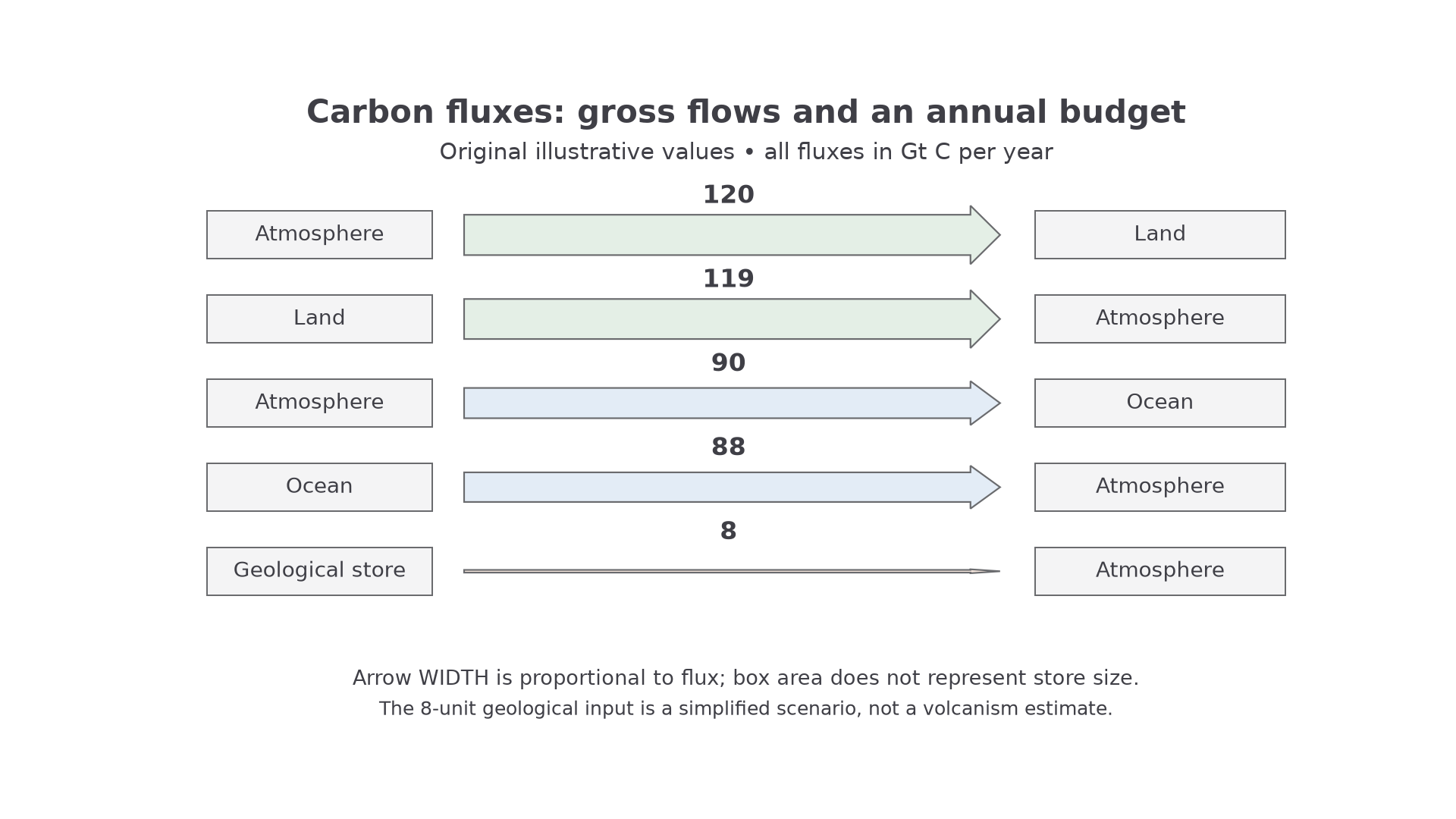
Original illustrative budget, not a measured global carbon budget. All arrow widths use the same scale; labels give Gt C per year. Store boxes are not scaled by their contents.
Here the atmosphere sends 120 Gt C per year to land and receives 119 back. It sends 90 to the ocean and receives 88 back. A separate geological-to-atmospheric input is 8. Thus very large gross exchanges can nearly cancel. The net land uptake is only Gt C per year, and the net ocean uptake is . The diagram's geological input is deliberately simplified; it is not an estimate of natural volcanism.
For an annual budget, every transfer must cover the same year and use the same mass unit. A positive change means the store grows; a negative change means it shrinks.
For the atmosphere, inputs are , and outputs are . The atmospheric store increases by 5 Gt C in that year. This is a mass balance: carbon has changed location, rather than being created. Under this simplified boundary, land gains 1, ocean gains 2 and geological storage loses 8; .
Read the legend before ranking arrows. Width is not carbon concentration, store size or speed along a river. A missing pathway, mismatched year, rounded value or inconsistent boundary can produce an apparent imbalance. Real budgets also contain uncertainty: a residual is not automatically proof of an unidentified process.
Continue this lesson.
You’re previewing NovaLearn without an account. Create a free account to read the rest.
Create free account