2A.4 - Glacial mass balance and feedback
Learn how glacier inputs and losses determine mass balance, calculate balance and equilibrium-line altitude, and explain why feedbacks and timescales matter when interpreting glacier change.
Inputs, storage and losses
A glacier is an open system: snow and ice enter, water and ice leave, and the amount stored changes when those fluxes differ.
Glacial mass balance
The net change in glacier mass over a stated period, equal to accumulation minus ablation. Positive balance means a gain, negative balance a loss, and zero balance no net change over that period.
Accumulation is mass added to the glacier. Ablation is mass removed. Internal flow transfers ice from higher accumulation areas towards lower ablation areas; transfer within the glacier is not itself a loss from the whole system. Ice discharged across the system's boundary is a loss. The chosen boundary and time period must therefore be explicit.
High areas commonly have net annual accumulation while lower areas have net ablation. The equilibrium line joins points where local annual balance is zero. Its altitude, the ELA, separates these zones in a simplified mountain glacier. A zero local balance at the ELA does not mean the whole glacier has zero balance: the sizes and balance rates of all areas matter.
is net balance, accumulation and ablation, using the same period, boundary and units. Specific balance is often given in metres of water equivalent, the depth of water obtained if the mass change were spread over a unit surface area. Water equivalent allows snow and ice of different densities to be compared.
For an original illustrative glacier, annual accumulation of 1.8 metres water equivalent and ablation of 2.3 metres gives metres water equivalent. The glacier loses mass even though fresh snow has fallen. Over an unchanged 4-square-kilometre area, this would represent approximately cubic metres of water equivalent. The conversion assumes the balance is an area-wide mean.
A retreating snout does not mean ice flows uphill: ice continues to move towards the snout while loss exceeds supply there. Snout position responds to ice flow and geometry as well as climate, often with a lag. One season's zero balance is also different from long-term dynamic equilibrium, in which geometry and flow are approximately stable under persistent conditions.
How mass is added and removed
Accumulation and ablation each include several processes, whose importance changes with the glacier's environment.
Direct snowfall adds mass. Avalanches from valley sides can add snow and ice to a glacier below, enabling accumulation in a shaded basin even when local snowfall is modest. Wind deposition redistributes snow onto sheltered surfaces. Compaction turns surviving snow into firn and then glacial ice; densification changes volume but does not create extra mass.
Surface melting removes mass only when water leaves the glacier system. If meltwater refreezes within snow or firn, some mass is retained. Sublimation transfers ice or snow directly into water vapour, important in cold dry windy settings. Evaporation removes liquid meltwater. Calving breaks ice from a terminus into a lake or sea, so a glacier can lose mass without that ice first melting locally. An avalanche can be an ablation process if snow or ice falls out of the glacier boundary, rather than onto it.
Seasonally, winter accumulation often exceeds loss, while summer ablation often exceeds accumulation. Spatially, increasing altitude commonly lowers temperature and reduces melt. Orographic precipitation, aspect, wind exposure, avalanche supply and debris alter this pattern. Thin dark debris can enhance melt by absorbing energy; a sufficiently thick debris layer can insulate the ice. “More debris means more melt” is therefore not a universal rule.
Air temperature, solar radiation, cloud conditions, wind and humidity control the energy available for melt or sublimation. Ocean or lake temperature and terminus geometry affect calving and underwater melt. Warming may increase atmospheric moisture and snowfall in a sufficiently cold interior while simultaneously increasing melt around lower margins. Glacier health depends on the resulting balance, not on the presence of either snowfall or melting alone.
Calculating the equilibrium line and mapping health
Elevation-dependent balance measurements can locate an equilibrium line, while repeated spatial evidence tests whether the whole glacier is gaining or losing mass.
The following original illustrative measurements apply to one glacier over the same balance year. Values are specific annual balances, not snow depth.
| Elevation (metres) | Annual balance (metres water equivalent) |
|---|---|
| 1,800 | −1.2 |
| 2,000 | −0.6 |
| 2,200 | +0.2 |
| 2,400 | +0.8 |
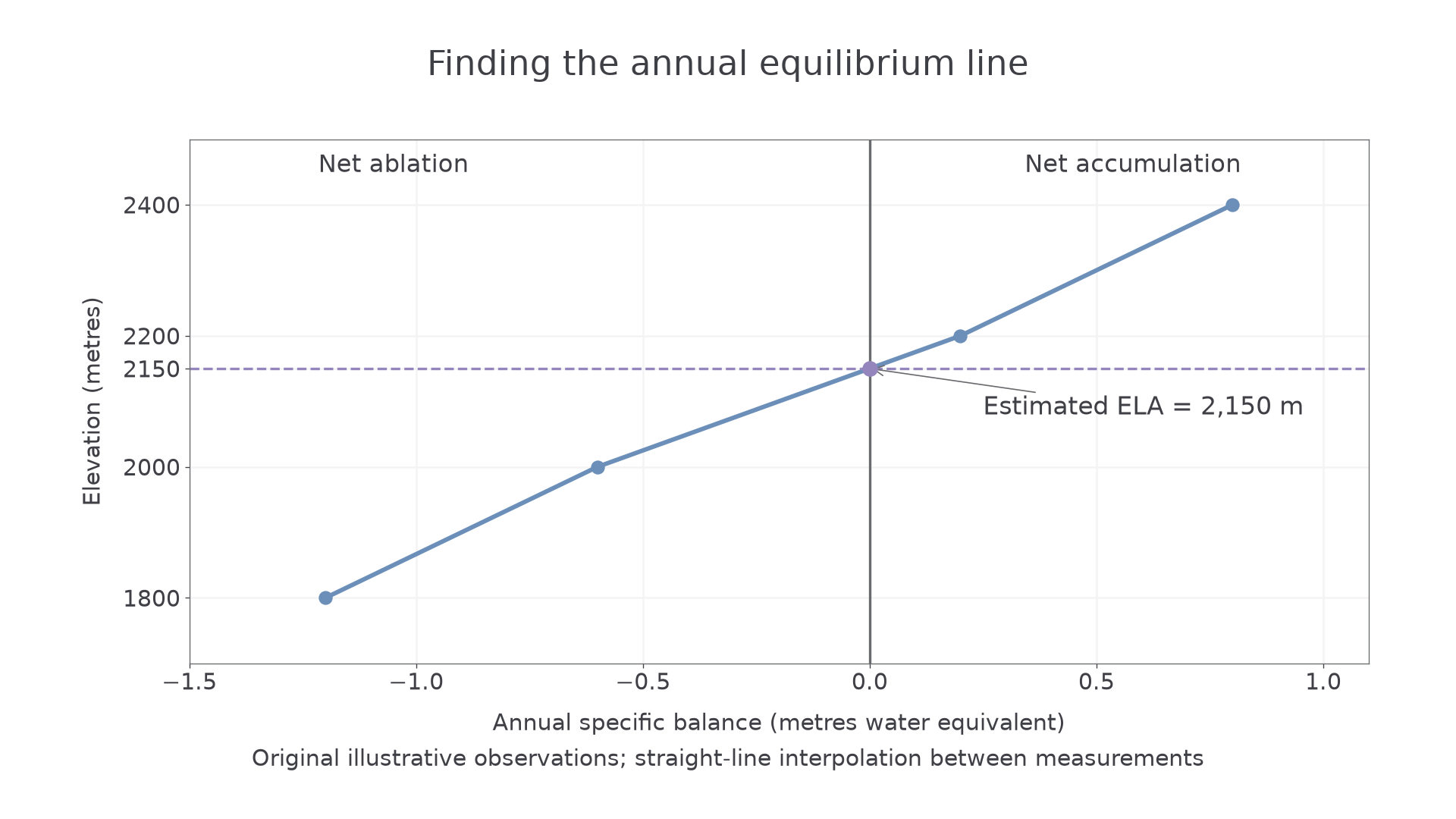
The line joins original illustrative observations. Linear interpolation between 2,000 and 2,200 metres estimates the ELA; it is not a measured zero-balance point.
Zero lies between −0.6 and +0.2. The increase needed from −0.6 to zero is 0.6 out of the total 0.8 increase, so the fraction of the 200-metre altitude interval is . Thus the estimated ELA is metres. This assumes balance changes linearly between those observations. More measurements or strong local shading could change the estimate.
An unweighted mean of these four readings does not automatically give whole-glacier balance. Elevation bands can have different areas; a large low-elevation ablation zone can outweigh a small high-elevation accumulation zone. For bands with known areas, calculate each band's mass change and combine them, or use an area-weighted mean.
In GIS, overlay an accurately dated glacier outline, a digital elevation model and end-of-summer imagery. Dome-like outlines suggest caps; valley-following tongues suggest valley glaciers; interconnected mountain ice with protruding peaks suggests a field. Map the snowline cautiously: the late-summer snowline can approximate ELA in suitable circumstances, but seasonal snow, debris, avalanche deposits and refreezing can cause differences.
Compare outlines and elevations across several years to identify area change and thinning. Use the same coordinate system, comparable seasonal dates and clear image resolution. A high ELA or small accumulation area suggests a poor year, but one image cannot prove a long-term trend or quantify total mass balance. Combine imagery with stakes, snow measurements, repeat elevation surveys or satellite mass estimates as appropriate.
Feedbacks and changing balance over time
A feedback occurs when a system's response changes the original process, reinforcing or opposing the initial change.
Positive feedback amplifies change; it does not mean a beneficial outcome. In Greenland, warming can remove bright snow, expose darker bare ice and increase absorbed solar energy, promoting further melt. Thinning can lower the ice-sheet surface into warmer air, causing more melt and further lowering. These are respectively melt–albedo and elevation–melt feedbacks. Their strength depends on snow renewal, topography and other conditions.
Negative feedback opposes change. A warmer atmosphere can supply more snowfall over Greenland's interior if temperatures remain below freezing. More accumulation adds mass and fresh bright snow can reduce energy absorption, partly opposing the initial loss. On a retreating mountain glacier, removal of the lowest, warmest part of the tongue can reduce the remaining area exposed to intense ablation. This geometric adjustment can move the glacier towards balance under the new climate; it does not restore its former size.
These mechanisms compete. Greenland's relatively cold high interior and lower coastal margins do not respond identically. Surface mass balance includes surface inputs and losses; total ice-sheet balance must also account for ice discharge and relevant basal losses. Positive surface balance therefore does not establish that Greenland as a whole gained mass. Copernicus' account of Greenland's 2019 melt season documents early snow loss and exposure of darker ice as an example of the albedo mechanism; the process is more useful here than treating one exceptional year as a permanent rate.
Timescale changes the interpretation. A hot week can accelerate melt; winter snowfall can compensate for some seasonal loss; several consecutive negative years reduce storage and commonly drive thinning and retreat. Large ice sheets may adjust over centuries to millennia, while smaller glaciers can respond more quickly. The snout response may lag balance changes because stored ice continues to move through the glacier. A few cold years do not necessarily reverse a long period of mass loss.
Separate seasonal fluxes, annual balance, cumulative storage change and delayed geometric response. Feedbacks alter these relationships, but no single loop is a complete prediction.