9GE0/03 - Futures, uncertainties and resource-based judgements
Learn to compare future pathways for a connected water and energy system, interpret uncertain ranges, and justify decisions using risk, resilience and evidence about who may be affected.
Contrasting future pathways
A future pathway combines assumptions about change with choices about how people respond; it is not a guaranteed prediction.
Scenario
A plausible description of a future built from stated, internally consistent assumptions. It explores what could happen under those assumptions, rather than establishing what will happen.
The Kora basin is an original fictional setting. The river flows from Arun to Belen, supporting an export-oriented metal plant, farms, towns and hydropower. Its governments must plan for 2040 while future runoff, demand and international investment remain uncertain. All data below are illustrative scenario values, not measured or forecast evidence about a real basin. The issue connects compulsory Topic 5 water insecurity, Topic 6 energy and carbon, Topic 3 global production networks and Topic 7 international influence.
Three pathways answer the same question: how should the basin provide water, livelihoods and energy?
| Pathway | Objective and main actions | Important constraint |
|---|---|---|
| Business as usual | Expand export production and supply infrastructure; retain existing allocation priorities | Growth in demand can absorb new supply and deepen dependence on river flow |
| Sustainability priority | Retain production but introduce leakage repair, recycling, protected environmental flows and diversified electricity | Requires investment, coordination and enforceable allocations |
| Radical alternative | Restructure the economy towards less water-intensive activities; decentralise renewable electricity and strengthen community allocation | Employment, skills and public revenue must change during the transition |
“Business as usual” means continuation of the stated policy approach, not that nothing changes. A radical alternative changes underlying production or governance rather than just improving efficiency. Neither label establishes the best outcome. Compare feasibility, distribution, time and environmental effects using the same criteria.
Mitigation addresses causes of climate change, for example reducing net greenhouse gas emissions. Adaptation adjusts to actual or expected climate effects, for example drought allocation rules. Diversifying electricity may do both if it replaces fossil-fuel generation and reduces dependence on drought-sensitive hydropower. A strategy's mitigation benefit is global and cumulative; its immediate water-allocation effects may be local and unequal.
Sources of uncertainty
Uncertainty arises from incomplete knowledge and from future processes and decisions that can develop in different ways.
For Kora, scientific uncertainty includes the response of regional rainfall and runoff to future conditions and the accuracy of the basin model. Demographic uncertainty includes future population, household formation and movement into towns. Economic uncertainty includes global demand for metal, energy prices, investment costs and whether firms adopt recycling. Political uncertainty includes elections, contract enforcement and cooperation between Arun and Belen. These types interact: investment may depend on a treaty, while employment changes may alter migration and therefore water demand.
Distinguish observation from projection. A gauge record describes flow at a place and time, subject to measurement and coverage limits. A model projects future flow using assumptions. A high-quality historical record can improve calibration without proving future rainfall or policy. Averaging ten similar model runs does not automatically remove a shared model bias.
Uncertainty is not a reason to treat every outcome as equally likely. If probabilities have a defensible basis, risk can be compared using both likelihood and consequence. If they do not, scenarios allow stress-testing without invented percentages. Also distinguish a stated range from a confidence interval: a scenario range may simply cover the selected assumptions and exclude more extreme possibilities.
Ranges and water balance
A range makes uncertainty visible, but its meaning and the relationships between its endpoints determine what can be inferred.
The original Kora planning team compares usable water supply after environmental reserves, losses and treatment limits with human demand during the same four-month dry season in 2040. Both are in million cubic metres. The ranges cover selected hydroclimatic, uptake and demand assumptions; they are not probability distributions or confidence intervals. The alternative pathways apply to the same basin and period.
| Pathway | Usable dry-season supply (million m³) | Dry-season human demand (million m³) |
|---|---|---|
| Business as usual | 60–90 | 84–102 |
| Sustainability priority | 68–98 | 70–84 |
| Radical alternative | 66–96 | 55–70 |
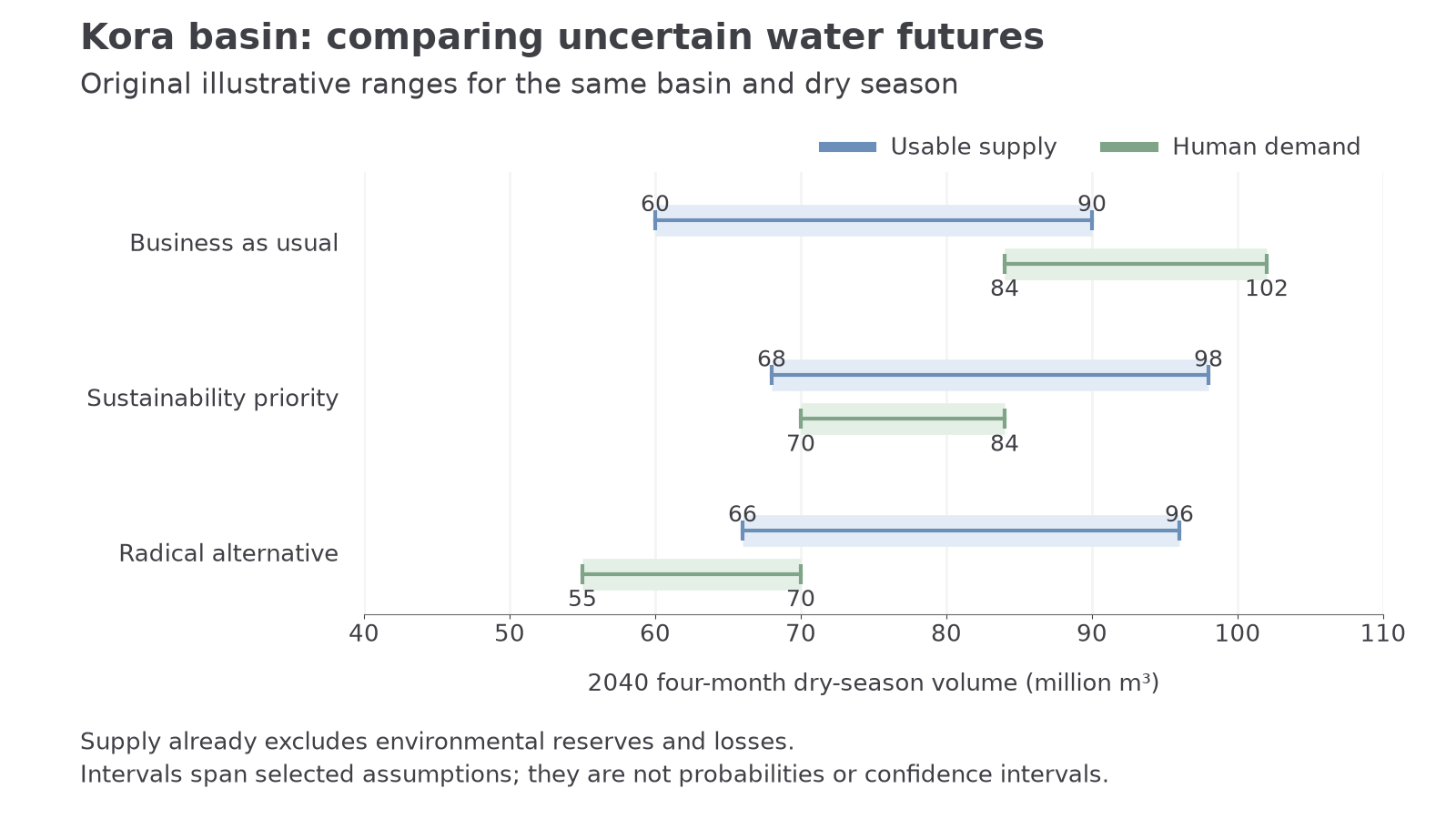
Illustrative 2040 dry-season supply and demand ranges for three Kora pathways. The interval endpoints match the table; the bars do not show probabilities.
Use the same geographical boundary, time period and volume unit. A negative balance is a shortfall; a positive balance is a surplus relative to the stated demand. Environmental reserves are already excluded from usable supply here, so do not subtract them twice.
Continue this lesson.
You’re previewing NovaLearn without an account. Create a free account to read the rest.
Create free account