2A.5 - Glacier movement and its controls
Learn how glaciers move, why thermal and physical conditions change their speed, and how to compare measured movement rates without confusing ice flow with snout advance or retreat.
Polar and temperate movement
Gravity drives ice from areas of higher potential energy towards lower areas, but resistance and ice properties determine its speed.
A temperate glacier is close to its local pressure-melting point through much of its thickness. Water can occur at the bed, allowing sliding as well as internal deformation. A polar glacier contains substantial ice below that melting point; a frozen bed limits sliding, so movement is often slower and dominated by deformation. The pressure-melting point is not necessarily exactly 0°C: pressure alters the melting temperature.
The comparison is a tendency, not a rule that every Arctic glacier is slower than every Alpine one. Thick polar ice sheets may have warm beds due to geothermal energy, insulation and friction, and fast-flowing ice streams. A polythermal glacier contains cold and temperate zones. Conversely, a small, gently sloping temperate glacier need not move rapidly.
Within a valley glacier, resistance at valley walls commonly makes central ice move faster than ice near the sides. If internal deformation dominates, the surface usually moves faster than the bed, which experiences resistance. A warm sliding base adds motion to the whole column. Crevasses form where stresses exceed the brittle strength of near-surface ice; deeper ice can deform without breaking into the same open cracks.
Sliding, regelation and deformation
Several mechanisms contribute to glacier movement, and their relative importance varies between and within glaciers.
Internal deformation, or creep, occurs as ice crystals deform, slip and reorganise under sustained stress. Warmer ice generally deforms more readily, and greater stress produces a much larger deformation rate. Ice is a solid undergoing deformation; a glacier is not a river of liquid water.
Basal slip, commonly called basal sliding, is ice movement over the underlying bed. Meltwater pressure can reduce effective pressure holding ice against the bed, allowing faster sliding and opening small cavities. Water at the bed does not guarantee one fixed speed: drainage efficiency, roughness, pressure and sediment strength also matter. Waterlogged sediment beneath ice can deform, contributing to basal motion.
Regelation helps ice pass small bedrock obstacles when it is sufficiently close to melting conditions. Higher pressure on an obstacle's upstream side lowers the local melting point and permits melting. Water passes towards a lower-pressure zone, where it refreezes. Ice deformation around obstacles also contributes; some teaching describes the combined obstacle-bypassing movement as regelation creep. Do not confuse regelation with the entire glacier melting and flowing as water, or treat pressure melting as the sole source of basal water.
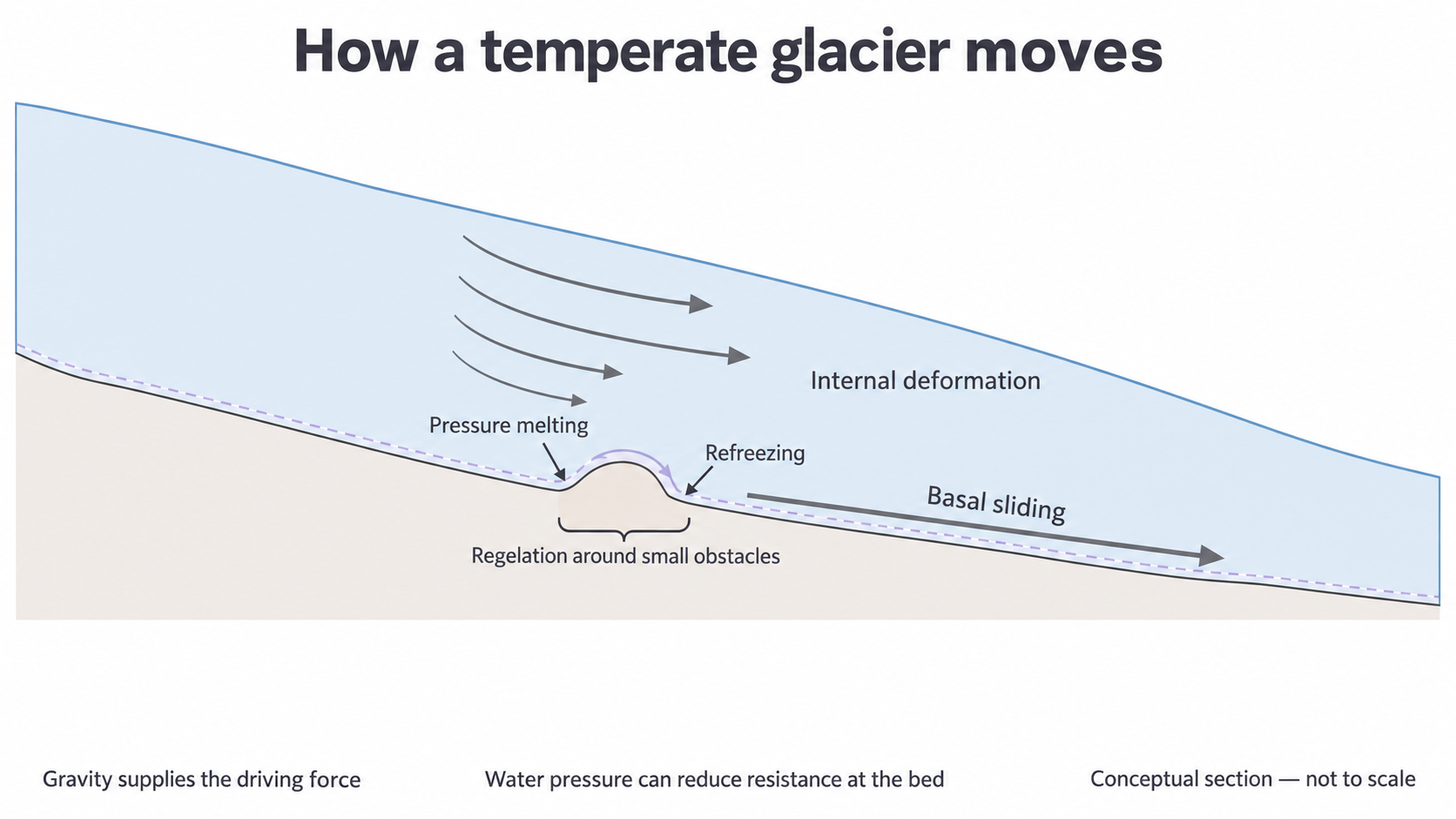
Conceptual temperate glacier section, not to scale. The arrows show mechanisms and direction; their lengths are not measured velocities. Regelation is possible close to local melting conditions.
The processes combine. In a cold frozen-bed sector, sliding and regelation are restricted while internal deformation continues. In a warm wet sector, basal motion can contribute substantially to surface velocity. The surface velocity measured by GPS or satellite feature tracking is therefore not automatically the internal-deformation rate or the basal-sliding rate alone.
Physical controls and movement feedbacks
Movement rates result from interacting controls, so changing one factor does not produce the same response in every glacier.
Increasing slope or ice thickness generally increases gravitational driving stress. A larger glacier may be thicker and heavily stressed, but width or total area alone does not determine velocity. Altitude affects temperature and accumulation; high elevation may keep ice cold while greater snowfall thickens it. These effects can act in opposing directions.
Basal temperature determines whether the bed is frozen or able to support water and sliding. Air temperature is only one influence: thickness, geothermal heat and friction affect the base. Lithology matters through bed roughness, jointing and production of sediments. A rough rocky bed can resist sliding; a weak, water-rich sediment bed can deform. The same rock type does not impose one universal rate because water pressure and sediment thickness differ.
Mass-balance variations change thickness, surface slope and meltwater supply. Increased snowfall can eventually thicken ice and increase driving stress. Summer meltwater reaching a poorly drained bed can raise water pressure and accelerate sliding. A possible positive loop is faster sliding producing frictional heat, allowing more basal melt and reduced resistance. It is conditional: additional meltwater need not always increase speed.
A negative response can occur when rising meltwater discharge enlarges efficient drainage channels. Better drainage lowers water pressure, increases effective bed contact and slows sliding compared with the initial speed-up. Over longer periods, thinning can reduce driving stress and slow flow, even while the snout retreats. Feedbacks therefore change with drainage development and timescale.
Glacier advance and retreat describe snout position. Faster ice can still feed a retreating snout if ablation is greater than the incoming supply. A glacier can also advance after increased accumulation without every part speeding up immediately. Always distinguish velocity of ice, rate of mass loss and rate of margin movement.
Comparing measured movement rates
Rates and summary statistics make comparisons useful only when measurement locations, intervals and units are comparable.
For a marker tracked between two surveys, rate equals displacement divided by elapsed time. A 6-metre displacement in 20 days gives metres per day. Use the direction and length of the displacement vector, not just a change in northing. Survey uncertainty and movement of the reference point affect the result.
Consider original illustrative daily velocities at five surface markers measured over the same 30-day summer period:
| Glacier dataset | Marker velocities (metres per day) |
|---|---|
| A | 0.10, 0.12, 0.12, 0.14, 0.52 |
| B | 0.16, 0.17, 0.18, 0.19, 0.20 |
The mean is the sum divided by the number of observations. The median is the middle value after sorting; for an even number, average the two middle values. The mode is the most frequent value. Range is maximum minus minimum and describes spread rather than central tendency.
A's sum is 1.00, so its mean is 0.20 metres per day. Its median and mode are both 0.12, and its range is 0.42. B's mean and median are both 0.18 and its range is 0.04; it has no repeated value, so no mode. A has a higher mean but a lower median. Its unusually fast marker strongly raises the mean, whereas B's markers are tightly clustered.
Neither average proves which entire glacier moves faster. A may include one icefall marker while B samples a uniform central reach. Compare similar positions, use adequate spatial coverage, repeat in different seasons and state sample sizes. Do not simply delete A's 0.52: check whether it is a recording error, unusual but real movement, or a genuinely different process zone. With five values, the summaries alone do not establish statistical significance or identify the cause of the contrast.