2B.6 - Weathering and coastal mass movement
Learn how weathering supplies sediment and weakens coastal slopes, why different failures occur, and how scars, scree and terraced profiles reveal mass movement.
Weathering weakens rock in place
Weathering breaks down or alters material where it lies, before erosion or gravity transports it away.
Subaerial weathering
Physical, chemical or biological breakdown of rock exposed to the atmosphere. It differs from erosion because transport is not required for the breakdown itself.
Mechanical weathering breaks rock without changing its mineral composition. In freeze–thaw, water enters fractures and repeated freezing can expand or widen them; effective frost weathering requires suitable temperatures and a water supply, so it is not equally important on every coast. Salt crystallisation occurs as saline water evaporates and crystals grow within pores or cracks, exerting pressure and loosening grains. Alternating wetting and drying can swell and shrink clay-rich material, reducing its integrity.
Chemical weathering changes minerals through reactions. Weakly acidic rainwater formed when carbon dioxide dissolves in water reacts with carbonate minerals, dissolving limestone and widening cracks. Hydrolysis can alter feldspar minerals into clay, weakening some crystalline rocks. Temperature, water availability, exposed surface area and mineral composition influence reaction rates. Mechanical fragmentation increases exposed surface area and can therefore assist chemical attack.
Biological weathering includes roots widening existing cracks and organisms producing organic acids that aid chemical reactions. Do not assume every plant destabilises a cliff: roots may also bind loose sediment and increase slope resistance. The effect depends on material, rooting pattern and scale.
Weathering supplies grains and fragments for beaches and abrasion. It also reduces cohesion or weakens joints, making subsequent failure easier. Sediment remains in place until it falls, washes away or is carried by waves or wind. Marine removal of fallen material can expose fresh rock, allowing weathering and erosion to continue together.
Why slopes fall, slump or slide
Mass movement occurs when gravity-driven forces exceed the resistance of rock or sediment on a slope.
Weathering can reduce strength. Rainfall can add weight and raise pore-water pressure, the pressure of water between particles or along fractures; this reduces effective contact and frictional resistance. Wave erosion can remove support at the foot and steepen the slope. A failure may require several conditions to coincide, with rainfall or a storm acting as the immediate trigger rather than the only cause.
Blockfall, a form of rockfall, occurs when a joint-bounded block detaches from a steep face and falls, bounces or rolls downslope. Undercutting and weathering can isolate it. Strong bedrock can suffer blockfall because the failure follows weaknesses between strong blocks.
Rotational slumping moves a mass along a curved, concave-up failure surface. The block rotates as it moves down and outward; its upper surface can tilt back towards the cliff. It is common in some weak, water-sensitive or unconsolidated materials. Multiple failures can form steps as separate blocks rotate, and a failed mass can break up into other movements.
A translational landslide moves material along a comparatively planar surface, for example a seaward-dipping bedding plane or a boundary between layers. It differs from rotation because the mass mainly translates down the plane. “Landslide” is also used as a broad term for slope failures; be precise about the movement when interpreting a resource.
At Aldbrough on the East Riding of Yorkshire coast, BGS identifies rotational slumping as a principal movement, with secondary topples and falls. This is evidence that one coastline can contain several failure mechanisms. Do not assume a single process label explains every fresh scar or that the absence of rainfall on the day means groundwater played no role.
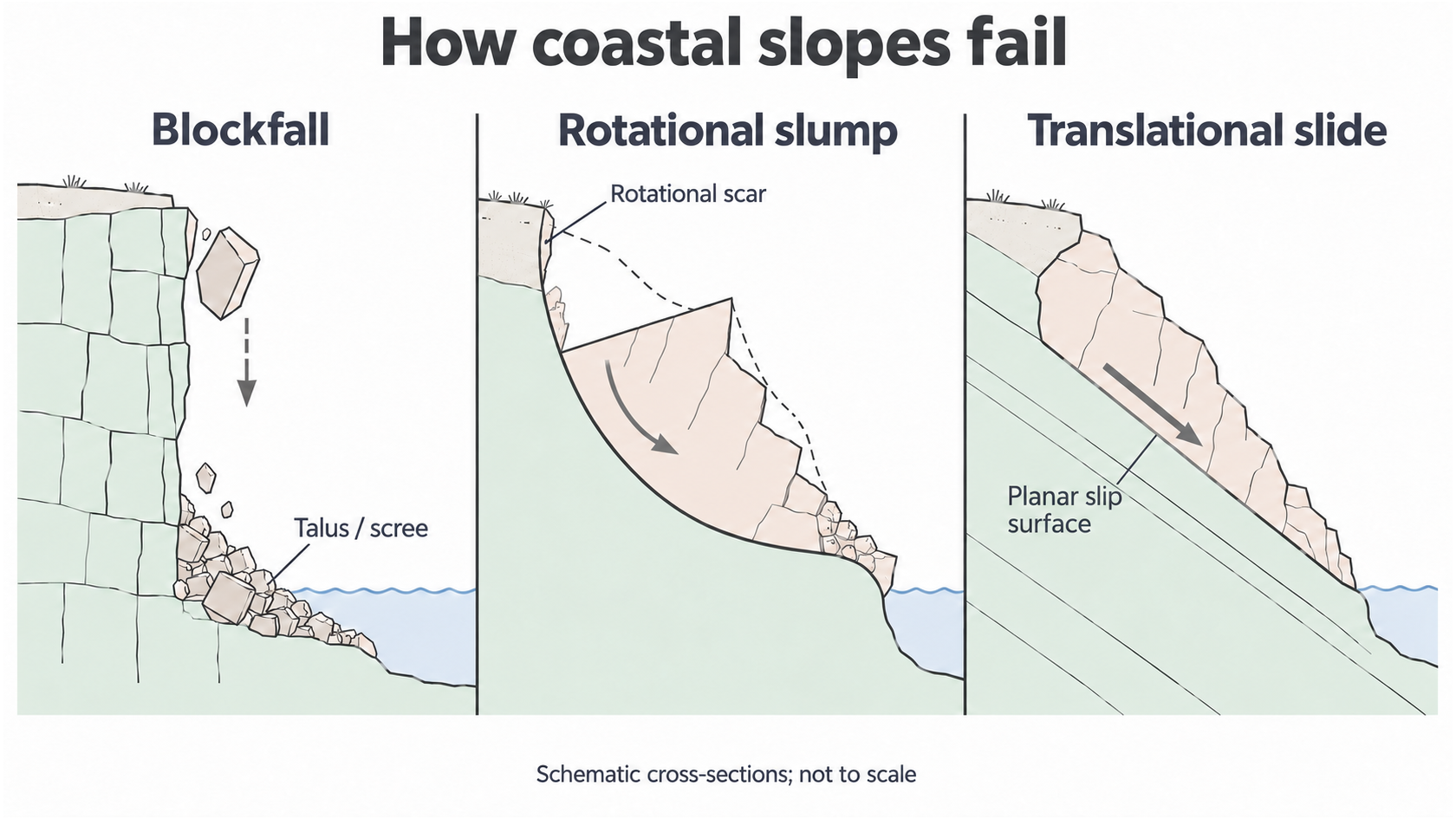
Schematic cross-sections distinguish free fall, curved rotational movement and translation along a plane; they are not to scale.
Reading scars, scree and terraced profiles
The shape and arrangement of displaced material can distinguish mechanisms, but no single feature is a complete record of past movement.
A rotational scar or head scarp is the steep curved face left where a mass pulls away. Behind it, tension cracks may mark developing failure; below it, back-tilted blocks and a bulging toe strengthen the interpretation of rotation. Several slumps can leave a terraced cliff profile, with benches and subsidiary scarps. Terraces alone are ambiguous because differential erosion of horizontal beds can also create steps. Look for displaced layers, curved scars and rotated surfaces before assigning a process.
A talus or scree slope is an accumulation of angular rock fragments beneath a steep rock face, supplied by falls and weathering. Its angle depends on grain size, shape, friction and water; it need not have one universal angle. At an exposed coastal foot, waves may remove fragments rapidly, leaving only a temporary debris apron. A small deposit therefore does not prove little mass movement occurred: it may indicate efficient marine removal.
Translational sliding can leave a relatively straight scar, an exposed planar surface and a displaced mass downslope. Mixed failures can blur this pattern. Record whether the observed cliff is freshly active, partly revegetated or an old deposit being eroded. Vegetation may suggest time since disturbance, but is not a precise clock.
Marine and subaerial processes form a cycle: weathering and water weaken the slope, gravity delivers debris, and waves remove it. Debris can temporarily protect the cliff foot, counteracting further marine erosion; renewed removal restores attack. This explains why recession can be episodic and why a cliff profile reflects both the failure process and what happened to its debris afterwards.