5.8 - Water insecurity, wellbeing and conflict
Learn why physical and economic scarcity differ, how water poverty affects development and wellbeing, and how seasonal international rivers create competing interests and opportunities for cooperation.
Physical scarcity, economic scarcity and price
Physical water scarcity occurs when available water cannot sustainably meet demand, including environmental needs. Aridity, seasonal low flow and heavy abstraction can create it. Economic water scarcity occurs when water exists but inadequate finance, infrastructure or institutions prevent reliable access. These causes can coexist: a village may lack a functioning pump in a drought-prone basin. National wealth is relevant to coping capacity, but does not give every household equal access.
Broad global patterns reflect both sets of causes. Arid regions of North Africa and western Asia face restricted renewable supply; rapidly growing irrigated regions also experience physical pressure. Economic barriers are significant in many poorer rural and informal urban communities, including parts of sub-Saharan Africa. These are spatial tendencies, not uniform country categories: wet regions can contain underserved communities and arid high-income places can finance reliable treatment and distribution. FAO's scarcity framework, 2012 distinguishes resource, infrastructure and institutional constraints.
The water bill reflects treatment, energy, storage, pipe networks and maintenance as well as physical supply. A gravity-fed local source differs in cost from pumped, desalinated water. Subsidies, metering, regulation and cross-subsidies redistribute costs; a low tariff may encourage use or leave a utility unable to maintain pipes. People outside the piped network may pay private vendors a high unit price and spend time collecting water even in a water-rich city. A high price is therefore not proof of low rainfall. Compare the same quantity, quality and service, and express affordability as a share of income before comparing households.
Water poverty profiles
A water-poverty index combines dimensions that a freshwater-per-person measure misses. The established WPI approach considers resources, access, capacity, use and environment. Resources describe quantity/reliability; access describes reaching suitable water; capacity concerns financial and human ability to manage it; use concerns water's roles; environment concerns ecological condition. Index definitions, normalisation and weights must be checked before comparison. UN environmental-accounting handbook discussion.
The following original illustrative scores run from 0 to 100, where higher means a better condition. H is an illustrative higher-income country and L an illustrative lower-income country; they are not observations or labels for real countries.
| Component | H | L |
|---|---|---|
| Resources | 30 | 80 |
| Access | 90 | 35 |
| Capacity | 85 | 25 |
| Use | 70 | 40 |
| Environment | 60 | 50 |
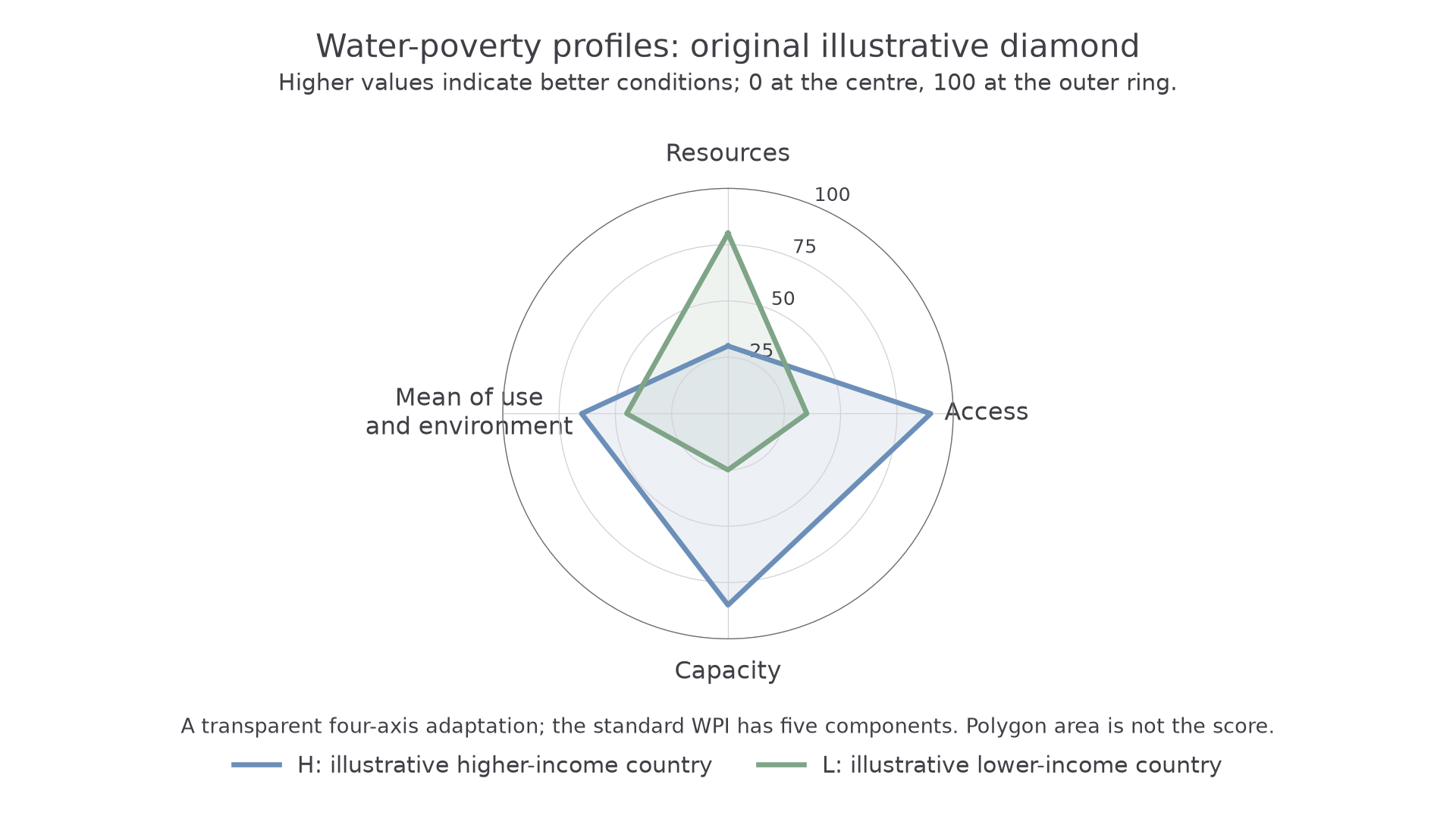
The diamond displays resources, access, capacity and the mean of use/environment. All five original values remain in the table; the combined axis is a transparent teaching adaptation, not the standard five-component WPI.
Read each axis from the centre outward and compare the same component. L has better resources, but weaker access and capacity; abundant natural water has not become a reliable service. H has scarce natural resources but stronger infrastructure/management. The equal-weight five-component means are for H and for L. Do not take the mean of the four displayed axes: that would underweight use and environment together. Polygon area is also not the index score, because it depends on axis order and shape. Aggregates conceal rural/urban and income differences and can hide the weakest dimension; inspect the profile before prescribing investment.
Development, health and environments
Water supports development through irrigated crops, industrial processing and energy production. Inadequate irrigation lowers yields and farm income; unreliable industrial supply interrupts output and employment. Hydropower depends on flow and head, while some thermal power stations need cooling water. Energy is also required to pump and treat water, so an electricity failure can disrupt supply and a water shortage can disrupt electricity.
Continue this lesson.
You’re previewing NovaLearn without an account. Create a free account to read the rest.
Create free account