9.6P-9.9P - Moments, levers and gears
A door turns more easily when pushed far from its hinges. Use force and perpendicular distance to calculate moments, balance opposing turning effects, and explain how levers and gears transmit them. These separate-Physics statements apply to both tiers.
Forces that turn
Push a door at its handle and it turns about its hinges. Push the same door with the same force close to the hinges and the turning effect is smaller. A force can change an object's rotational motion when its line of action does not pass through the object's pivot or axis.
The pivot is the point or axis about which an object can rotate. The line of action is an imaginary straight line extending through a force arrow in the force's direction. These are features of a model: the line is not a physical cord or track.
The turning effect of a force about a pivot is called its moment. A moment has a sense:
- clockwise if the force tends to turn the object in the direction of a clock's hands;
- anti-clockwise if it tends to turn the object in the opposite direction.
Always judge the sense from the same viewpoint and about the named pivot. A downward force on the right of a seesaw's central pivot causes a clockwise moment; the same downward force on the left causes an anti-clockwise moment.
[DIAGRAM: asset_name: 38_1PH0-P2-09B_9.6P-9.9P - Moments, levers and gears - diagram 01; asset_slug: 38_1ph0-p2-09b_9-6p-9-9p-moments-levers-gears_diagram_01; recommended_method: image_gen; description: monochrome scientific schematic of a sloping rigid bar about a labelled pivot, with downward force arrow, extended line of action, shortest perpendicular distance, and right-angle marker]
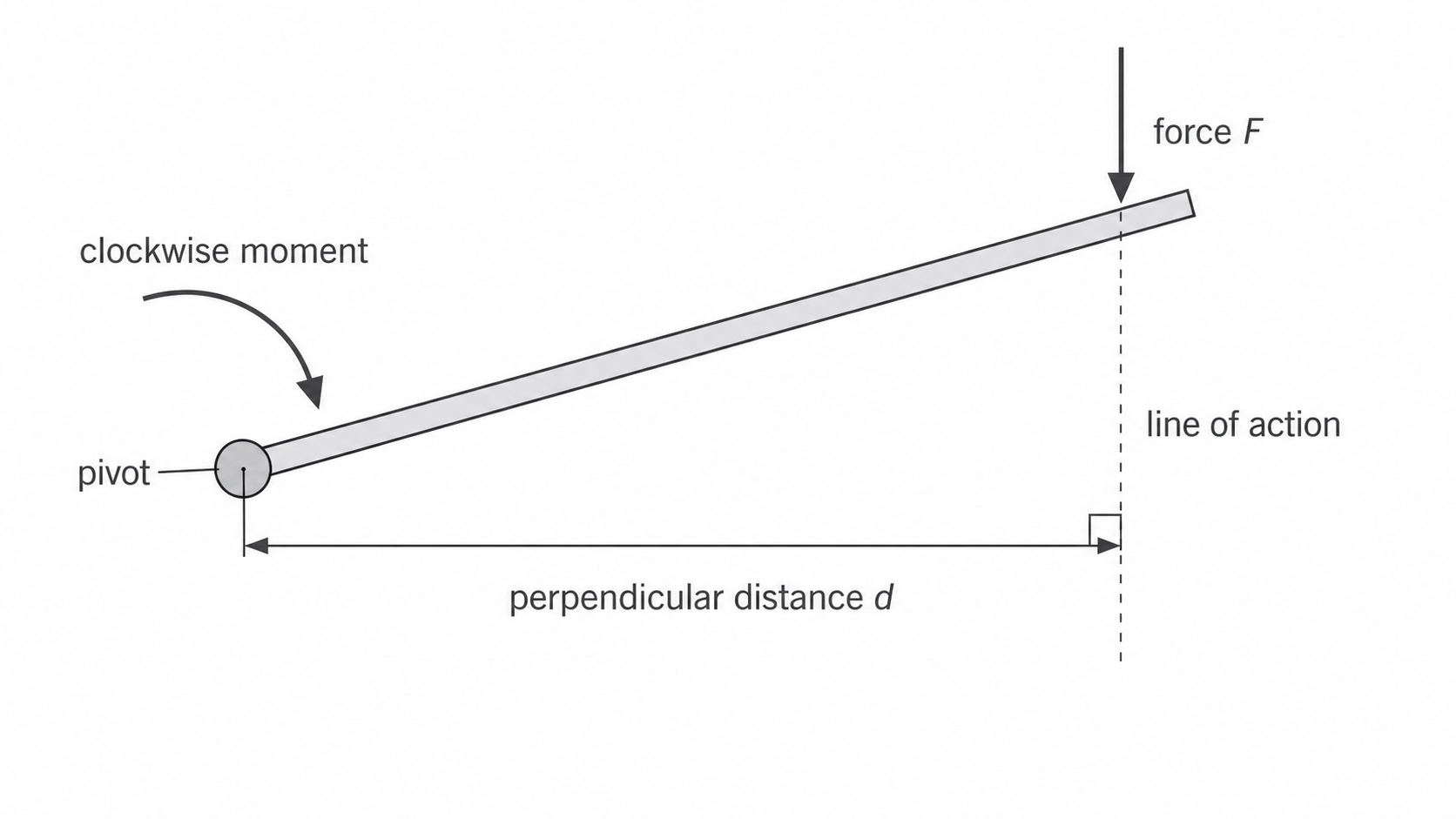
The relevant distance is the shortest distance from the pivot to the force's line of action. It must meet that line at 90 degrees, so it is called the perpendicular distance or the distance normal to the direction of the force. It is not necessarily the full length of the bar.
If a force's line of action passes through the pivot, the perpendicular distance is zero. The force then has zero moment about that pivot, however large the force is. This is why pushing a door directly towards its hinges is ineffective at turning it.
Everyday situations involving moments include:
- a hand turning a spanner about the centre of a nut;
- a child making a seesaw rotate about its central support;
- a foot turning a bicycle crank about its axle;
- a hand using a door handle to rotate the door about its hinges.
A moment is the turning effect of a force about a specified pivot or axis. Its size depends on the force and the perpendicular distance from that pivot to the force's line of action.
Calculating a moment
For a force acting about a pivot:
- is the moment in newton metres, .
- is the force in newtons, .
- is the shortest perpendicular distance in metres, .
This relationship is provided on the Edexcel equation sheet, but you must still select the correct distance, convert it to metres, substitute and give the result in . Write the unit as , not : a moment is a turning effect, whereas a joule measures energy.
Worked example: turning a valve
A technician pushes down with a force of on a horizontal handle. The force's line of action is from the valve's pivot. Calculate the moment.
First convert the perpendicular distance:
Choose the moment equation and substitute:
Both measurements are given to two significant figures, so is appropriate. The result is sensible: because the distance is only one quarter of a metre, the numerical value of the moment is one quarter of .
The equation can also be rearranged. If a moment of is produced by a force, then:
Rotational equilibrium
Two unequal forces can balance rotationally. What matters is not force alone but each force multiplied by its perpendicular distance from the pivot.
For rotational forces in equilibrium:
This is the principle of moments. In a balanced, stationary beam, there is no resultant turning effect, so its rotational motion does not change. Several moments in the same sense must be added before the clockwise and anti-clockwise totals are compared.
A support force acting at the pivot has zero moment about that pivot because its perpendicular distance is zero. This does not mean the support force is absent; it means choosing the pivot as the reference removes its turning effect from the moments calculation.
Worked example: balancing a display arm
A light horizontal arm is balanced about a pivot. A downward force acts to the left of the pivot. A downward force acts to the right.
The left force produces an anti-clockwise moment:
For equilibrium, the clockwise moment on the right must also be :
Check both sides:
The forces are unequal, but their moments are equal and opposite. The smaller force is farther from the pivot. In a fully stationary beam the upward support force also balances the downward forces, but it has zero moment about the pivot. Zero resultant moment concerns rotation; zero resultant force concerns translation.
Continue this lesson.
You’re previewing NovaLearn without an account. Create a free account to read the rest.
Create free account