7.8P-7.15P - Big Bang, red-shift and CMB
Use wave measurements to explain galaxy red-shift and test two models of the Universe. Distinguish evidence shared by both models from the microwave background that favours a hot early Universe.
Two models of the Universe
A scientific theory is an explanation that must be tested against observations. Two theories were once serious rivals for explaining the origin and large-scale behaviour of the Universe. They agreed about one important observation but disagreed about whether the Universe had a beginning.
| Feature | Big Bang theory | Steady State theory |
|---|---|---|
| Beginning | The Universe began in an extremely hot, dense state. | The Universe has always existed, so it has no beginning. |
| Expansion | The Universe expands. | The Universe expands. |
| Change over time | As it expands, the Universe cools and its large-scale state changes. | On a large scale, the Universe has the same overall appearance at all times. |
| Matter | Matter was present in the early Universe and later formed structures such as galaxies. | New matter is continuously created as the Universe expands, keeping its average density roughly constant. |
The Big Bang is not modelled as an ordinary bomb exploding from one place into empty space. The model concerns the expansion and evolution of the Universe itself from a hot, dense early state.
This comparison creates a useful evidence question: because both theories include expansion, evidence for expansion can support both. Scientists need an observation that one theory predicts more successfully than the other.
Relative motion changes observed waves
Imagine a source emitting wave crests at regular time intervals. If the source and observer are not moving relative to each other, successive crests reach the observer with their usual spacing and frequency.
If the source moves towards the observer, each new crest is emitted from a position closer to the observer. The crests arrive closer together, so the observer detects a shorter wavelength and a higher frequency.
If the source moves away from the observer, each new crest is emitted from a position farther from the observer. The crests arrive farther apart, so the observer detects a longer wavelength and a lower frequency. This change caused by relative motion is called the Doppler effect.
[DIAGRAM: asset_name: 32_1PH0-P1-07B_7.8P-7.15P - Big Bang, red-shift and CMB - diagram 01; asset_slug: 32_1ph0-p1-07b_7-8p-7-15p-big-bang-red-shift-cmb_diagram_01; recommended_method: matplotlib; description: two-panel precisely constructed wavefront model with a moving source approaching and receding from a fixed observer, showing correct arrow directions and paired wavelength-frequency changes]
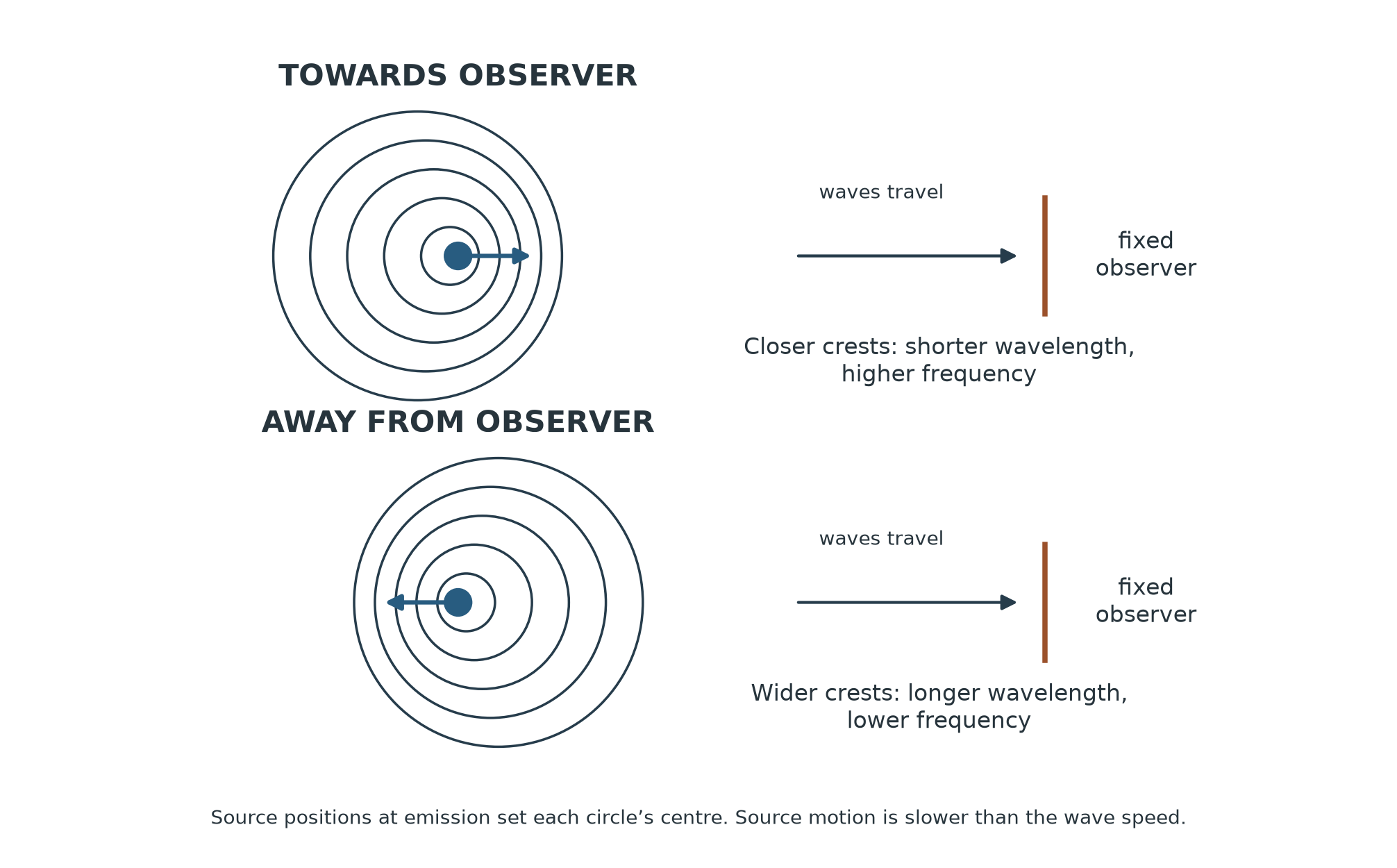
The change is in the wavelength and frequency observed because of relative motion. It does not mean that distance alone changes a wave, and the wavefront lines in the model are a representation of equal-phase positions, not tracks followed by particles.
This moving-source wavefront model explains the direction of the Doppler change. For light crossing the expanding Universe, the expansion of space stretches wavelength; it is not simply a sound wave travelling through a material medium.
Spectral lines reveal red-shift
Light from a source can be spread into a spectrum. Atoms absorb particular wavelengths, producing a recognisable pattern of dark spectral lines. Scientists can compare the pattern in light from a galaxy with the reference pattern for the same atoms measured on Earth.
For most distant galaxies, the whole pattern appears at longer wavelengths, shifted towards the red end of the visible spectrum. This is red-shift. The name describes a shift in measured wavelength; it does not mean that a galaxy simply looks red.
[DIAGRAM: asset_name: 32_1PH0-P1-07B_7.8P-7.15P - Big Bang, red-shift and CMB - diagram 02; asset_slug: 32_1ph0-p1-07b_7-8p-7-15p-big-bang-red-shift-cmb_diagram_02; recommended_method: matplotlib; description: exact monochrome wavelength-axis plot comparing a reference spectrum, a nearer galaxy and a more distant galaxy, with the same five-line pattern shifted progressively right]
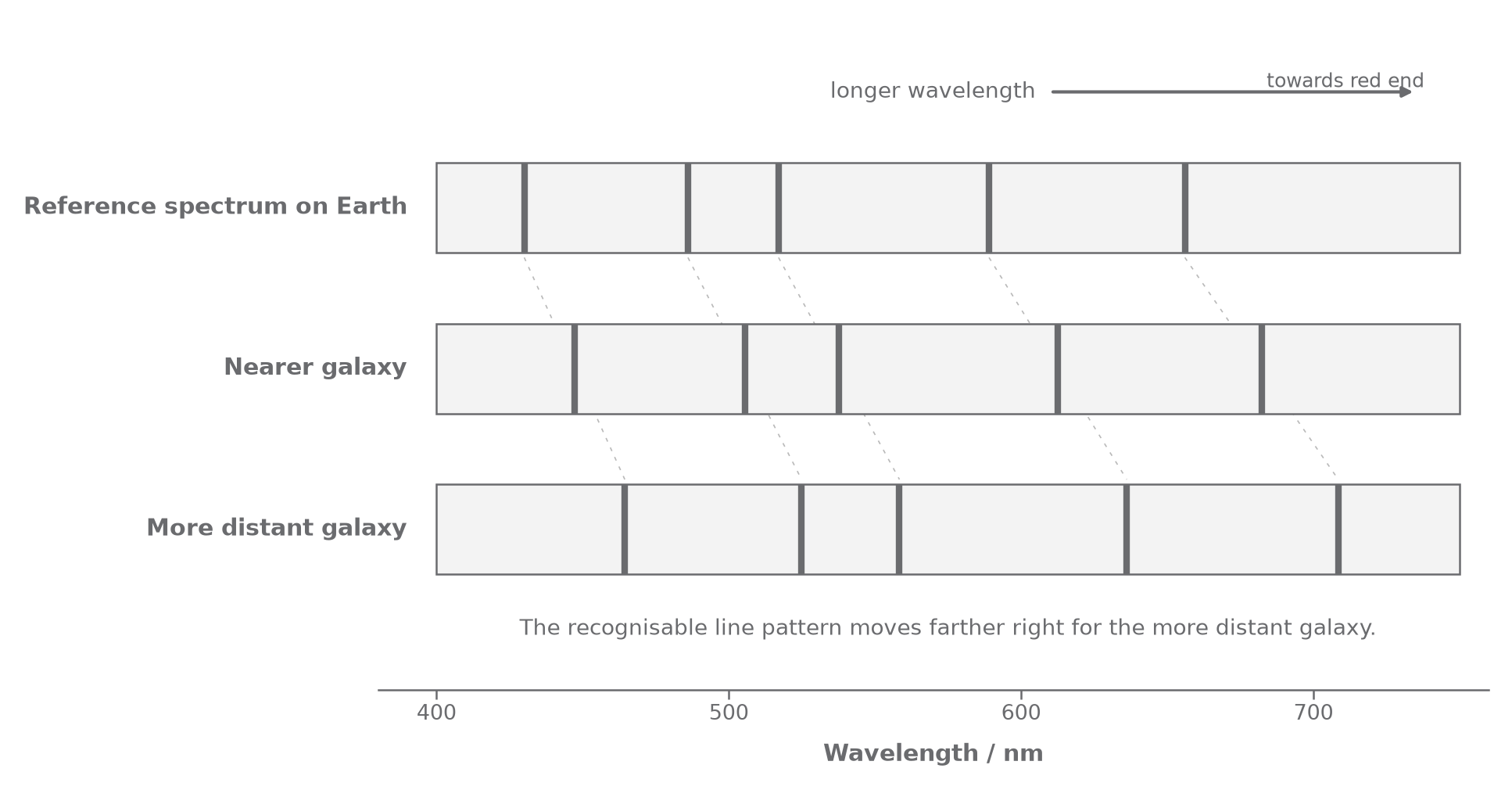
The evidence forms a chain:
- A shift to longer wavelength shows that the galaxy is moving away from us.
- On large scales, more distant galaxies generally show a greater red-shift than nearer galaxies. Nearby gravitationally bound galaxies can have additional motions; the statement describes the overall distance–red-shift trend.
- A greater red-shift means a greater recession speed, so more distant galaxies are moving away faster.
- Galaxies becoming farther apart in this systematic way is evidence that the Universe is expanding.
Continue this lesson.
You’re previewing NovaLearn without an account. Create a free account to read the rest.
Create free account