6.7-6.9 - Electron energies and positive ions
Follow energy as a bound electron changes level, then distinguish that change from an electron leaving the atom altogether. The same charge model explains why removing a negative electron creates a positive ion.
Electron orbits and electromagnetic radiation
In the GCSE shell model, electrons occupy different set distances from the nucleus, often called orbits, shells or energy levels. They cannot remain at any distance between these allowed levels.
This model is useful for tracking energy changes, but the circular shell lines in a diagram are not literal tracks followed by tiny planets. Modern atomic physics describes regions where an electron is likely to be found; the set-distance model is a simplified representation required here.
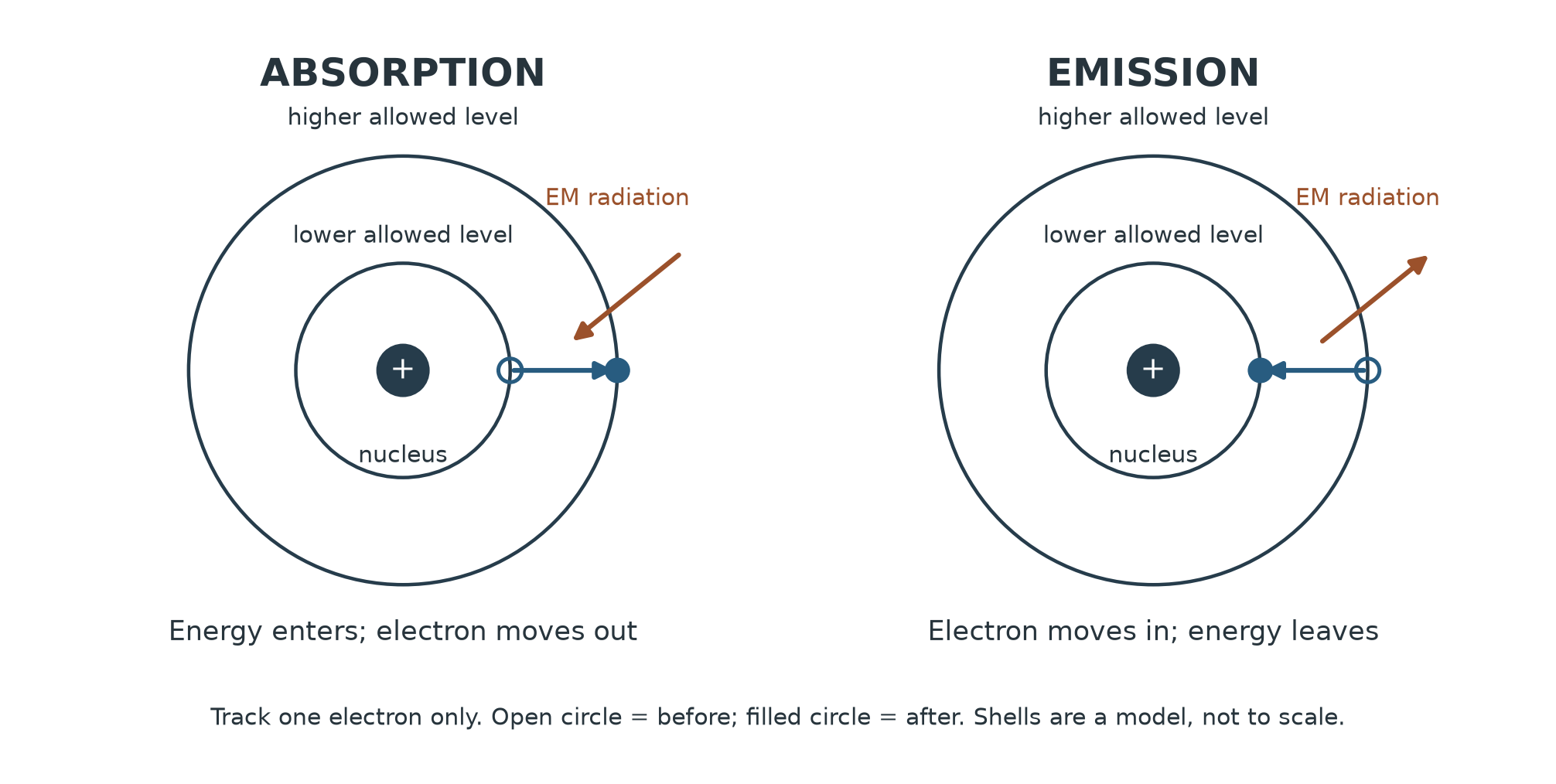
An electron changes orbit when energy is transferred by electromagnetic radiation:
- Absorption: an electron absorbs electromagnetic radiation, gains energy and moves from a lower orbit to a higher orbit farther from the nucleus.
- Emission: an electron moves from a higher orbit to a lower orbit closer to the nucleus and transfers the lost energy away as emitted electromagnetic radiation.
The energy absorbed or emitted matches the difference between the two allowed energy levels. A transition therefore involves both an electron movement and an energy transfer. The radiation is absorbed or emitted; the electron itself is not emitted merely because it changes orbit.
[DIAGRAM: asset_name: 24_1PH0-P1-06A_6.1-6.9 - Atomic structure, isotopes and ions - diagram 01; asset_slug: 24_1ph0-p1-06a-electron-transitions_diagram_01; recommended_method: matplotlib; description: a precise precisely constructed two-panel shell-model diagram showing electromagnetic absorption moving one electron outward and emission returning it inward with unambiguous energy-transfer arrows]
Continue this lesson.
You’re previewing NovaLearn without an account. Create a free account to read the rest.
Create free account