5.15P-5.18P - Thermal radiation and Earth's temperature
Explain how temperature changes thermal emission. At Higher tier, compare incoming and outgoing radiation to predict the temperature of a body or the Earth.
How temperature changes thermal emission
Every body above absolute zero emits electromagnetic radiation. At everyday temperatures, most of this thermal radiation is infrared, so human eyes cannot see it even though a thermal camera can detect it. The waves carry energy away from the body; matter is not carried away overall.
An object emits a range of wavelengths rather than one wavelength only. An emission spectrum shows how the radiation's intensity is distributed across wavelength:
- the horizontal axis is wavelength;
- the vertical axis is spectral intensity, meaning how strongly the body emits at each wavelength;
- the highest point is the peak wavelength, where the intensity is greatest.
[DIAGRAM: asset_name: 20_1PH0-P1-05D_5.15P-5.18P - Thermal radiation and Earth's temperature - diagram 01; asset_slug: 20_1ph0-p1-05d_5-15p-5-18p-thermal-radiation-earths-temperature_diagram_01; recommended_method: matplotlib; description: exact spectral-intensity graph for the same idealised body at 300 K and 450 K, showing higher overall intensity and a shorter peak wavelength at higher temperature]
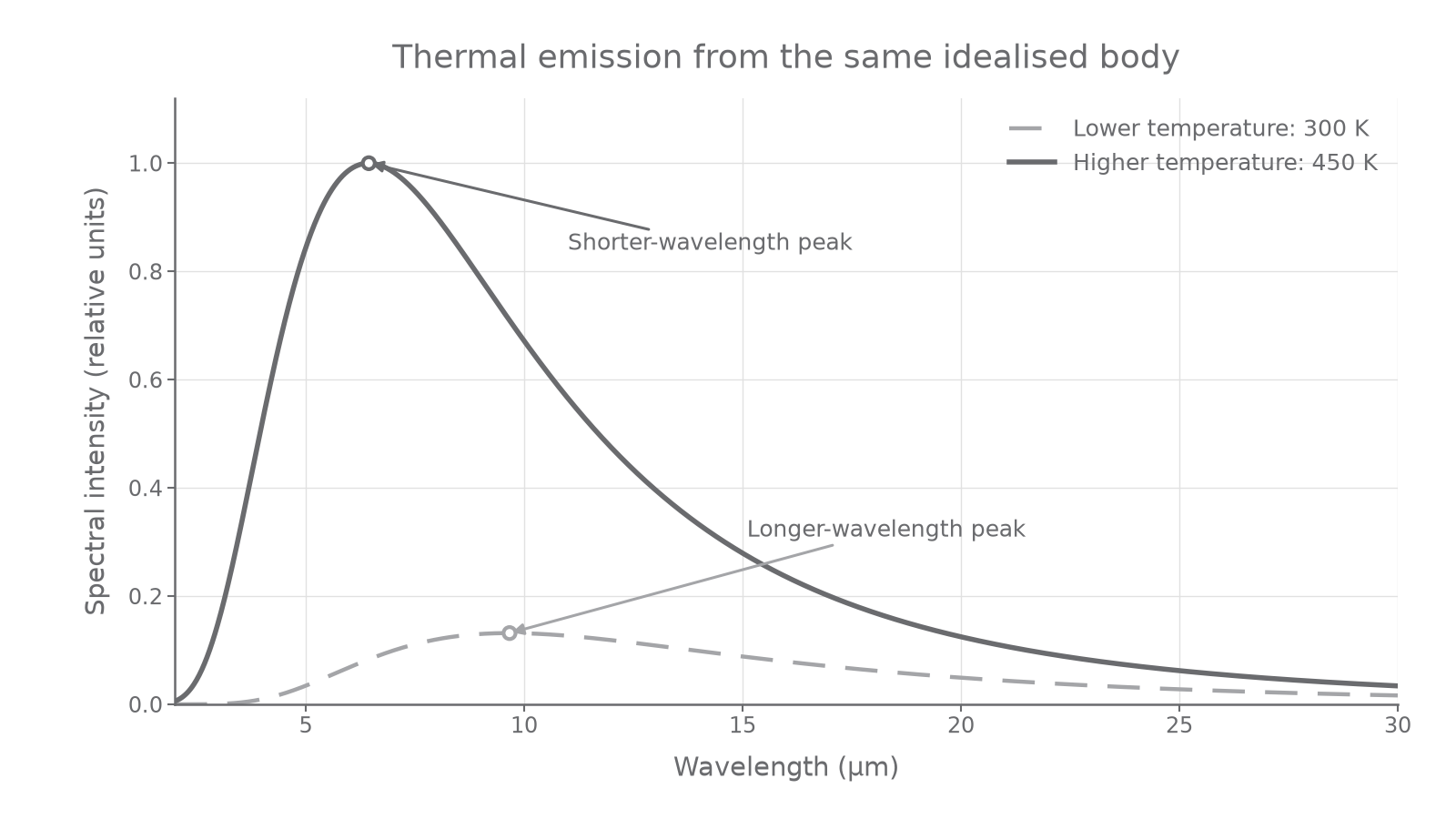
The graph compares the same idealised body at two temperatures. At 450 K, the curve is higher, so the body emits more intense radiation. Its peak is also at a shorter wavelength than at 300 K. The shape and position of the whole distribution change with temperature: a body does not suddenly stop emitting all wavelengths except the peak.
Increasing temperature increases the intensity of the emitted radiation and moves the peak of its wavelength distribution to a shorter wavelength.
Average power balance (Higher tier)
Power is the rate at which energy is transferred: it tells us how much energy is transferred each second. Let be the average power a body absorbs from its surroundings and be the average power it emits as radiation.
For constant temperature:
This is a model in which radiation is the only significant energy transfer and there is no phase change or internal power source. If conduction, convection or electrical heating also matter, they must be included in the complete energy balance.
This is a dynamic balance. Radiation still enters and leaves the body, but its thermal energy store has no average net change, so its temperature remains constant. The word average allows for small changes from moment to moment; the powers are compared over the same time interval.
| Power comparison | Change in thermal energy store | Temperature response |
|---|---|---|
| net energy enters | temperature rises | |
| no average net change | temperature stays constant | |
| net energy leaves | temperature falls |
Temperature itself helps restore balance. Suppose a cool object is placed near a steady radiant heater. At first, it absorbs more power than it radiates, so it warms. As its temperature rises, its emitted radiation becomes more intense, so increases. If the heater stays steady, the object reaches a higher constant temperature when the two average powers become equal.
The reverse happens during cooling. If a hot object radiates more power than it absorbs, its thermal energy store and temperature fall. Its radiated power then decreases until a lower-temperature balance may be reached.
Continue this lesson.
You’re previewing NovaLearn without an account. Create a free account to read the rest.
Create free account