5.7-5.8, 5.10-5.14 - Electromagnetic spectrum
Explore the continuous electromagnetic spectrum, its shared properties and visible colours. The final two parts explain wavelength-dependent interactions and refraction at Higher tier.
One family of energy-transfer waves
Pressing a television remote can make a detector respond even though your eyes see no beam. The infrared radiation from the remote and the visible light from the screen belong to the same family: electromagnetic waves. Radio waves, microwaves, ultraviolet, x-rays and gamma rays are members of that family too.
All electromagnetic waves are transverse. This means that their oscillations are perpendicular to the direction in which the wave and its energy travel. A transverse wave drawing is a representation of changing electric and magnetic fields; it is not a trail followed by moving matter.
All electromagnetic waves travel at the same speed in a vacuum:
speed of electromagnetic waves in a vacuum = 3.00 × m/s approximately
This is true for radio waves and gamma rays as well as visible light. It does not mean that all EM waves have the same frequency or wavelength, and it does not mean that their speeds must stay equal inside every material.
Every electromagnetic wave transfers energy from a source to an observer. Here, an observer can be a person, a detector or any material that receives the radiation; it does not need to be a human eye.
- A lamp is a source of visible light. An eye or light sensor receives some of the transferred energy.
- The Sun is a source of visible and infrared radiation. A solar panel or the ground can receive this energy.
- A transmitting aerial is a source of radio waves. A receiving aerial is an observer in which the wave's energy makes charges oscillate.
The wave can also carry information, but carrying information still involves transferring energy. It does not transport matter from the source to the observer overall.
Ordering the continuous spectrum
The electromagnetic spectrum is the complete, continuous range of electromagnetic frequencies and wavelengths. The named groupings are useful regions within that range, not separate wave families with physical gaps between them.
In order from long wavelength and low frequency to short wavelength and high frequency, the main groupings are:
| Position | Electromagnetic region |
|---|---|
| 1 | Radio waves |
| 2 | Microwaves |
| 3 | Infrared |
| 4 | Visible light |
| 5 | Ultraviolet |
| 6 | X-rays |
| 7 | Gamma rays |
[DIAGRAM: asset_name: 18_1PH0-P1-05B_5.7-5.8, 5.10-5.14 - Electromagnetic spectrum - diagram 01; asset_slug: edexcel-gcse-physics-5-7-5-14-electromagnetic-spectrum_diagram_01; recommended_method: image_gen; description: wide monochrome continuous electromagnetic spectrum ordered from radio waves to gamma rays, with correct opposing wavelength and frequency trends and a word-labelled visible-colour inset]
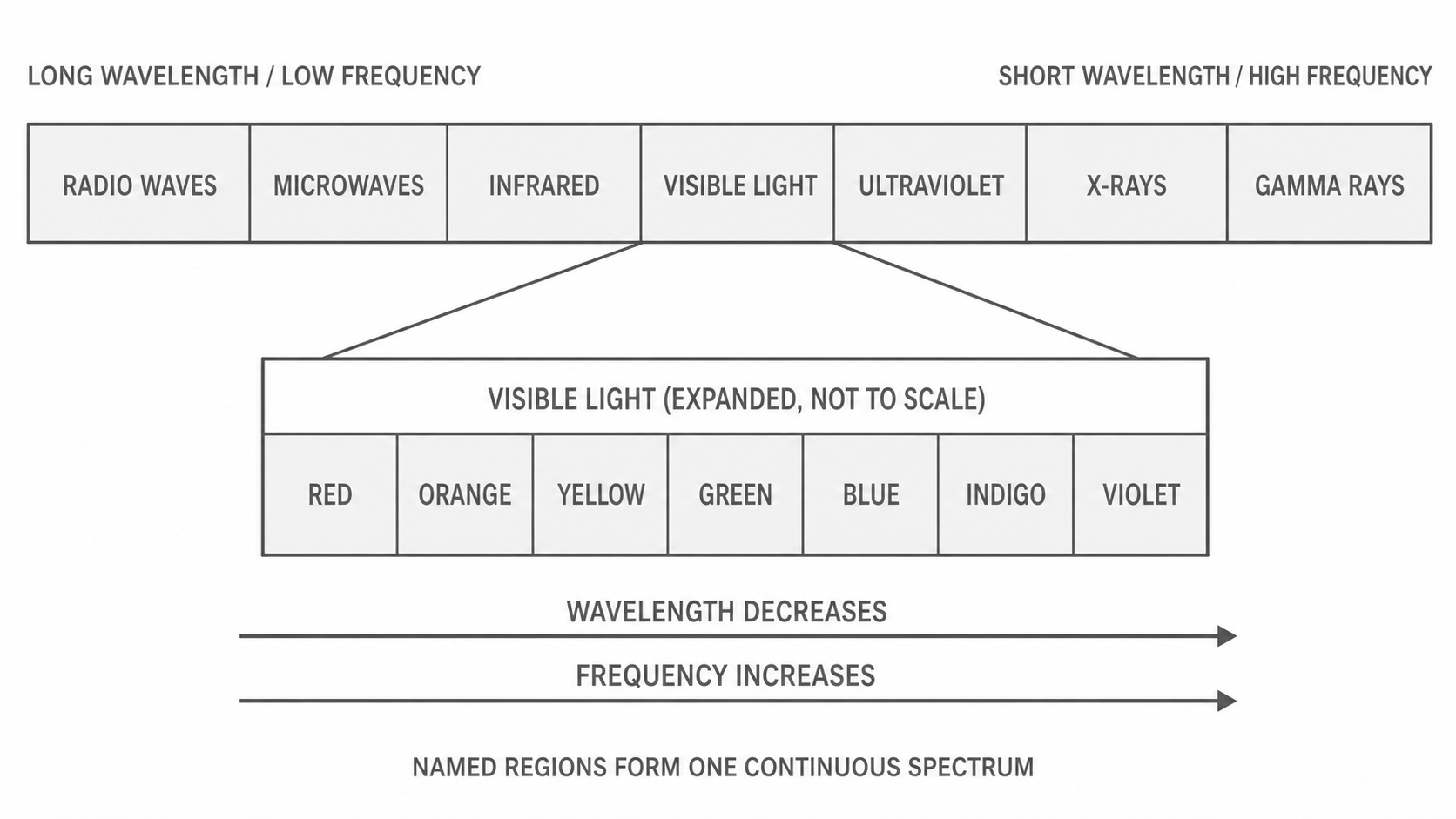
Moving from radio waves towards gamma rays:
- wavelength decreases;
- frequency increases.
Moving in the reverse direction reverses both trends. The wave equation connects them:
wave speed = frequency × wavelength
In a vacuum, v has the same value for every EM wave. Therefore, a higher frequency must be paired with a shorter wavelength. For example, if the frequency is multiplied by ten while the wave remains in a vacuum, its wavelength becomes one tenth as large. The supplied Physics equation list includes this wave equation, but you still need to select and interpret it correctly.
Visible light is itself a continuous range. In the same direction of increasing frequency, its colours are:
red -> orange -> yellow -> green -> blue -> indigo -> violet
Red has the longest wavelength and lowest frequency in the visible range; violet has the shortest wavelength and highest frequency. Our eyes detect only this limited visible range of electromagnetic frequencies. Infrared and ultraviolet are next to it in the wider spectrum, but being invisible to the eye does not mean they are absent or not transferring energy; suitable detectors can respond to them.
Continue this lesson.
You’re previewing NovaLearn without an account. Create a free account to read the rest.
Create free account