6.43P-6.46P - Nuclear fusion
Explain how smaller nuclei can join and release energy, why positive nuclei resist close approach and why maintaining fusion conditions makes useful power difficult to obtain.
Fusion powers stars
The centre of a star such as the Sun is extremely hot and under enormous pressure. These conditions allow nuclear fusion to occur: two or more smaller atomic nuclei join and remain joined, creating a larger nucleus. Fusion is therefore a change to nuclei, not a chemical reaction between electron shells.
Nuclear fusion is the joining of smaller nuclei to create a larger nucleus, accompanied by a release of energy.
The word larger needs care. In a simple joining model, the new nucleus is more massive than either starting nucleus on its own. For an energy-releasing reaction, the total rest mass of all products, including any other emitted particles, is slightly less than the total rest mass of all starting particles. Written as a comparison:
mass decrease = combined mass before fusion - total mass after fusion
The mass decrease corresponds to energy transferred out of the nuclear system. Mass has not vanished without consequence: the products have less mass because energy has been released.
In stars, many fusion reactions release energy continuously. That energy is transferred through the star and eventually radiated into space, so fusion is the energy source that makes stars shine.
Fusion and fission compared
Fusion and fission are both nuclear reactions that can release energy, but they change nuclei in opposite ways.
| Feature | Nuclear fusion | Nuclear fission |
|---|---|---|
| Starting point | two or more small nuclei | one large, unstable nucleus |
| Nuclear change | the small nuclei join | the large nucleus splits |
| Main nuclear result | a larger nucleus | two smaller daughter nuclei, usually with emitted neutrons |
| Familiar context | energy source in stars | controlled reactions in existing nuclear power stations |
[DIAGRAM: asset_name: 30_1PH0-P1-06G_6.43P-6.46P - Nuclear fusion - diagram 01; asset_slug: edexcel-gcse-physics-6-43p-6-46p-nuclear-fusion_diagram_01; recommended_method: image_gen; description: side-by-side monochrome nucleus models showing small nuclei joining and one large nucleus splitting, with unambiguous arrows, products and released energy]
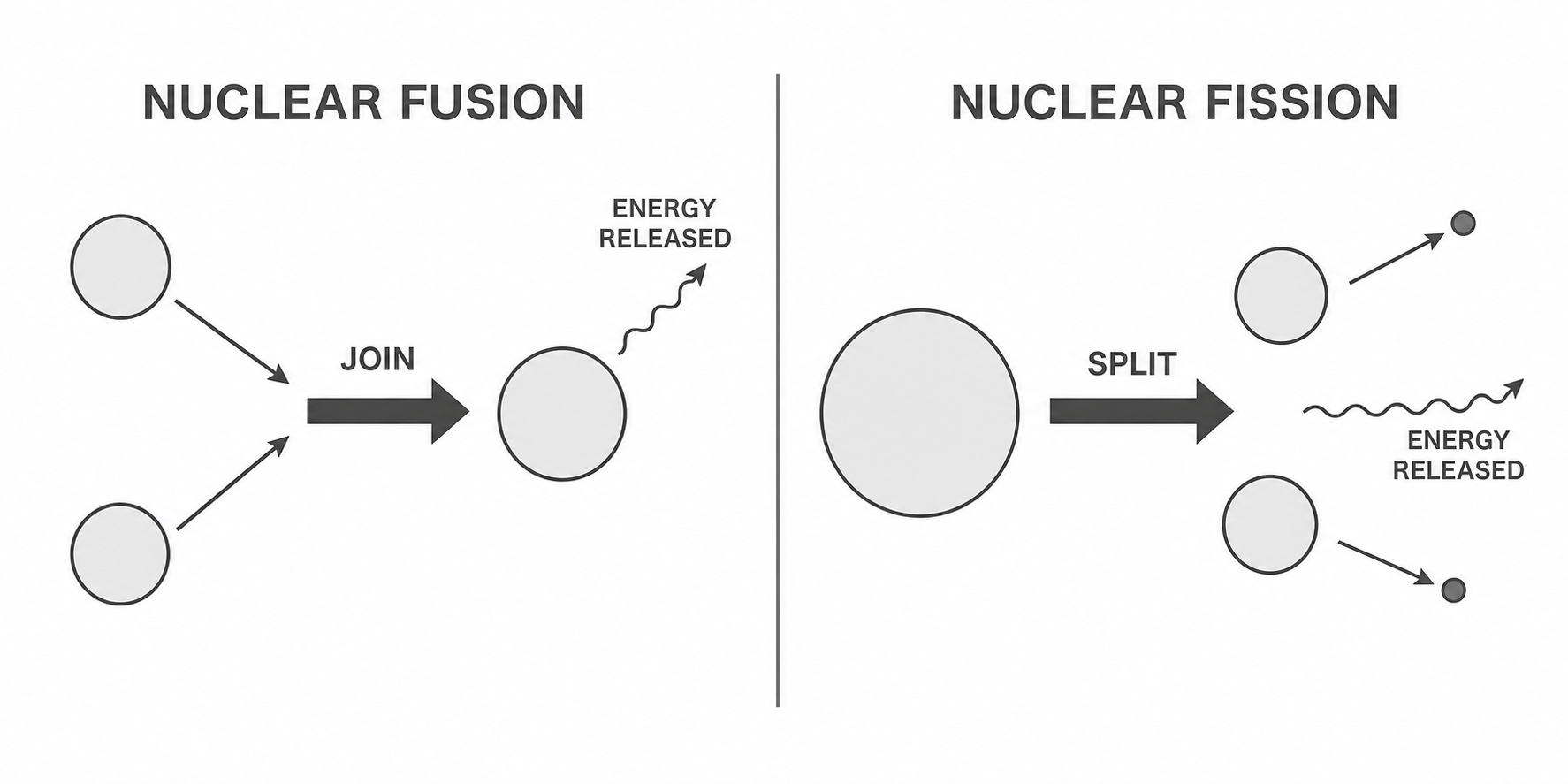
This diagram is a model of the direction of nuclear change. The circles represent nuclei, not full-size atoms, and the arrows show a process rather than the path of every particle. A collision between two nuclei is not automatically fusion: they must approach closely enough and form a new joined nucleus.
A reliable verbal test is:
- Fusion joins smaller nuclei.
- Fission splits a large nucleus.
Do not decide from the word energy: both reactions can release energy. Decide from what happens to the nucleus or nuclei.
Why fusion needs extreme conditions
Every atomic nucleus containing protons has an overall positive charge. When two nuclei approach, their protons cause an electrostatic repulsive force between them because like charges repel. At low temperature and pressure, most nuclei do not get close enough to remain joined, so fusion is extremely unlikely.
The two required conditions help in different but connected ways:
- High temperature gives the nuclei greater average kinetic energy, so they move faster. Some close approaches then have enough energy to act against the electrostatic repulsion.
- High pressure keeps many nuclei in a small volume. The nuclei are closer together and close approaches happen more frequently instead of the hot fuel simply spreading out.
Continue this lesson.
You’re previewing NovaLearn without an account. Create a free account to read the rest.
Create free account