7.1P-7.7P - Solar system, gravity and orbits
Use gravity to connect weight on different worlds with the paths of planets and satellites. Follow how observations changed the Solar System model, then distinguish orbital speed from changing velocity.
Weight on different worlds
Imagine an astronaut standing on Earth and then on the Moon. The astronaut's mass is unchanged because mass measures the amount of matter in the astronaut and their resistance to a change in motion. Their weight changes because weight is the gravitational force acting on that mass.
Gravitational field strength, symbol , describes the force experienced by each kilogram of mass at a location. Its unit is newtons per kilogram, N/kg. A field is a region in which a mass experiences a force; it is not a substance flowing out of a planet or moon.
The weight equation from earlier forces work connects the three quantities:
- is weight in newtons, N.
- is mass in kilograms, kg.
- is gravitational field strength in newtons per kilogram, N/kg.
At the surface of a space body, depends on the body's mass and on the distance from its centre:
- a body with more mass has a stronger gravitational field at a given distance;
- farther from the centre, the gravitational field is weaker;
- the surface radius sets how far a person on the surface is from the centre.
The Moon has a smaller radius than Earth, but it has far less mass. The effect of its much lower mass dominates, so its surface gravitational field strength is only about , compared with about on Earth. The same object therefore weighs about one-sixth as much on the Moon while keeping the same mass.
Worked example
A 50 kg astronaut stands first on Earth and then on the Moon. Calculate the astronaut's weight in each place.
The mass is already in kilograms. On Earth:
On the Moon:
The lunar weight is much smaller, as expected from the weaker gravitational field, but the astronaut's mass remains 50 kg in both places.
What is in the Solar System
The Solar System consists of the Sun and the objects held in orbit around it by gravity. The Sun is our star. The system includes eight planets and their natural satellites, dwarf planets, asteroids and comets.
The eight planets in increasing distance from the Sun are:
- Mercury
- Venus
- Earth
- Mars
- Jupiter
- Saturn
- Uranus
- Neptune
[DIAGRAM: asset_name: 31_1PH0-P1-07A_7.1P-7.7P - Solar system, gravity and orbits - diagram 01; asset_slug: 1ph0-p1-07a-solar-system-gravity-orbits_diagram_01; recommended_method: image_gen; description: Monochrome not-to-scale Solar System order diagram showing the Sun, all eight correctly named planets, the asteroid belt, a dwarf planet and a comet.]
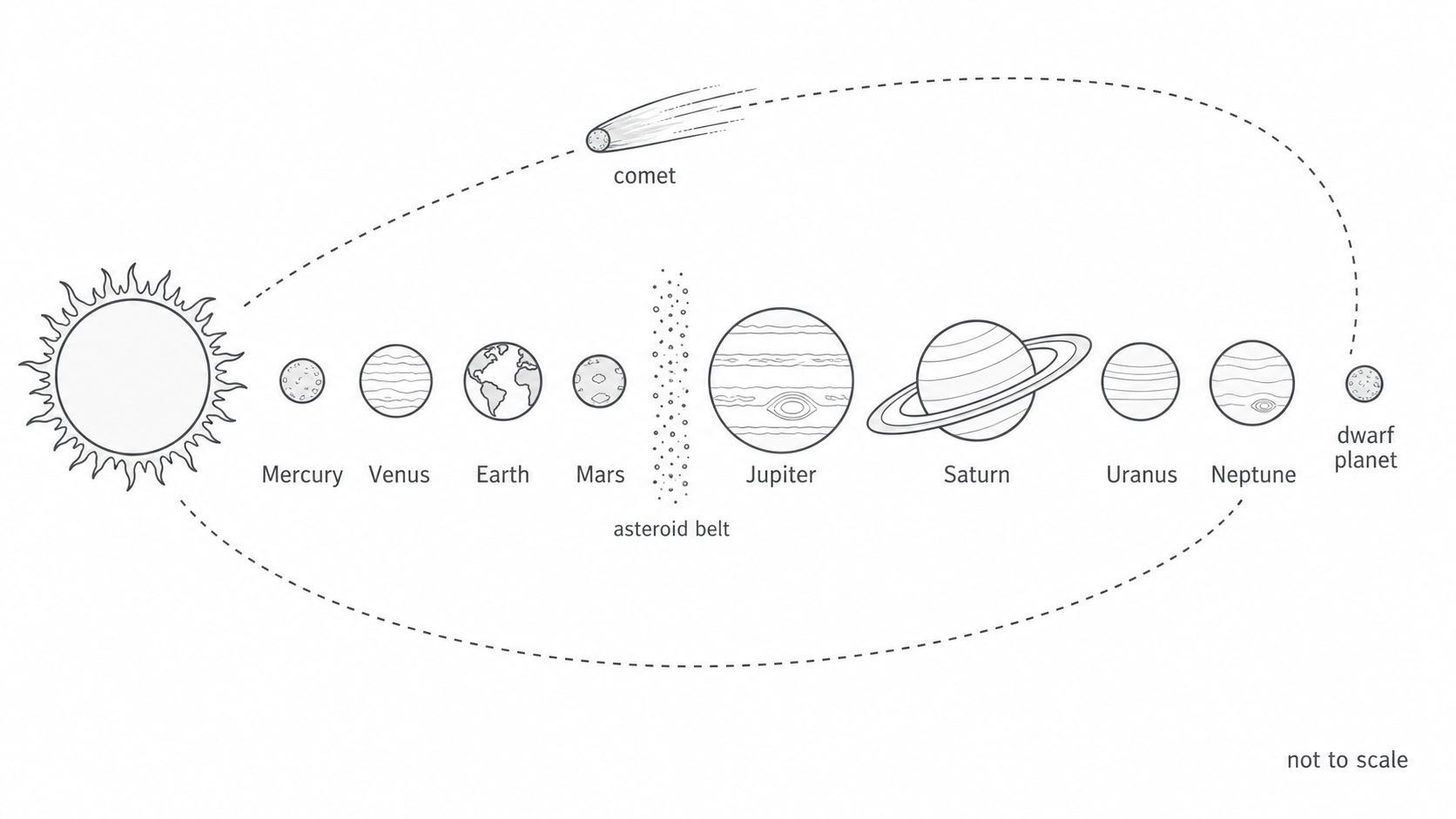
The diagram is an ordering model, not a scale drawing. Real planet sizes and the gaps between their orbits vary enormously. The first four planets are the smaller rocky planets. After Mars, many asteroids orbit in the asteroid belt before the four outer planets: Jupiter, Saturn, Uranus and Neptune.
A natural satellite, or moon, is a naturally occurring object that orbits another body. Earth's Moon orbits Earth, and many other planets have moons. A dwarf planet, such as Pluto, orbits the Sun but is not one of the eight planets. Asteroids are mainly rocky or metallic small bodies, while comets contain ice and dust and can develop a bright coma and tail when close to the Sun.
Stars seen beyond the Sun are not extra members orbiting inside our Solar System. They are much farther away; the Sun is the one star in our Solar System.
How the Solar System model changed
From Earth, the Sun, Moon, planets and stars appear to cross the sky. An early geocentric, or Earth-centred, model treated a stationary Earth as the centre, with the Sun, Moon, planets and fixed stars moving around it. This model matched many everyday observations, but complicated additions were needed to predict some planetary movements.
Copernicus developed a heliocentric, or Sun-centred, model in which Earth is one of the planets orbiting the Sun. It still assumed circular paths, so it was not the final model. Better observations allowed the model to be tested and refined:
- Galileo observed moons orbiting Jupiter, showing that not everything in the sky orbits Earth.
- Galileo observed the full pattern of phases of Venus, evidence that Venus orbits the Sun.
- Kepler used precise observations to show that planetary orbits are ellipses rather than perfect circles.
- Newton later explained that gravity supplies the force responsible for orbital motion.
Continue this lesson.
You’re previewing NovaLearn without an account. Create a free account to read the rest.
Create free account