12.10-12.13 - Motor effect and force calculations
A current-carrying wire in a magnetic field can experience a force. Learn how the two fields interact, use Fleming's left-hand rule for the force direction, and calculate the force using the length of wire inside the field. This lesson is Higher-tier content.
When magnetic fields interact
Place a straight wire between the poles of a magnet and connect it to a low-voltage direct-current supply. Arrange the wire across the field. When the current is switched on, a sideways force can make it move. Switching the current off removes this magnetic force; it does not necessarily stop a moving wire instantly. The force on the current-carrying conductor is called the motor effect.
The permanent magnet has a magnetic field around it. A current in the wire also has a magnetic field around the wire. Where these fields overlap, they interact, producing a magnetic force on the wire. Field lines are a representation of the field's direction and relative strength; they are not physical threads pushing the wire.
The motor effect is the force experienced by a current-carrying conductor when its magnetic field interacts with another magnetic field.
The interaction involves both objects. If the wire experiences an upward force of , the magnet experiences a downward force of . The forces are equal in magnitude and opposite in direction.
These forces do not cancel on either object because they act on different objects. To decide what moves, always name the object whose forces you are considering. A clamped magnet may not move noticeably because its support provides other forces, but the magnetic force on it is still present.
Field, current and force directions
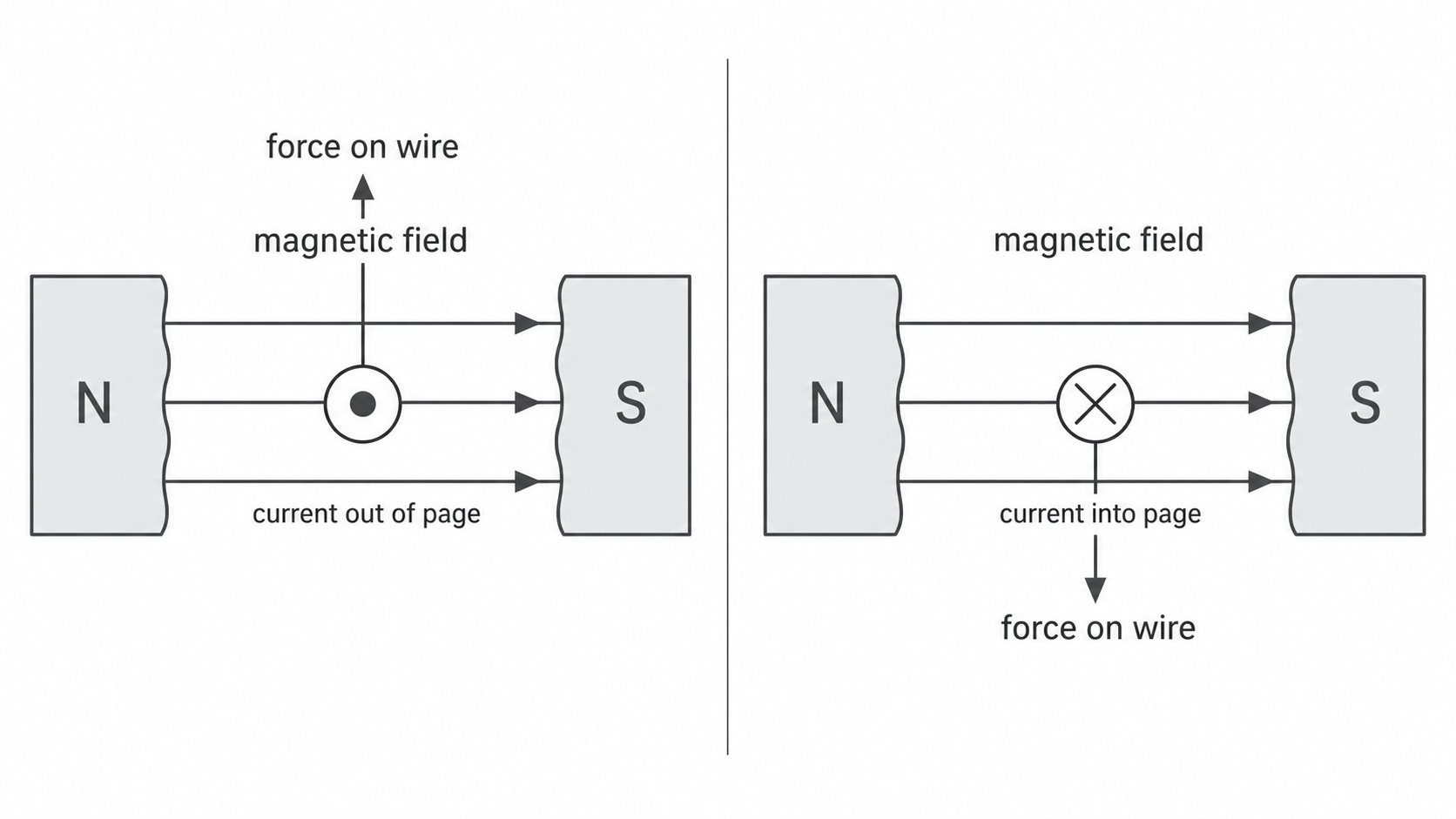
When the current, magnetic field and force are mutually perpendicular, Fleming's left-hand rule connects their relative directions. Hold the thumb, first finger and second finger of your left hand at right angles:
- first finger: magnetic field, directed from the magnet's north pole to its south pole;
- second finger: conventional current, directed from positive to negative through the external circuit;
- thumb: force or thrust on the current-carrying conductor.
Orient the first finger with the field and the second finger with the current. The thumb then gives the force on the conductor. Rotate the whole hand until both given directions match; do not change the meaning assigned to a finger. The rule uses conventional current, not the opposite direction in which electrons drift through a metal.
[DIAGRAM: asset_name: 50_1PH0-P2-12C_12.10-12.14P - Motor effect and electric motors - diagram 01; asset_slug: 50_1ph0-p2-12c_12-10-12-14p-motor-effect-electric-motors_diagram_01; recommended_method: image_gen; description: two-panel monochrome schematic with fixed north-to-south field arrows, out-of-page and into-page conventional currents, and the corresponding opposite force directions on the wire]
Continue this lesson.
You’re previewing NovaLearn without an account. Create a free account to read the rest.
Create free account