15.15P-15.17P - Upthrust, floating and sinking
Higher tier: explain how fluid pressure produces upthrust and relate it to displaced-fluid weight. Use this to predict floating, sinking and changes in submerged volume.
How pressure creates upthrust
A fluid exerts pressure on every surface it touches. Pressure is a scalar quantity, but the force that the fluid exerts on a small part of a surface has a direction: it acts perpendicular to that surface.
Consider a block fully immersed in a liquid. Its lower face is deeper than its upper face, so the pressure on the lower face is greater. For equal top and bottom areas, the upward force on the bottom is therefore greater than the downward force on the top. Forces on opposite vertical sides are equal and opposite, so they cancel. The remaining resultant force from the fluid is upward.
Upthrust is the resultant upward force that a fluid exerts on an object immersed in it. It is also called the buoyant force.
[DIAGRAM: asset_name: 62_1PH0-P2-15C_15.13P-15.17P - Liquid pressure, upthrust and floating - diagram 01; asset_slug: phy-g-upthrust-repaired; recommended_method: matplotlib; description: a precise immersed-block diagram showing smaller downward pressure force at the shallower top, larger upward force at the deeper bottom, cancelling side forces, and resultant upthrust]
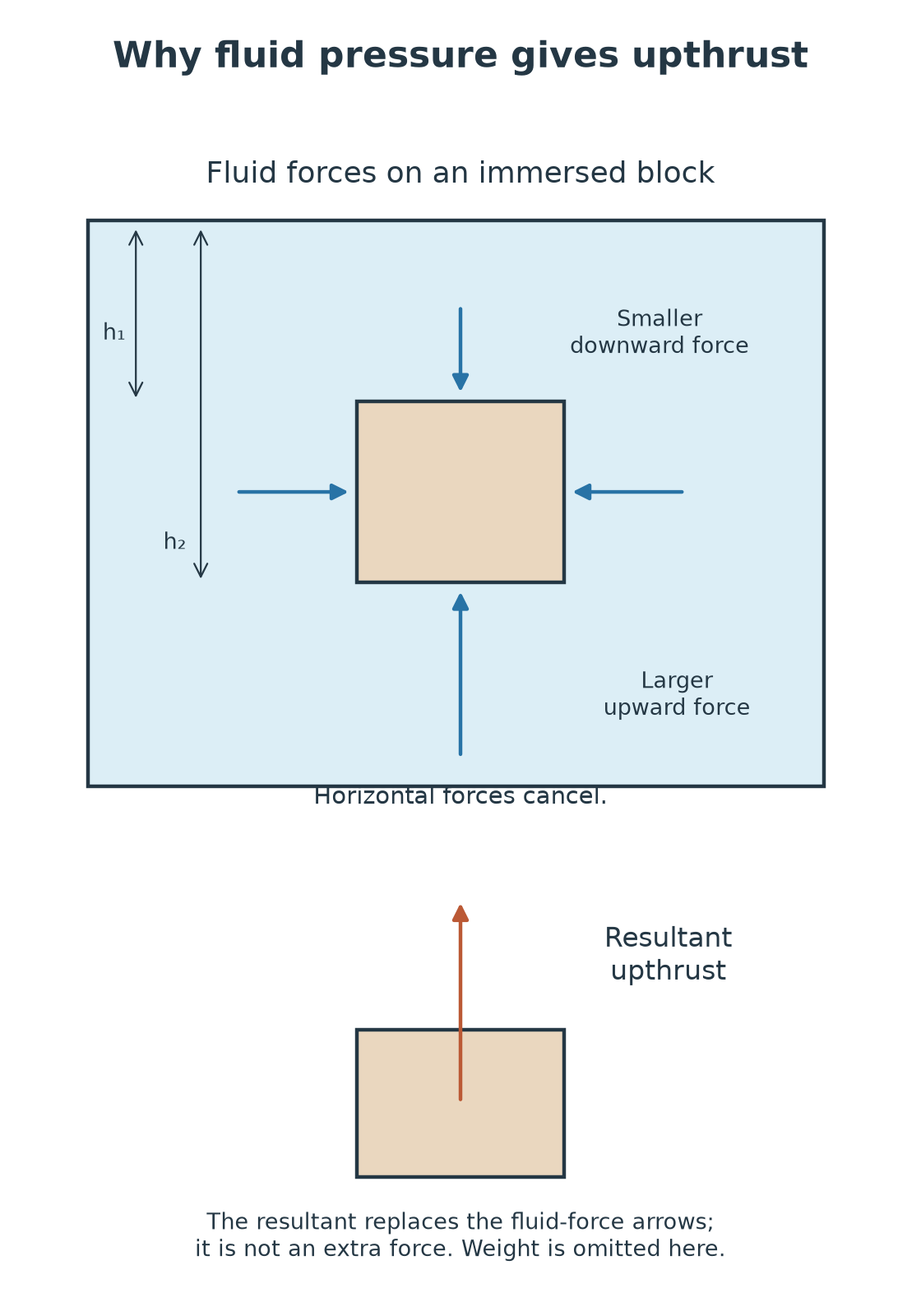
The component arrows represent forces exerted by the fluid on the block. The separate resultant diagram replaces those arrows with their sum, upthrust; it is not an additional fluid force. Weight is a separate force and is not included in this fluid-only diagram. An irregular object has forces acting over all parts of its surface, but those forces still combine to give a net upward upthrust.
Upthrust acts whenever an object is immersed in a fluid. A submarine is fully immersed in a liquid, a balloon is fully immersed in the gas around it, and a floating boat is partially immersed in a liquid. Even a stone that is sinking experiences upthrust; it sinks because another force is larger, not because upthrust is absent.
Upthrust and displaced fluid
There is a second way to describe the size of the upthrust. When an object enters a fluid, it takes the place of some of that fluid: it displaces it.
The upthrust on an object is equal to the weight of fluid displaced by the object.
For a rigid object fully immersed in a liquid, the volume of fluid displaced equals the whole volume of the object. For a partially immersed object, the displaced volume equals only the volume below the liquid surface. For an object in a gas, the same principle uses the weight of the gas displaced.
Fluid density changes the weight in a given displaced volume. The same immersed volume displaces more mass of a denser fluid, so it displaces a greater fluid weight and receives a greater upthrust.
Depth needs more careful thought. If a rigid object is already fully immersed in a uniform-density liquid, moving it deeper does not change its displaced volume. Pressure rises at both its top and bottom, but the pressure difference across it stays the same. Its upthrust therefore stays equal to the same displaced-fluid weight.
Continue this lesson.
You’re previewing NovaLearn without an account. Create a free account to read the rest.
Create free account