6.17 - Evidence for atomic models
Trace a prediction, the observations that challenged it and the changes scientists made to their atomic model. Separate what alpha scattering revealed about the nucleus from Bohr’s later model of electron energies.
A model makes a prediction
A scientific model is a representation used to explain observations and make predictions. It is not a claim that an atom literally looks like a classroom picture. A model remains useful only while its predictions agree with the available evidence.
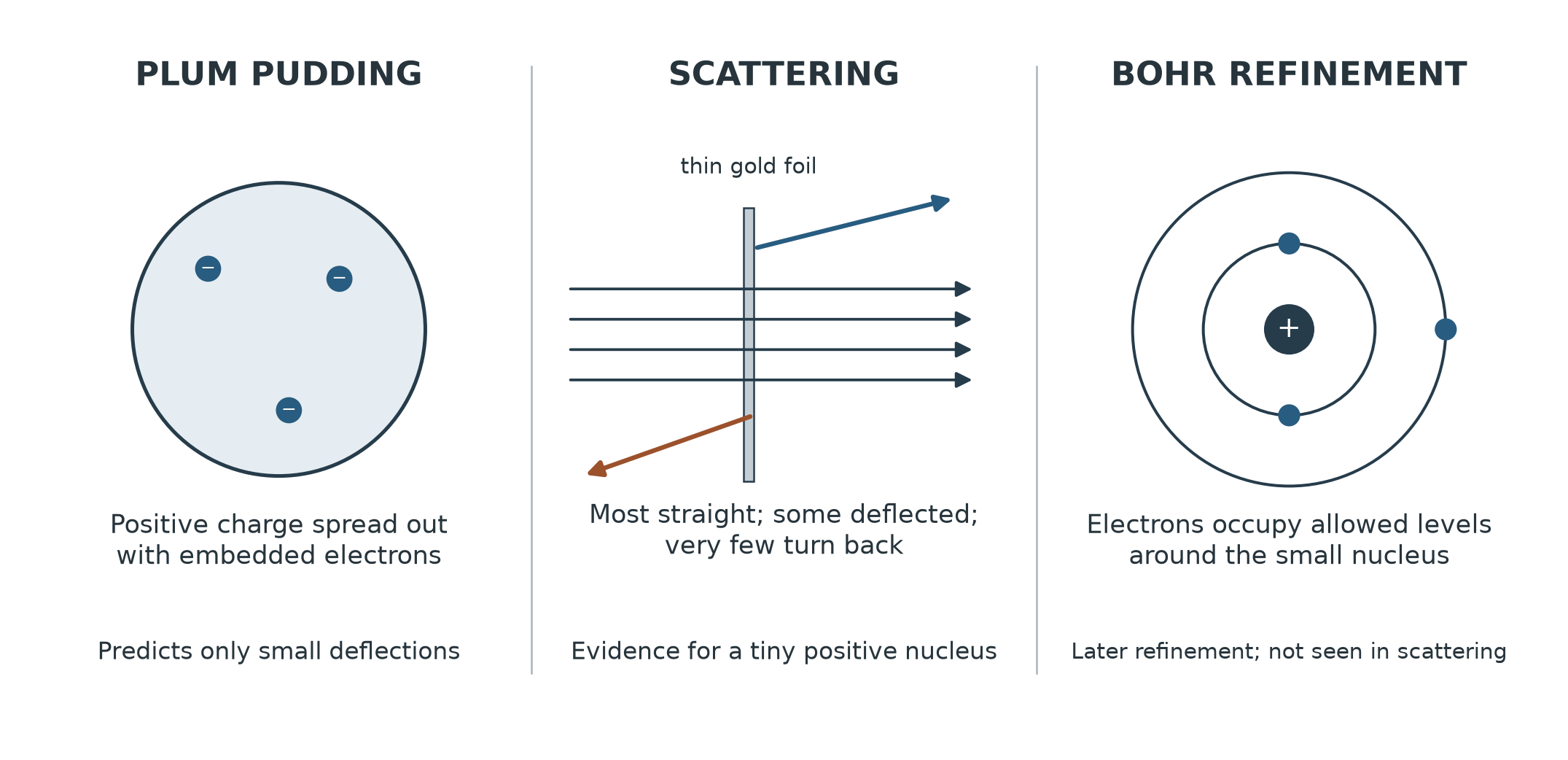
After the electron was discovered, the plum pudding model described an atom as a sphere of spread-out positive charge with negative electrons embedded within it. The positive charge was not concentrated in a nucleus. This model explained why an atom could be neutral, but it made a testable prediction: an energetic, positively charged alpha particle passing through a thin metal foil should experience only small deflections from the spread-out charge.
Scattering evidence and the nucleus
Rutherford's team directed alpha particles at very thin gold foil and observed where the particles travelled:
- Most passed straight through. This suggested that most of an atom is empty space.
- Some were deflected through an angle. This suggested that positive charge is concentrated, because a positive alpha particle is repelled when it passes near the concentrated positive region.
- A very small number were deflected through large angles or came back. This required a tiny, dense region containing most of the atom's mass and its positive charge.
[DIAGRAM: asset_name: 26_1PH0-P1-06C_6.17-6.22 - Atomic models and nuclear decay - diagram 01; asset_slug: edexcel-gcse-physics-6-17-6-22-atomic-models-nuclear-decay_diagram_01; recommended_method: matplotlib; description: three-panel precisely constructed scientific sequence comparing the plum pudding prediction, Rutherford gold-foil scattering observations, and the resulting Bohr atomic model with electrons at set distances]
Continue this lesson.
You’re previewing NovaLearn without an account. Create a free account to read the rest.
Create free account