11.8P-11.10P - Electric fields
Use electric fields to describe forces without contact, draw and interpret point-charge and parallel-plate patterns, and connect field strength to familiar static effects.
Electric fields and test charges
Charged objects can attract or repel without touching. The electric-field model describes how a source charge affects the space around it.
An electric field is a region where an electric charge experiences a force.
The source charge creates the field. A second charge placed in the region experiences the force, but the field exists even when that second charge is absent. It is not a stream of matter released by the source charge.
Field direction uses an agreed convention: it is the direction of the force that a small positive test charge would experience at that position.
- Near a positive source charge, a positive test charge is repelled, so the field points away from the source.
- Near a negative source charge, a positive test charge is attracted, so the field points towards the source.
- A negative charge placed in either field experiences a force in the direction opposite to the field arrow.
The test charge is a thinking tool. It is imagined to be small enough not to change the source charges or their arrangement significantly.
Reading field-line models
Field lines form a map of an electric field. They show its direction and allow relative field strengths to be compared, but they are not physical lines and they are not compulsory paths for moving charges. The actual field fills the region between the drawn lines and extends in three dimensions.
[DIAGRAM: asset_name: 47_1PH0-P2-11B_11.6P-11.10P - Electrostatic uses, dangers and fields - diagram 02; asset_slug: 47_1ph0-p2-11b_11-6p-11-10p-electrostatic-uses-dangers-fields_diagram_02; recommended_method: image_gen; description: Three-panel monochrome field-line model comparing outward positive and inward negative point-charge patterns with a uniform field between oppositely charged parallel plates.]
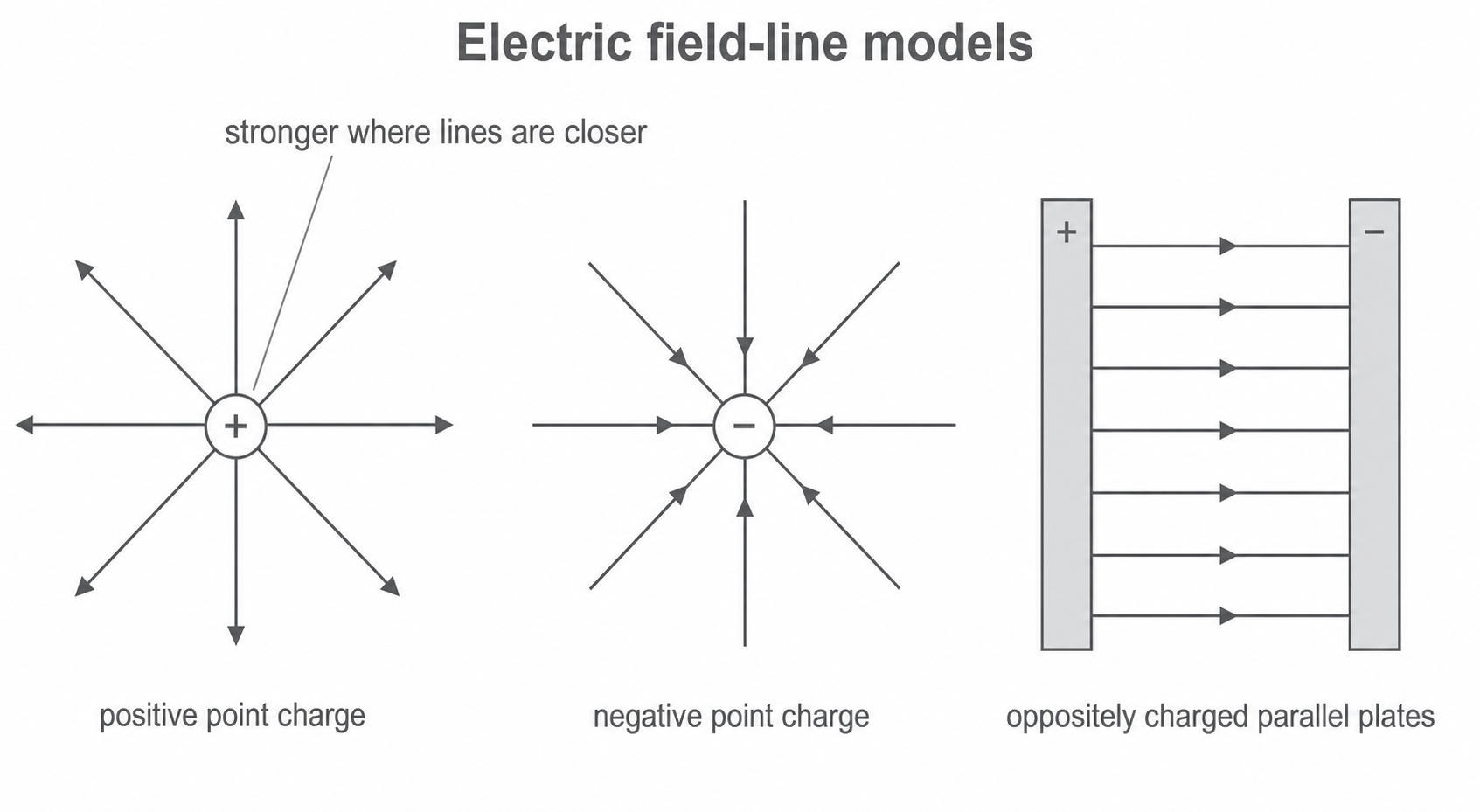
Use four rules to read the model:
- Direction: arrowheads show the direction of force on a positive test charge, so lines leave positive charge and enter negative charge.
- Point charges: lines are radial. They point directly away from a positive point charge and directly towards a negative point charge.
- Parallel plates: between the central regions of oppositely charged parallel plates, lines are straight, parallel, evenly spaced and perpendicular to the plates. They point from the positive plate to the negative plate. In this idealised model the field there is uniform, meaning it has the same direction and strength throughout the central region; edge effects are ignored.
- Relative strength: a greater concentration of lines represents a stronger field. Around a point charge, the lines spread farther apart with distance, representing a field that becomes weaker farther from the charge. Evenly spaced lines between the plates represent a field of constant strength.
Field lines never cross. At any one point, a positive test charge has one resultant force direction, so crossing lines would assign two different field directions to the same point.
Continue this lesson.
You’re previewing NovaLearn without an account. Create a free account to read the rest.
Create free account