8.1-8.5 - Energy changes and work done
A wound-up toy moves, slows and warms its surroundings. Use energy stores and transfer diagrams to explain these changes, then measure the force and distance needed to determine mechanical work.
Energy stores in changing systems
Wind the key of a toy car and the car remains still, but something has changed: the spring inside has been twisted. Release it and the car speeds up. Later the car stops and the toy, floor and nearby air may be slightly warmer.
An energy store is part of a model used to keep account of energy in a system. Energy is not a visible material inside an object. Instead, the model compares how much energy is associated with particular objects and interactions before and after a change.
| Energy store | When this store is relevant |
|---|---|
| chemical | chemicals react, as in a cell, fuel or muscles |
| kinetic | an object is moving |
| gravitational | objects have changed separation in a gravitational field |
| elastic | an object is stretched, compressed, bent or twisted |
| thermal | the temperatures or internal states of objects change |
| magnetic | interacting magnets change position |
| electrostatic | interacting charges change position |
| nuclear | an atomic nucleus changes |
Not every store belongs in every description. To analyse a change:
- Name the system: the object or group of objects being studied.
- Choose a clear starting snapshot and finishing snapshot.
- Identify stores that decrease and stores that increase between those snapshots.
- Leave out stores whose amounts do not change.
For the toy car from just before release to while it is speeding up, the elastic store of the spring decreases and the kinetic store of the car increases. From the moving car to the stopped car, its kinetic store decreases while thermal stores of the car, floor and surroundings increase. The energy has changed where it is stored; it has not been used up.
Energy-transfer diagrams and closed systems
An energy-transfer diagram is an accounting representation. Its boxes name stores associated with objects or interactions, while its arrows show that energy is transferred. The arrows are not tracks followed by energy particles.
A compact diagram can be drawn in this form:
[starting store decreases] -- transfer pathway --> [receiving store increases]
Each label needs enough detail to identify the object. For a falling ball before it hits the ground:
[gravitational store of the ball-Earth system decreases] -- mechanical working by gravity --> [kinetic store of the ball increases]
To draw or interpret a diagram reliably:
- mark the system boundary and the start and finish of the change;
- identify the decreasing store on the left;
- label the arrow with the transfer pathway;
- identify the increasing store on the right;
- check that no energy has vanished from the account.
[DIAGRAM: asset_name: 34_1PH0-P2-08A_8.1-8.5 - Energy changes and work done - diagram 01; asset_slug: 34_1ph0-p2-08a_8-1-8-5-energy-changes-and-work-done_diagram_01; recommended_method: image_gen; description: three-row monochrome energy-account diagram comparing mechanical working, electrical working and heating with clearly named decreasing and increasing stores and directional transfer arrows]
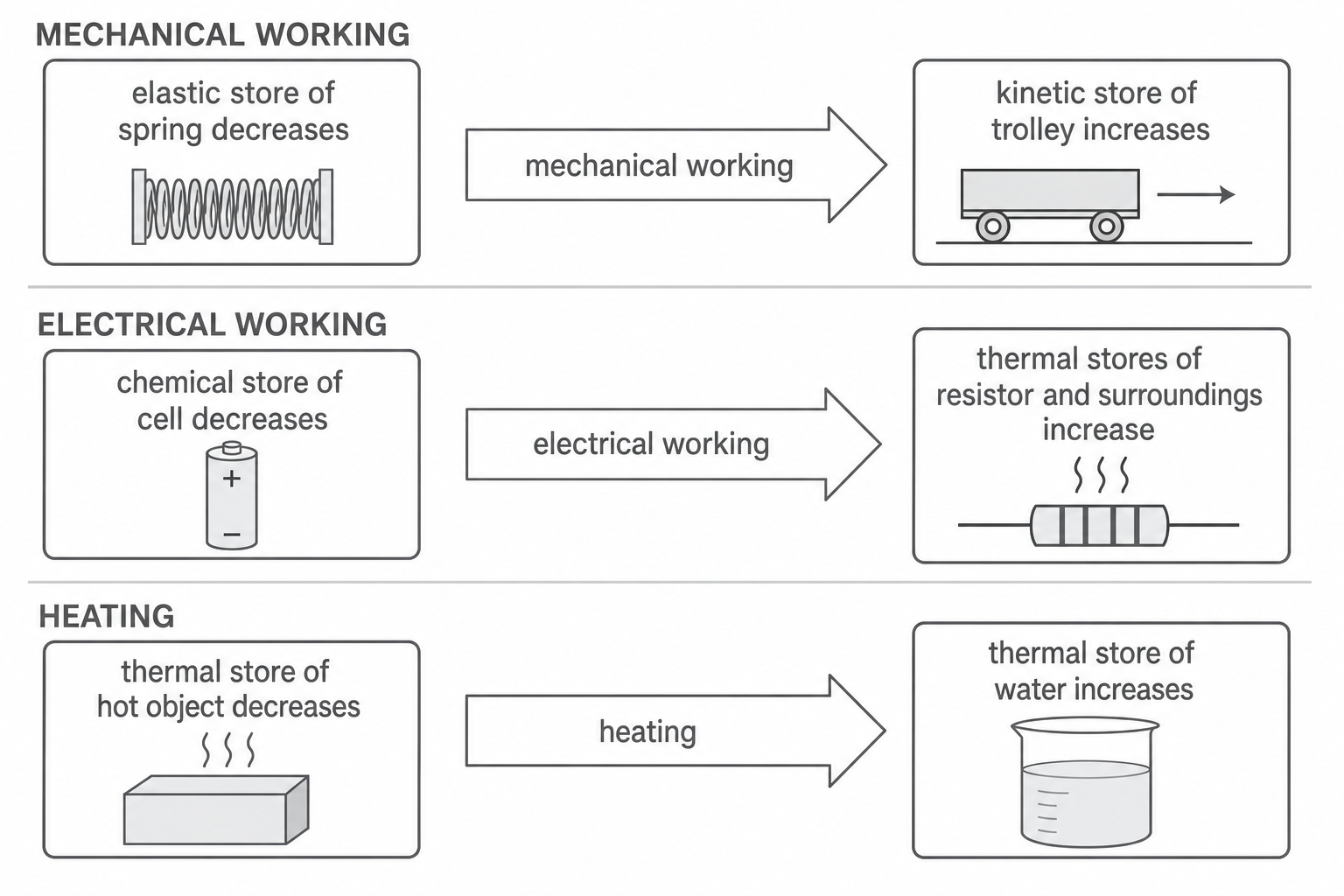
The diagram separates stores, shown at the start and finish, from pathways, written on the arrows. The electrical row summarises transfer into the resistor; energy subsequently reaches the nearby surroundings by heating. Read each row as a complete sentence: energy is transferred from the named decreasing store, by the named pathway, to the named increasing store.
Try a diagram in your notebook (self-check): draw the energy account for a stretched elastic band launching a dart horizontally. Choose the instant before release and the instant the dart leaves the launcher. Include a branch for energy dissipated to the surroundings.
Model check: the elastic store decreases. Mechanical-transfer arrows lead to an increasing kinetic store of the dart and increasing thermal stores of the band, launcher and air. For a boundary including those objects, the total store increases equal the decrease. A force arrow or the dart's flight path is not an energy-transfer diagram. This drawing is for your own comparison, not automatic marking.
A closed system is chosen so that no energy enters or leaves across its boundary during the change being studied. Energy can still transfer between stores inside that boundary. Because no energy crosses the boundary, the total energy of the closed system has no net change:
total energy at the start = total energy at the finish
Suppose a ball is released above a tray of sand and eventually comes to rest in it. If the closed system includes the ball, Earth, sand and nearby surroundings, the gravitational store decreases and thermal stores increase. The ball may have a kinetic store during the fall, but it is stationary at both chosen snapshots, so that store is not needed in the start-to-finish account. The total energy is unchanged even though its distribution among stores changes.
Continue this lesson.
You’re previewing NovaLearn without an account. Create a free account to read the rest.
Create free account