6.28P-6.32 - Radiation uses, hazards and protection
Match each use of radiation to its ionising and penetrating properties. Then connect tissue damage, half-life and the route of exposure to the precautions that protect patients, workers and the public.
Ionisation smoke alarms
Radioactive decay is random, but a large sample produces a measurable average activity. A useful device matches the radiation's ionising ability, penetration and range to a particular job. It also keeps the radioactive material sealed or controlled so that the benefit is much greater than the risk.
Smoke alarms
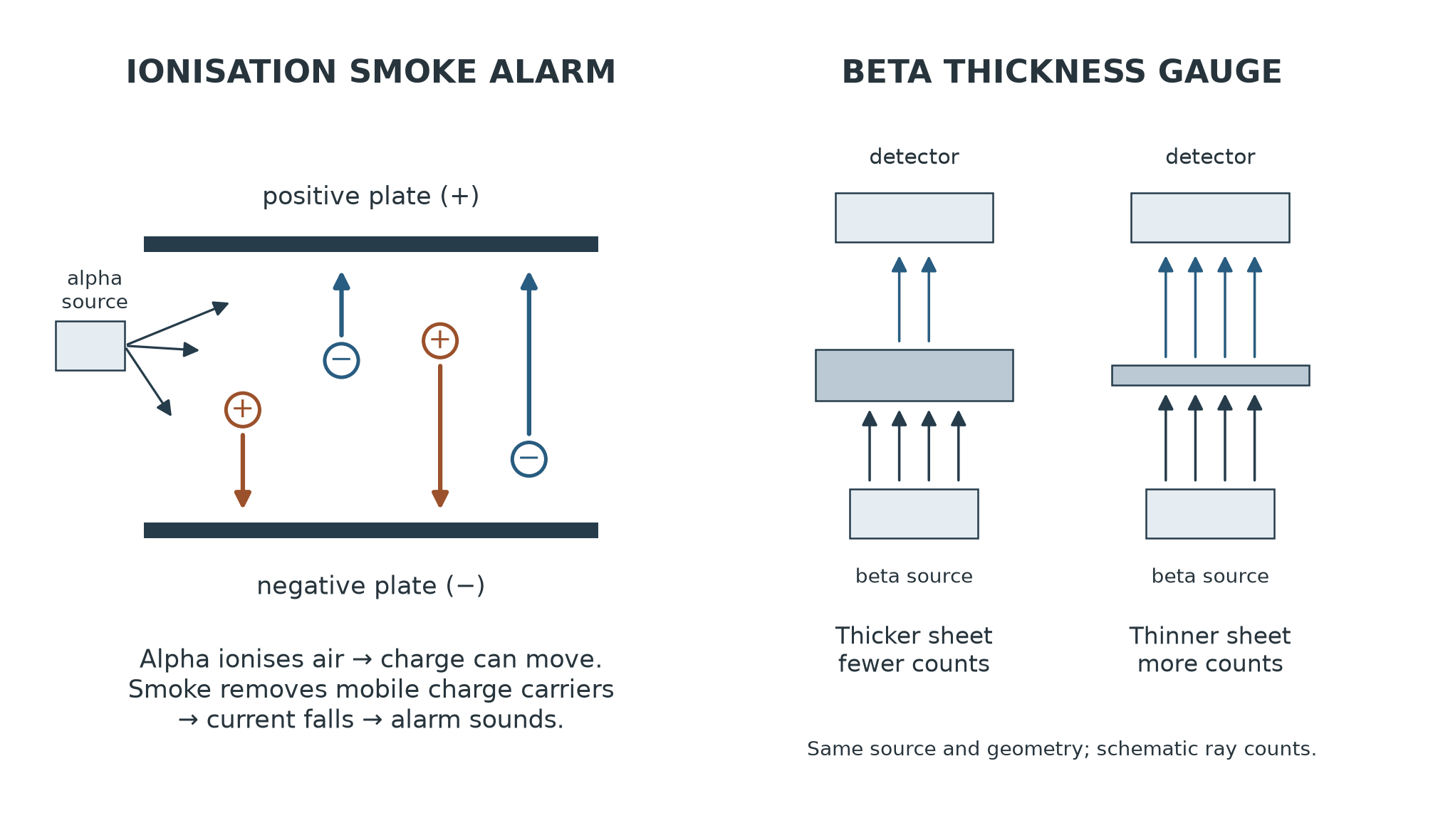
An ionisation smoke alarm contains a tiny, sealed source of americium-241. It emits alpha particles, which strongly ionise the air between two charged plates. Positive ions move towards the negative plate and negative charge carriers towards the positive plate. Their movement carries a small, steady electric current.
When smoke enters the chamber, it disrupts the movement of ions, so the current falls. The circuit detects this change and sounds the alarm. Alpha radiation is suitable because it ionises the air strongly but has a very short range; the source is sealed inside the alarm and should not be removed or damaged.
Irradiation in food, equipment and medicine
Food can be passed through a controlled beam of penetrating ionising radiation. The radiation kills microorganisms and insects or stops them reproducing, which can reduce foodborne illness and extend shelf life. Medical equipment can be sterilised in a similar way: penetrating radiation kills microorganisms, even when the equipment is already sealed in its packaging.
In both cases, the food or equipment is irradiated by a source outside it. Radioactive material is not added, so the process does not contaminate the product or make it radioactive. Gamma radiation from a controlled source is one possible method because it can pass through packaging and reach the whole product.
Diagnosis and treatment of cancer
A small diagnostic tracer helps locate unusual activity inside the body because its radiation can be detected outside. Radiotherapy deliberately gives tumour tissue a large, carefully targeted dose to kill cells or stop their division. Diagnosis seeks information with a low useful dose; treatment seeks a biological effect at the tumour. The medical-radiation lesson develops the different arrangements and PET detection.
Tracing flow and controlling thickness
Tracing movement and gauging thickness
A radioactive tracer is a small amount of radioactive substance deliberately added to a moving material. Detectors placed outside a pipe can follow the tracer. A sudden build-up can reveal a blockage, while radiation detected where none should escape can help locate a leak. The emission must penetrate the pipe wall and reach the detector; the activity should be high enough to measure but should fall after the investigation.
A thickness gauge uses a source and detector on opposite sides of a moving sheet. For paper, plastic or thin metal, beta radiation is often suitable:
- a thicker sheet absorbs more beta radiation, so the detector count rate falls;
- a thinner sheet absorbs less beta radiation, so the detector count rate rises;
- a control system compares the count rate with a target and adjusts the rollers to restore the required thickness.
Alpha radiation would be absorbed too easily to pass through the sheet. Very penetrating gamma radiation would show less change for a thin sheet, although gamma can be useful for gauging thicker, denser materials.
[DIAGRAM: asset_name: 28_1PH0-P1-06E_6.28P-6.35P - Radiation uses, hazards and medicine - diagram 01; asset_slug: edexcel-gcse-physics-6-28p-6-35p-radiation-uses-hazards-medicine_diagram_01; recommended_method: matplotlib; description: two-panel precisely constructed scientific diagram showing alpha ionisation current interrupted by smoke and beta transmission changing with sheet thickness between source and detector]
Harm, half-life and protection
Ionising radiation transfers enough energy to remove electrons from atoms. In living tissue, this can damage molecules and kill cells. If DNA is damaged, a cell may die or may survive with a mutation. Some mutations can make cells divide uncontrollably and lead to cancer; a mutation is a possible outcome, not a certainty after every exposure.
The chance and severity of harm increase with the dose absorbed by tissue. A high local dose can kill many cells and damage tissue. A lower dose may still increase the probability of a harmful mutation, so avoidable exposure should be reduced even when no immediate injury is visible.
What half-life changes
Half-life tells us how quickly the activity of a large sample falls. It affects hazard, but it does not determine hazard on its own.
Continue this lesson.
You’re previewing NovaLearn without an account. Create a free account to read the rest.
Create free account