5.4P-5.6P - Lenses and real or virtual images
Connect lens curvature, focal length and power, then construct rays to locate images and distinguish actual convergence from a virtual image.
Connecting lens shape, focus and power
A lens changes a ray's direction by refraction at its two surfaces. In a thin-lens ray model, that total change is shown at one line through the lens to keep the construction clear.
In the figures, a vertical line with arrows pointing outwards represents a converging lens; arrows pointing inwards represent a diverging lens. O is the optical centre.
A converging lens is usually thicker at the centre than at the edges. It bends rays parallel to the principal axis towards the axis so they meet at the principal focus F on the far side. A diverging lens is usually thinner at the centre. It bends parallel rays away from the axis; their dashed backward extensions meet at F on the incident side. Dashed extensions show where rays appear to come from and are not paths travelled by light.
[DIAGRAM: asset_name: 17_1PH0-P1-05A_5.1P-5.6P - Rays, reflection and lenses - diagram 03; asset_slug: 17_1ph0-p1-05a_5-1p-5-6p-rays-reflection-and-lenses_diagram_03; recommended_method: matplotlib; description: Thin-lens line at x0; f±2; parallel rays follow yout=y(1-x/f); diverging extensions exactly collinear to near F. Arrow symbols define lens type.]
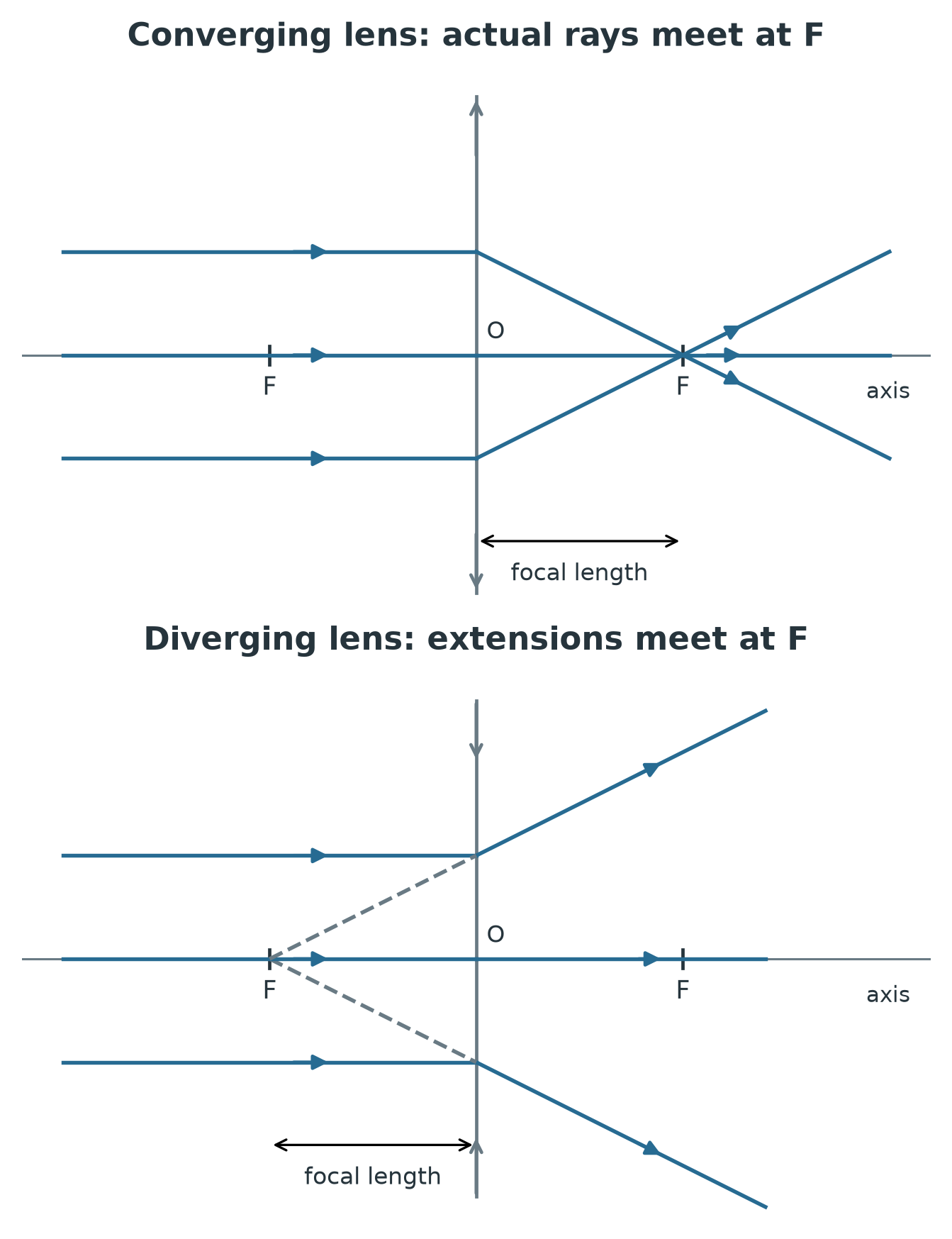
The focal length f is the distance from the optical centre to the principal focus. For lenses of the same material in the same surroundings, more strongly curved surfaces bend rays more, giving a shorter focal-length magnitude and a greater lens-power magnitude.
The required relationship is qualitative: a more powerful lens has a shorter focal-length magnitude. The following quantitative relationship is supplied here whenever a calculation uses it.
lens power = 1 / focal length in metres
Lens power is measured in dioptres (D), equivalent to . Under the usual sign convention, a converging lens has positive focal length and power, while a diverging lens has negative focal length and power. For example, +5 D converges more strongly than +2 D, and -5 D diverges more strongly than -2 D.
Worked example
A converging lens has a focal length of 25 cm. Calculate its power.
First convert the focal length to metres:
Then substitute:
The positive sign matches a converging lens. A focal length of one quarter of a metre giving a power of four reciprocal metres is physically consistent.
Constructing converging-lens images
Draw the principal axis horizontally, the thin lens vertically, and F at equal distances from the optical centre on both sides. Draw the object as an arrow with its base on the axis. Rays from its tip locate the tip of the image; do not start different rays at unrelated object points.
- Draw a ray from the object tip parallel to the axis. After a converging lens it passes through the far focus.
- Draw a second ray from the same tip through the optical centre. Continue it in the same straight line.
- If the outgoing rays meet, draw the image arrow from the axis to their crossing. The rays can continue beyond the image; place a screen at the crossing to focus it.
- If the outgoing rays spread apart, extend their straight lines backwards using dashes. Draw the image arrow from the axis to the intersection of these extensions. The dashed lines are construction lines, not backwards-travelling light.
Continue this lesson.
You’re previewing NovaLearn without an account. Create a free account to read the rest.
Create free account