8.6-8.9 - Work, GPE and kinetic energy
A force can raise a load or speed up a trolley. Work describes the energy transfer; gravitational potential energy and kinetic energy describe the stores that change. Link these ideas through worked calculations.
Work changes a system's energy
Imagine using a force to lift a load, then using a force to speed up a trolley. The results look different, but in each case the force acts through a distance and does work. Work is a way of transferring energy; it is not an energy store of its own.
Before describing the change, choose the system being considered:
- For a raised load, the useful system is the load and Earth together. Work done against gravity increases the gravitational potential energy of this system.
- For a speeding trolley, the trolley can be the system. Net work done on it increases its kinetic energy.
[DIAGRAM: asset_name: 35_1PH0-P2-08B_8.6-8.9 - Work, GPE and kinetic energy - diagram 01; asset_slug: 35_1ph0-p2-08b_8-6-8-9-work-gpe-kinetic-energy_diagram_01; recommended_method: matplotlib; description: precise two-panel work diagram, with same-point vertical and horizontal displacement markers, upward lifting force, forward net force, and correct increasing energy stores]
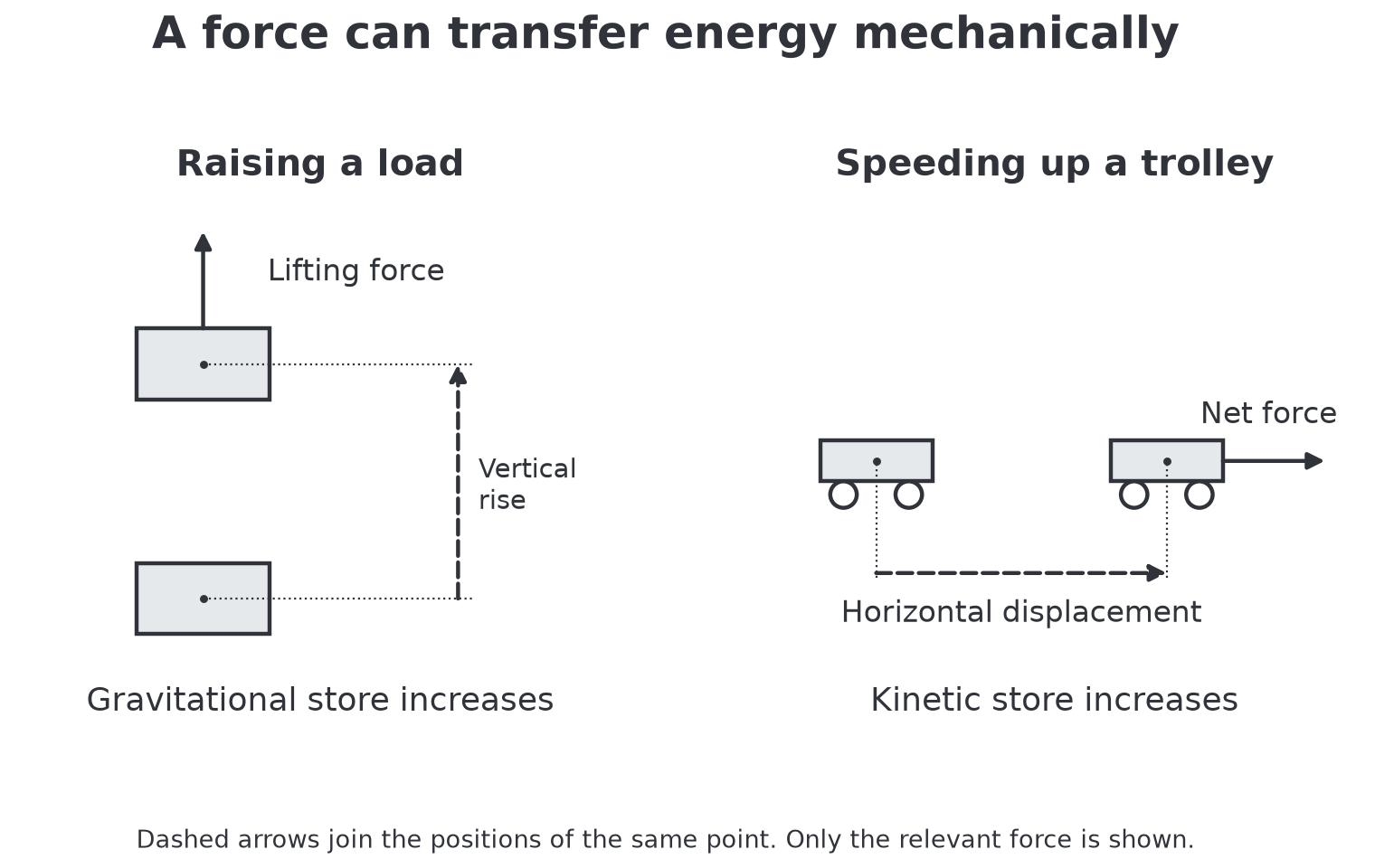
The diagrams show simplified forces relevant to the energy change, rather than full free-body diagrams. Other forces, such as weight and support, may also act. The arrows are representations. A solid force arrow begins on the object and shows the direction of the force. The separate dashed arrow joins the positions of the same point on the object and shows its displacement; it is not another force.
A force can act without doing work. A hand holding a stationary bag exerts an upward force, but the bag has no displacement. When the bag is carried horizontally at constant height, the upward support force is perpendicular to the horizontal displacement, so there is no distance moved in the direction of that force.
Calculating work done
For a constant force acting in the direction of motion, the work done is:
work done = force × distance moved in the direction of the force
Eis the work done, or energy transferred, in joules (J).Fis the force in newtons (N).dis the distance moved in the direction of the force in metres (m).
The symbol E is used because work done and energy transferred have the same value and the same unit. One joule is the work done when a force of 1 N moves an object 1 m in the force's direction, so .
This relationship is included on the Edexcel equation sheet and applies to both tiers. You still need to choose it, use metres rather than centimetres, rearrange it when necessary and give the answer in the requested unit.
Worked example
A constant horizontal force of 420 N pulls a maintenance cart through 7.50 m in the force's direction. Calculate the work done in kilojoules.
Since :
The positive result represents 3.15 kJ transferred by mechanical working. Multiplying hundreds of newtons by several metres should give thousands of joules, so the order of magnitude is sensible.
Work done in raising an object
When an object is raised, work is done against the gravitational force. This transfers energy to the gravitational potential energy store of the object-Earth system. A reference level, often the ground, is chosen so that the change between the starting and finishing heights can be found.
change in gravitational potential energy = mass × gravitational field strength × change in vertical height
- is the change in gravitational potential energy in joules (
J). mis mass in kilograms (kg).gis gravitational field strength in newtons per kilogram (N/kg).- is the change in vertical height in metres (
m).
The value of g should be taken from the question. Near Earth's surface it is often given as 9.8 N/kg or 10 N/kg. The g in the equation means gravitational field strength, not GPE.
For an ideal lift at steady speed, where no other energy change is included, the work done on the object equals its increase in GPE:
work done = energy transferred = increase in GPE
Worked example
A winch raises an 18.0 kg toolkit from a platform 0.80 m above the ground to a shelf 3.30 m above the same reference level. Use to calculate the increase in GPE.
First find the change in vertical height:
Then substitute:
Continue this lesson.
You’re previewing NovaLearn without an account. Create a free account to read the rest.
Create free account