5.20-5.22 - Electromagnetic dangers and uses
Match electromagnetic waves to useful applications and distinguish the heating, cell and eye damage caused by excessive exposure.
Connecting frequency to potential danger
Imagine two rooms in a hospital. In one, an x-ray beam is carefully controlled to make an image. In another, gamma radiation is aimed at a tumour. The radiation is useful because it transfers energy in a particular place, but unwanted or excessive energy transfer can harm healthy cells.
The electromagnetic spectrum is ordered:
radio waves -> microwaves -> infrared -> visible light -> ultraviolet -> x-rays -> gamma rays
Frequency increases from radio waves towards gamma rays. Pearson's required trend is:
As the frequency of an electromagnetic wave increases, its potential danger increases.
Actual risk also depends on intensity, exposure time, the part of the body exposed and how much radiation it absorbs. A very intense lower-frequency beam can be harmful; frequency alone is not a complete exposure assessment.
The word potential matters. Frequency tells you the overall danger trend across the spectrum, but a named use can still be safe when the exposure is controlled. The harmful effects in this lesson concern excessive exposure, meaning that too much radiation energy is absorbed by the body.
Electromagnetic waves transfer energy without transferring matter overall. The word radiation applies to the whole electromagnetic spectrum; it does not mean that radio waves, microwaves or light are radioactive materials.
Distinguishing microwave and infrared heating
Microwaves and infrared can both transfer energy by heating, but Pearson expects two different harmful effects.
Microwaves: internal heating
When body tissue absorbs microwaves, energy is transferred to the tissue and its temperature rises. Excessive exposure can therefore cause internal heating of body cells. The word internal distinguishes this effect from the surface burn associated with infrared.
The same energy transfer is useful in microwave cooking: food absorbs microwave energy and becomes hotter. A controlled use does not remove the hazard of excessive exposure; the amount and location of the transfer are controlled by the appliance.
Infrared: skin burns
Skin absorbs infrared radiation from a hot source. If the rate or duration of this energy transfer is excessive, the skin temperature can rise enough to cause a skin burn.
Infrared heating is useful in cooking and radiant heaters. Infrared can also be detected rather than deliberately absorbed for heating. A thermal-imaging camera detects differences in infrared radiation arriving from different parts of an object or scene and turns the pattern into an image.
Keep the pair precise:
| Region | Harmful effect of excessive exposure |
|---|---|
| Microwaves | Internal heating of body cells |
| Infrared | Skin burns |
Do not swap infrared and ultraviolet. Infrared is the thermal skin-burn hazard in this scope; ultraviolet is associated with cell and eye damage.
Comparing ultraviolet, x-ray and gamma damage
At the higher-frequency end of the spectrum, the specified harmful effects are damage to cells and eyes rather than simply heating.
Ultraviolet
Excessive ultraviolet exposure can damage surface cells and the eyes. Damage to skin cells can lead to skin cancer, while eye damage can lead to eye conditions. The damage may build without the strong heating sensation that would warn you about a hot surface, so ultraviolet should not be confused with infrared.
X-rays and gamma rays
X-rays and gamma rays can travel into the body. Excessive exposure can damage cells or cause mutations in cells. A mutation is a change to a cell's genetic material; it does not automatically become cancer, but some mutations can increase the risk of uncontrolled cell division.
These effects also explain useful controlled applications. Radiation that can damage living cells can be aimed at cancer cells during treatment, while radiation that kills microorganisms can sterilise food or medical equipment. In imaging, the exposure is controlled so that useful information is obtained while unnecessary exposure is avoided.
[DIAGRAM: asset_name: 22_1PH0-P1-05F_5.20-5.22 - Electromagnetic dangers and uses - diagram 01; asset_slug: 22_1ph0-p1-05f_5-20-5-22-electromagnetic-dangers-and-uses_diagram_01; recommended_method: image_gen; description: four-row monochrome controlled-use versus excessive-exposure comparison for microwaves, infrared, ultraviolet and x-rays or gamma rays, with correct tissue locations, concise labels and inward energy-transfer arrows]
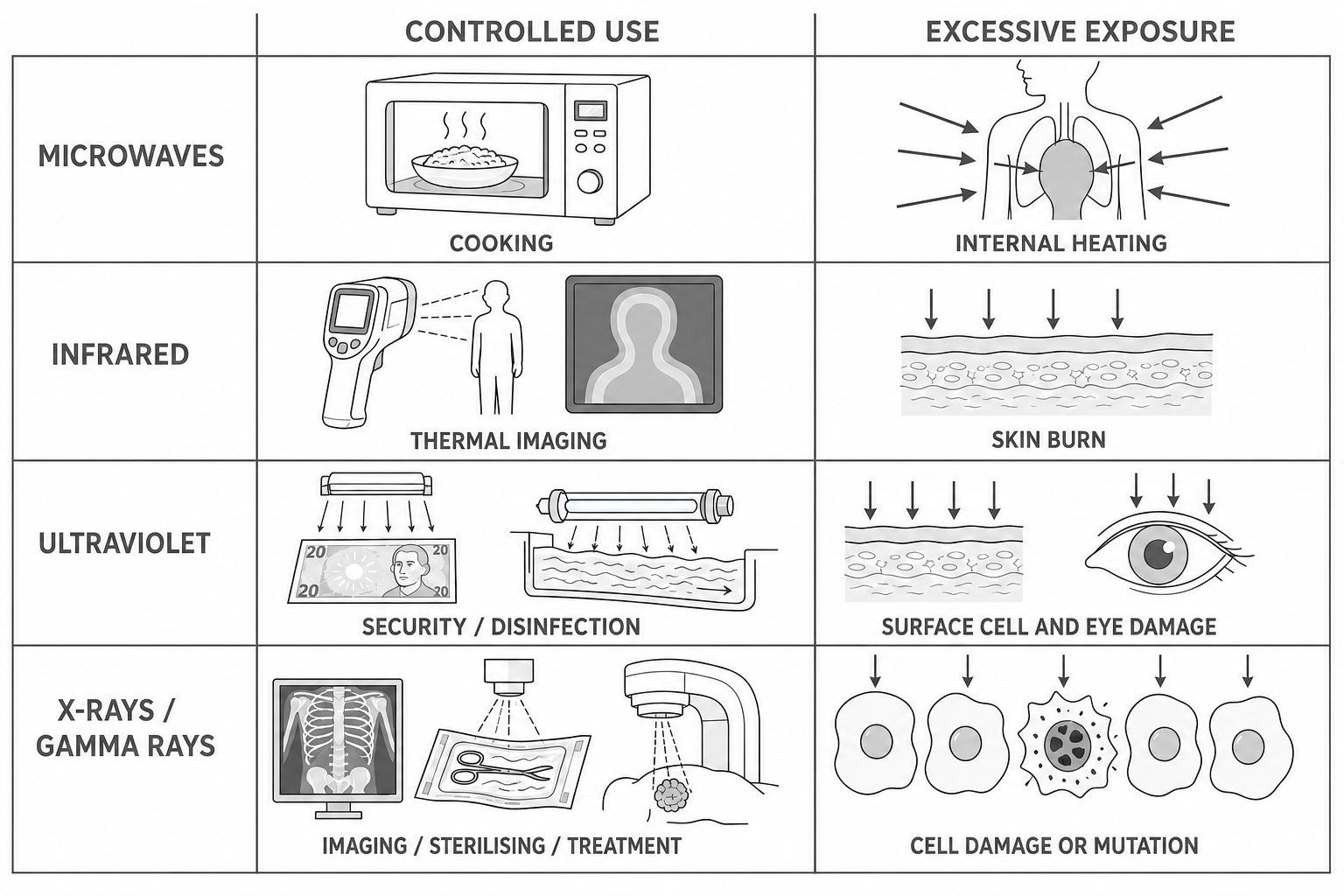
Read each row as a comparison, not a claim that the useful device normally causes the harm shown. The left side represents a controlled transfer for a chosen purpose; the right side represents excessive unwanted exposure.
Continue this lesson.
You’re previewing NovaLearn without an account. Create a free account to read the rest.
Create free account