11.1P-11.5P - Charging, induction and earthing
Track the electrons that charge insulators, explain attraction to neutral objects and connect sparks, lightning and earthing to the movement of charge.
Charging by friction moves electrons
Rub an insulating balloon with a dry cloth and the balloon may attract hair or cling to a wall. The rubbing does not create charge. Instead, close contact between the two different materials allows some electrons to transfer from one material to the other. Because the materials are insulators, the transferred electrons do not then flow away easily, so charge remains on the surfaces after they separate.
Before rubbing, each object is usually neutral: it contains equal amounts of positive and negative charge. In a solid, the positively charged protons remain fixed inside atomic nuclei. Electrons carry negative charge and are the particles that transfer between the surfaces.
After rubbing:
- the material that gains electrons has more electrons than protons, so it becomes negatively charged;
- the material that loses electrons has fewer electrons than protons, so it is left positively charged.
The diagram is a particle model, not a scale drawing of atoms or electron paths. It shows six positive and six negative charge units in each initially neutral material. Three electrons move from A to B: the positive units stay fixed, and the total number of electrons stays twelve. A ends with six positive and three negative units; B ends with six positive and nine negative units. Real objects contain far more charges.
[DIAGRAM: asset_name: 46_1PH0-P2-11A_11.1P-11.5P - Charging, induction and earthing - diagram 01; asset_slug: 46_1ph0-p2-11a_11-1p-11-5p-charging-induction-earthing_diagram_01; recommended_method: vector; description: Exact charge bookkeeping: A and B initially each 6 positive and 6 negative units; three electrons transfer A to B; final A has 6 positive 3 negative, B has 6 positive 9 negative. Positive counts and total electrons conserved.]
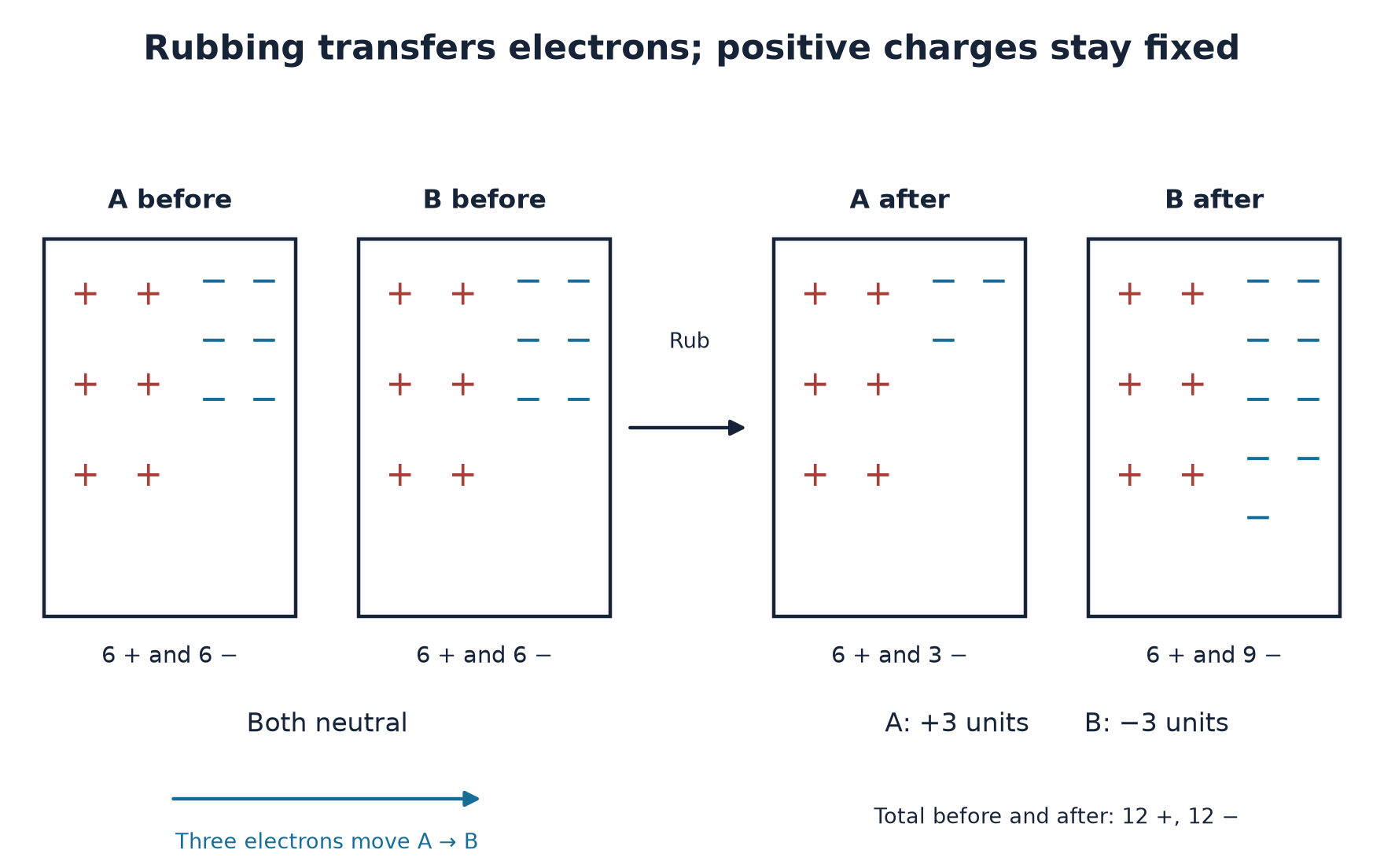
Every electron gained by one material is lost by the other. Charge is transferred, not made or destroyed, so the final negative charge on one material has the same magnitude as the final positive charge on the other. The signs are opposite, but the amount of charge transferred is equal.
Charges can attract or repel
Once objects are charged, the signs of their charges predict the direction of the force between them:
| Charge on the two objects | Interaction |
|---|---|
| positive and positive | repel |
| negative and negative | repel |
| positive and negative | attract |
Like charges repel. Unlike charges attract.
Two balloons rubbed with the same cloth often gain the same type of charge, so they push apart. A positively charged object and a negatively charged object pull together.
Attraction alone does not prove that two objects carry opposite net charges. A charged object can also attract a neutral object by induction, because charge shifts within the neutral object. Repulsion, however, requires the two objects to have the same sign of net charge in this model.
Induction separates charge without contact
Hold a charged balloon close to a neutral wall and the balloon may stick even though no electrons have crossed from the balloon to the wall. The nearby charged object causes electrons already in the wall to shift slightly. This redistribution is called electrostatic induction or polarisation.
Consider a negatively charged balloon:
- Excess electrons on the balloon repel electrons in the wall, so the wall's electrons shift slightly away from the nearby surface.
- The surface nearest the balloon is left with more positive than negative charge, while negative charge is displaced slightly farther away.
- The nearby unlike charges attract more strongly than the farther like charges repel, so the net force pulls the balloon toward the wall.
[DIAGRAM: asset_name: 46_1PH0-P2-11A_11.1P-11.5P - Charging, induction and earthing - diagram 02; asset_slug: 46_1ph0-p2-11a_11-1p-11-5p-charging-induction-earthing_diagram_02; recommended_method: vector; description: Negative balloon next to an insulating wall with enlarged neutral atomic/molecular pairs, each positive region nearer the balloon and electron displacement farther away. Net attraction points toward wall; no electrons cross the gap.]
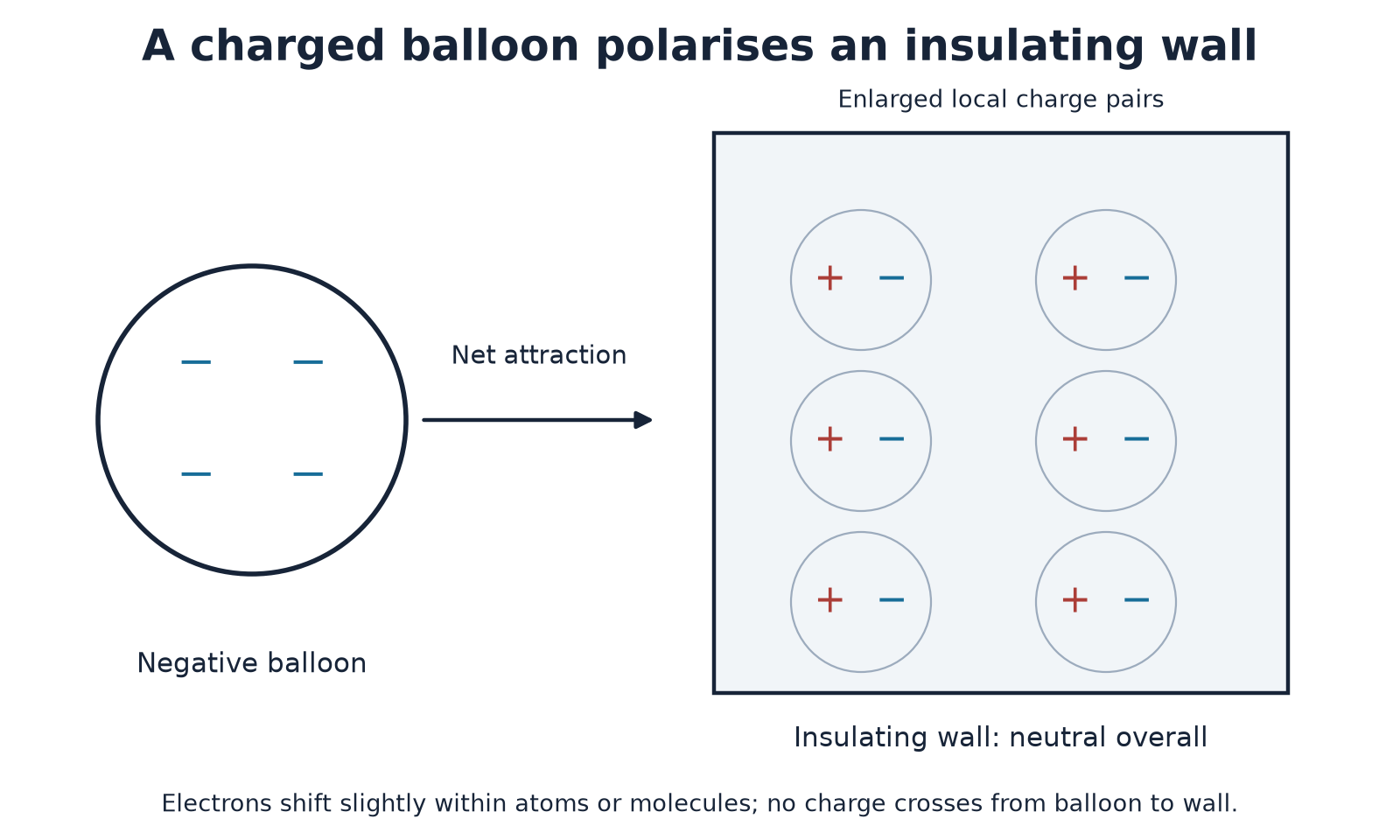
In an insulating wall, electrons shift slightly within atoms or molecules; they do not flow freely across the whole wall as they could in a conductor. The enlarged pairs in the diagram show this small local displacement. The wall remains neutral overall because it has not gained or lost electrons; its positive and negative charges have only become slightly separated. If the balloon is positive, the directions reverse: electrons shift toward the nearby wall surface, which becomes negatively charged relative to the farther region.
Continue this lesson.
You’re previewing NovaLearn without an account. Create a free account to read the rest.
Create free account