5.1P - Reflection, refraction and total internal reflection
Construct and interpret rays at a boundary, measure angles from the normal, and identify when light is totally internally reflected.
Following rays at a boundary
A drinking straw can look displaced where it enters water, while a mirror sends light back into the room. Both observations can be analysed with a ray model. A ray is a straight, arrowed line showing one direction in which light energy travels through a uniform medium; it is a geometric representation, not a material trail left by light.
Where a ray meets a surface, draw a normal: a construction line at 90 degrees to the surface at the point of incidence. Angles of incidence, reflection and refraction are always measured between a ray and the normal, not between a ray and the surface.
For reflection:
angle of incidence = angle of reflection
This is the law of reflection. The incident and reflected rays are on opposite sides of the same normal, and arrowheads show light travelling towards and then away from the surface.
Refraction is a change in direction when light crosses a boundary and its speed changes. When light enters glass from air, it slows down and bends towards the normal. When it leaves glass for air, it speeds up and bends away from the normal. A ray travelling along the normal has an incident angle of 0 degrees, so its speed and wavelength change at the boundary but its direction does not.
The light's frequency stays the same as it crosses a boundary because the oscillations must match at the boundary. Since wave speed = frequency × wavelength, a change in speed with unchanged frequency means the wavelength changes too.
[DIAGRAM: asset_name: 17_1PH0-P1-05A_5.1P-5.6P - Rays, reflection and lenses - diagram 01; asset_slug: 17_1ph0-p1-05a_5-1p-5-6p-rays-reflection-and-lenses_diagram_01; recommended_method: matplotlib; description: Exact common incidence point; reflection35degrees each; air/glass45→28.1degrees from normal with n1.5 geometry.]
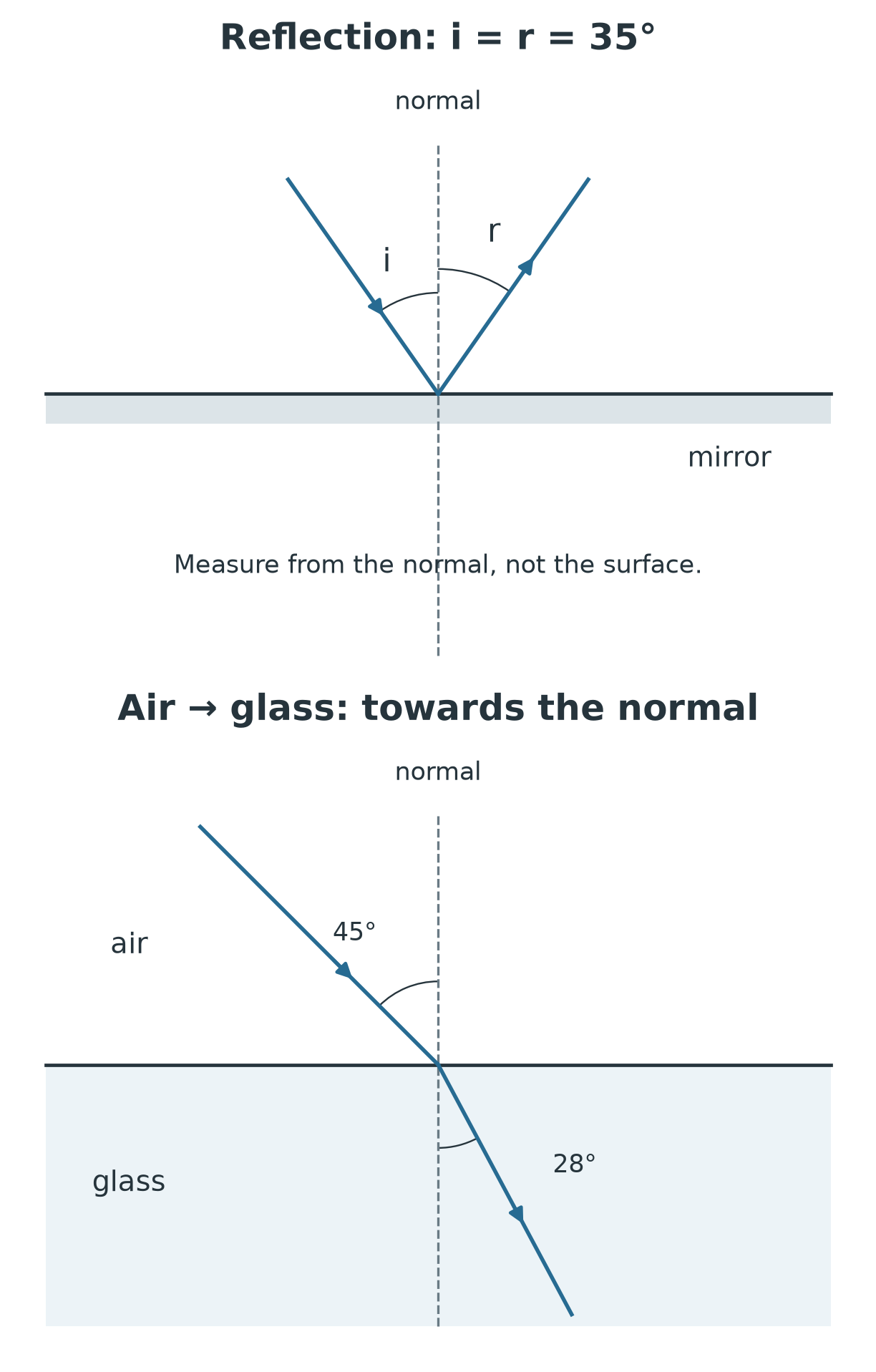
When drawing or reading any boundary diagram, use this order: locate the boundary, construct the normal, read each arrow direction, and only then compare angles. That prevents the common error of measuring from the surface.
Notebook construction and self-check
Draw a horizontal mirror and a normal through one point on it. Draw an incoming ray at 35° to the normal. Complete the reflected ray with an arrow.
Check your drawing: the outgoing ray is on the other side of the normal, makes 35° with it, and stays on the incident side of the mirror. Its angle to the mirror is 55°. Both rays meet the normal at the same surface point. This notebook construction is practice; the scored questions ask you to interpret the geometry in words and numbers.
Reaching the critical angle
Now follow a ray travelling from a medium where light travels more slowly (more optically dense), such as glass, towards a less optically dense medium, such as air. As its angle of incidence inside the glass increases, the refracted ray bends progressively farther away from the normal.
Continue this lesson.
You’re previewing NovaLearn without an account. Create a free account to read the rest.
Create free account