9.1-9.5, 9.10 - Force interactions and free-body diagrams
Objects interact through contact and fields. Use force pairs and scalar/vector quantities to describe these interactions, then study free-body diagrams and scale constructions at Higher tier. Finish with lubrication, which is for both tiers.
Interactions, fields and force pairs
Place a book on a table. The table changes shape by a tiny amount where the book touches it, and the book does not fall through. At the same time, Earth attracts the book even though Earth and the book do not need to touch across all the space between their centres. These are two kinds of interaction.
Contact interactions require the objects to touch. Two important contact forces are:
- a normal contact force, which a surface exerts perpendicular to itself; the table pushes upward on the book;
- friction, which acts parallel to contacting surfaces and opposes their relative movement, or their tendency to move relative to one another.
Non-contact interactions act at a distance. They are linked to fields:
- a gravitational interaction acts through a gravitational field, such as Earth attracting a book;
- an electrostatic interaction acts through an electrostatic field, such as two charged balloons attracting or repelling;
- a magnetic interaction acts through a magnetic field, such as separated magnets attracting or repelling.
A field is a region in which an appropriate object experiences a force. A field is not a material sent across the gap, and any field lines used to represent it are not physical threads or paths.
Every interaction involves two objects and produces a pair of forces. The forces in an interaction pair:
- act on different objects;
- have equal magnitudes;
- act in opposite directions;
- arise at the same time.
For the contact interaction, the table pushes upward on the book while the book pushes downward on the table. For the gravitational interaction, Earth pulls downward on the book while the book pulls upward on Earth. Each force can be represented by a vector arrow on the object that experiences it.
The forces in an interaction pair do not cancel each other on one object because they act on different objects. This is different from two balanced forces acting on the same object, which will be examined in a free-body diagram later.
Scalars, vectors and force arrows
A scalar quantity has magnitude, meaning size, but no specific direction. A vector quantity has both magnitude and direction.
| Scalar quantities | Vector quantities |
|---|---|
| mass | force |
| energy | weight |
| distance | displacement |
| speed | velocity |
| time | acceleration |
For example, 12 kg completely describes a mass because mass is scalar. A statement such as 12 N gives only the magnitude of a force. A complete force description also needs a direction, such as 12 N downward.
A force arrow is a representation, not a physical mark or a path followed by the object. Read it carefully:
- the arrowhead shows the force's direction;
- the length represents magnitude when a scale is used, so a longer arrow means a larger force;
- the arrow begins on the object acted on, at the relevant point or region of action when that matters;
- a label should identify the kind of force or the object exerting it.
Naming the object prevents vague statements. The table exerts an upward normal contact force on the book says who exerts the force, which object experiences it and its direction.
Free-body diagrams (Higher tier)
Statements 9.3-9.5 are Higher tier. The final lubrication part, statement 9.10, applies to both tiers.
A free-body diagram isolates one chosen object or system and shows the external forces acting on it. The object can be simplified to a box or point because the diagram is a model for analysing forces, not a realistic picture.
Use this routine:
- Name and isolate the object or system being studied.
- Identify each object outside the boundary that interacts with it.
- Draw every external force acting on the chosen object as a labelled vector arrow.
- Check that no force exerted by the chosen object on something else has slipped into its diagram.
[DIAGRAM: asset_name: 37_1PH0-P2-09A_9.1-9.5, 9.10 - Force interactions and free-body diagrams - diagram 01; asset_slug: 37_1ph0-p2-09a_9-1-9-5-9-10-force-interactions-and-free-body-diagrams_diagram_01; recommended_method: image_gen; description: a monochrome two-panel comparison showing the table-book normal interaction pair on different objects beside the isolated book with equal upward normal and downward weight vectors]
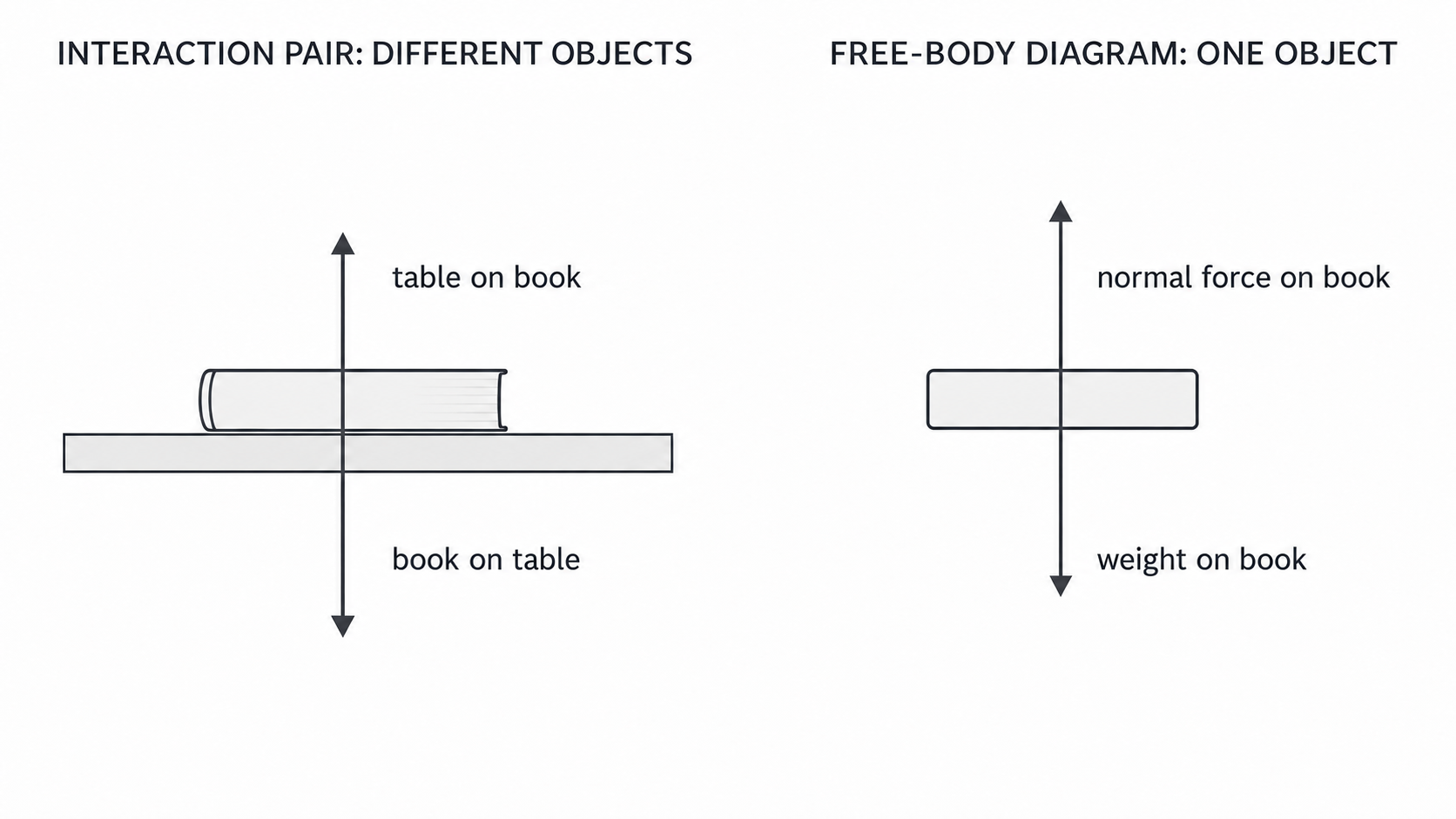
For a stationary book on a level table, the free-body diagram of the book contains:
- the downward weight exerted on the book by Earth;
- the upward normal contact force exerted on the book by the table.
If the arrows are equal in length and opposite in direction, these two forces are balanced. They are not an interaction pair: both act on the book and they come from two separate interactions. The partner of the upward normal force on the book is the downward force of the book on the table. The partner of the downward gravitational force on the book is the gravitational force of the book on Earth.
Try a free-body diagram in your notebook (self-check). Draw a stationary book on a horizontal table as a box. Add and label the forces on the book only, then compare with the right-hand model above. You should have equal upward normal contact and downward weight arrows. The force of the book on the table belongs to the other object's diagram. This drawing is not automatically marked.
Do not add velocity or acceleration arrows as if they were forces. Do not draw a separate resultant arrow alongside all the individual forces in the free-body diagram either; find the resultant from the force vectors after the diagram is complete.
Resultant force and equilibrium (Higher tier)
The resultant force, also called the net force, is the single force vector with the same overall effect as all the external forces acting on the chosen object or system. It is found by adding the force vectors, including their directions.
For forces along one straight line, choose one direction as positive. Suppose a sledge has a pull of 120 N to the right and friction plus air resistance totalling 80 N to the left:
taking right as positive: resultant force = (+120 N) + (-80 N) = +40 N
Continue this lesson.
You’re previewing NovaLearn without an account. Create a free account to read the rest.
Create free account