14.11 - Water heating and melting-ice core practical
A heater can make liquid water steadily warmer, yet keep transferring energy to melting ice while its temperature barely changes. In core practical 14.11, you will determine the specific heat capacity of water and obtain a temperature-time graph for melting ice. Together, the measurements show why energy transferred and temperature change are related but are not the same quantity.
Two water investigations
In the first investigation, measure the mass of water, the energy supplied to a heater through a joulemeter, and the temperature rise using a thermometer. These measurements determine the specific heat capacity:
Here is energy in J, is water mass in kg, is final minus initial temperature in °C, and is in J/(kg °C).
The second investigation records the temperature of crushed ice as it melts in a water bath heated by a Bunsen burner. These are the two methods specified in Pearson Appendix 5. The ice sample is inside a separate small beaker; the thermometer measures the sample, not the surrounding bath.
The joulemeter experiment measures energy and temperature change. The ice experiment measures temperature and time; it does not by itself determine latent heat because the energy reaching the ice is not measured.
Measure specific heat capacity
Use a balance, a supported insulated cup and lid, water, a clamped low-voltage immersion heater connected through a joulemeter to its supply, a thermometer, and a separate stirrer.
[DIAGRAM: asset_slug: phy-g-water-calorimeter-repaired; description: Specific-heat-capacity apparatus: insulated cup, immersed heater, thermometer bulb and stirrer, with supply and joulemeter connected by labelled paired cables.]
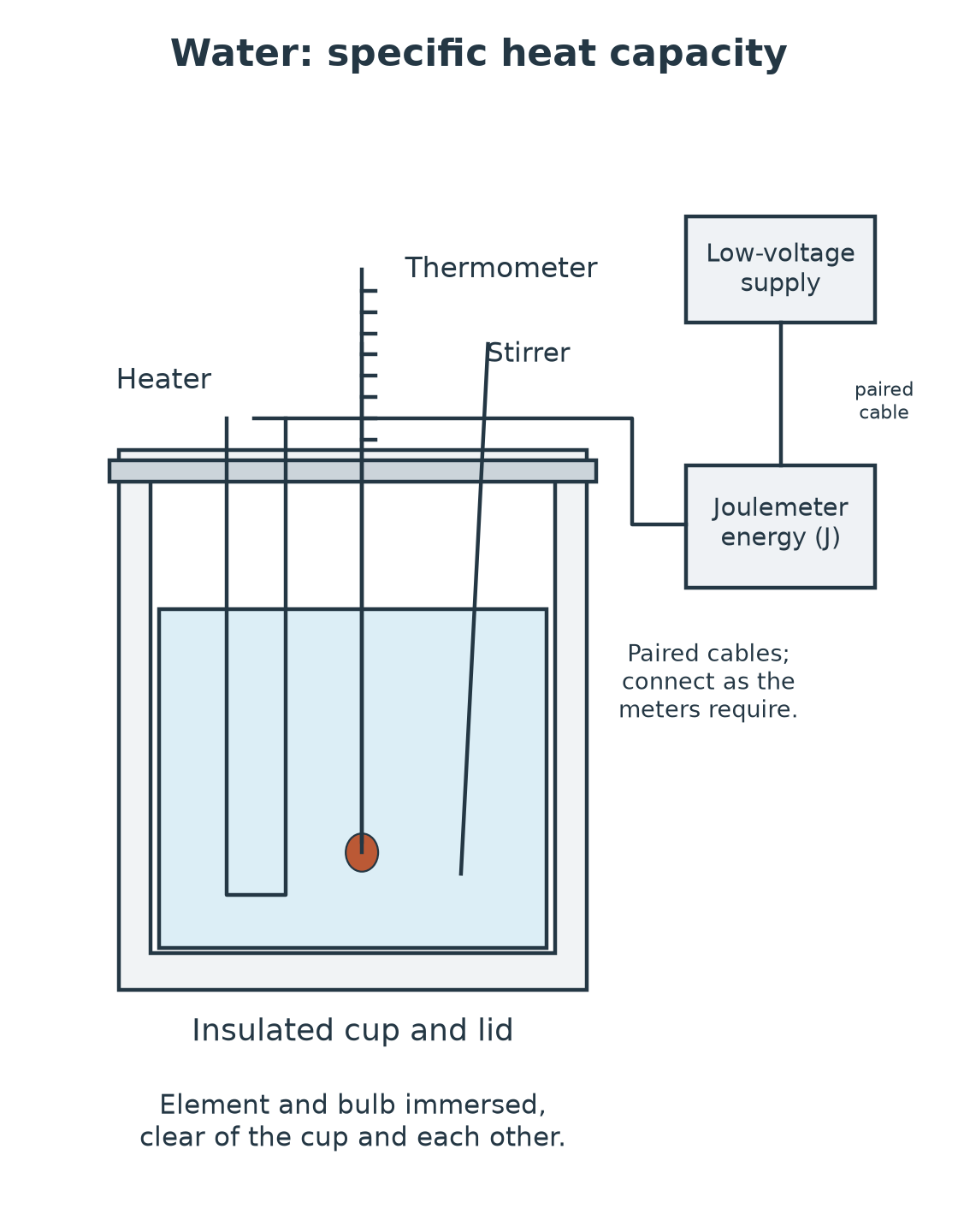
- Measure the empty dry cup mass and the cup-plus-water mass; subtract to obtain water mass. Alternatively tare the empty cup first. Convert grams to kilograms.
- Clamp the heater with its element fully immersed and clear of the cup. Support the thermometer with its bulb in the water, away from the heater and walls. Fit the lid and stir gently to make the water temperature uniform.
- Record the steady initial temperature. Reset the joulemeter, then switch on the heat supply. Read energy and temperature at regular intervals while stirring gently. Keep water mass, apparatus arrangement and stirring consistent.
- After a safe temperature rise of about 10–15 °C, switch off and record the total supplied energy. Continue gentle stirring and use the highest uniform final temperature to account for the thermometer’s response delay. Record this endpoint procedure so repeats use the same rule.
- Calculate final minus initial temperature, then use . Repeat complete runs with fresh equal masses of water at a similar starting temperature and compare results.
The independent quantity is energy supplied and the dependent quantity is water temperature. A graph of energy supplied vertically against temperature rise horizontally should be approximately straight; its gradient is , so dividing by water mass gives . This also uses more measurements than one endpoint pair.
Keep electrical connectors dry, use the specified low-voltage supply, keep the element immersed while powered and switch off before removal. Let the element cool before handling it. A secure supporting beaker prevents the insulated cup tipping.
Calculate and evaluate the result
Worked example. A mass of 0.200 kg of water warms from 20.1 °C to 29.8 °C. The joulemeter reads 8500 J.
The joulemeter measures input energy, not only the energy gained by water. Some energy warms the cup and heater and some transfers to the surroundings. Putting all of that energy over the water’s measured usually makes the calculated too high. Insulation and a lid reduce unwanted transfer; they do not remove the apparatus’ heat capacity.
| Limitation | Improvement and reason |
|---|---|
| Energy escapes through the sides or surface | Use insulation and a lid to retain a greater fraction of measured input energy. |
| Water near the heater is warmer | Stir gently and keep the thermometer away from the element to measure a representative temperature. |
| Temperature rise is very small | Use a safe larger rise: the same reading uncertainty becomes a smaller fraction of the difference. Excessive heating increases losses and risk. |
Repeated measurements reveal scatter and averaging reduces its effect. Repetition cannot remove a bias that remains in every run, such as energy consistently warming the cup.
Continue this lesson.
You’re previewing NovaLearn without an account. Create a free account to read the rest.
Create free account