10.37-10.42 - Mains safety and appliance ratings
Trace normal and fault-current paths to explain mains protection, then use appliance ratings to compare how quickly energy stores change.
The three mains wires
A domestic appliance with an earthed metal case can have three mains wires. Their jobs differ, so earth must not be treated as a second neutral wire.
| Wire | Function | Current during normal operation | Potential relative to earth |
|---|---|---|---|
| Live | Connects the appliance to the alternating supply and is interrupted by its switch and fuse | Carries the operating current | About 230 V |
| Neutral | Completes the normal circuit and keeps the other appliance terminal near earth potential | Carries the operating current | About 0 V |
| Earth | Connects exposed metal casing to earth as a protective fault path | No current in normal operation | About 0 V |
Potential difference is always between two points. In the GCSE mains model:
- live to neutral is about 230 V;
- live to earth is about 230 V;
- neutral to earth is about 0 V.
The live wire is therefore dangerous because touching it while also connected to earth can put a large potential difference across the body. Neutral carries current during normal operation even though its potential is close to earth potential. Real wiring can be faulty, so no conductor should be assumed safe to touch.
Because this is a.c., live and neutral are not called positive and negative. The polarity of the supply reverses, but the wires keep their different functions: live supplies the alternating potential and neutral is the normal return path.
Earth fault protection
Consider a metal-cased appliance in which damaged insulation allows the live wire to touch the case. The case has an unintended connection to live. Without effective earthing, a person touching the case while connected to earth could complete a path through their body, so a dangerous current could cause an electric shock.
[DIAGRAM: asset_name: 45_1PH0-P2-10G_10.33-10.42 - Mains electricity and safety - diagram 02; asset_slug: 45_1ph0-p2-10g_10-33-10-42-mains-electricity-and-safety_diagram_02; recommended_method: vector; description: Connected mains protection model: fuse in live lead, appliance between live and neutral, separate low-resistance earth wire attached to metal case, and dashed live-to-case fault after fuse. Fuse opens live after large fault current.]
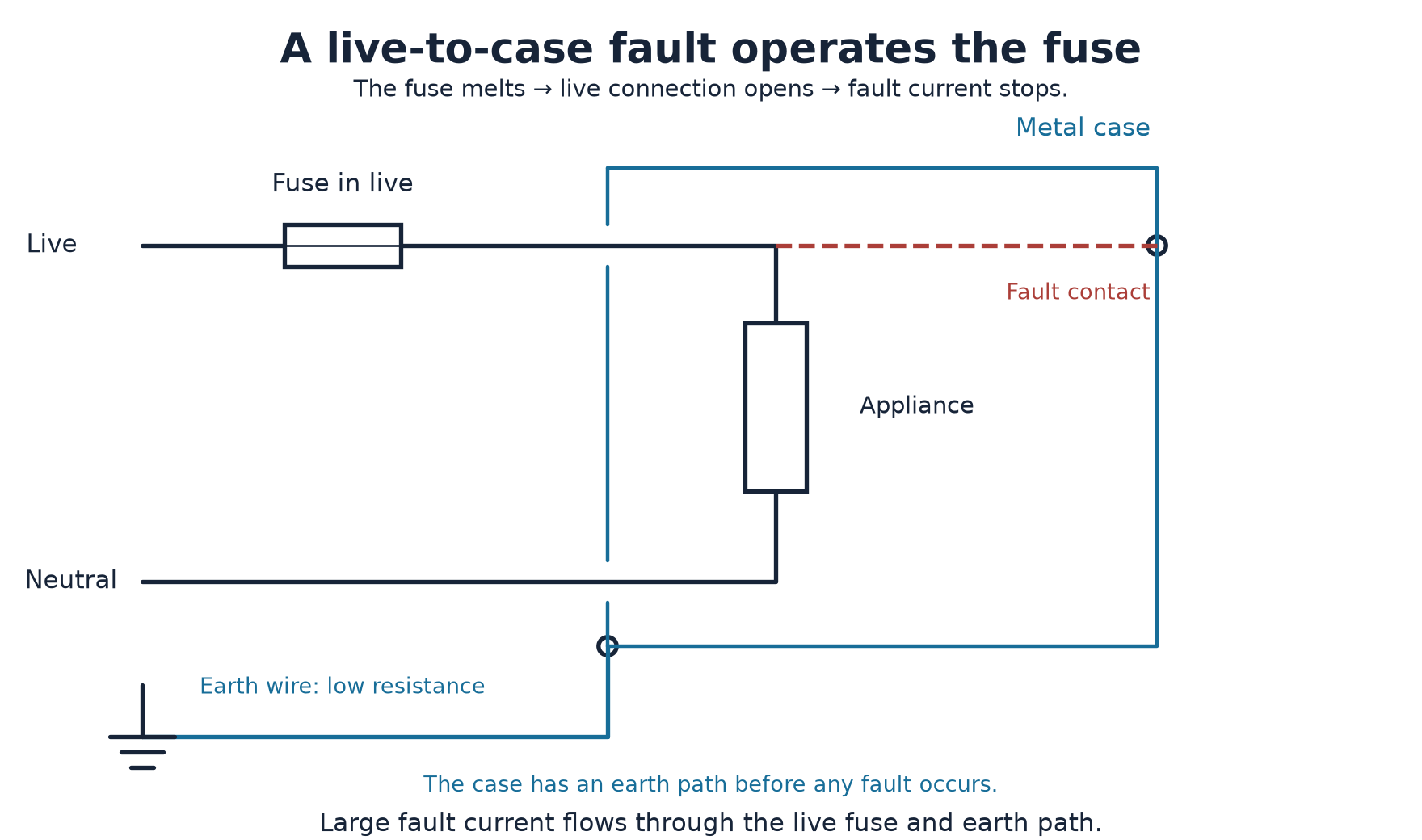
The earth wire changes what happens after this fault:
- The earth wire gives the metal case a low-resistance path to earth and helps keep it close to earth potential while the fault is cleared.
- The live-to-case fault produces a large current through this path.
- The excessive current makes a fuse melt or a circuit breaker trip, opening the circuit and disconnecting the live supply.
The earth wire is connected to the case, not to live, during normal operation. The fault creates the dangerous live-earth connection; the protection is designed to make that fault operate a disconnection device quickly. A live-earth connection can otherwise cause severe shock, intense heating, burns or fire, especially if a person becomes part of the path.
Continue this lesson.
You’re previewing NovaLearn without an account. Create a free account to read the rest.
Create free account