14.12-14.15 - Gas pressure and temperature
A rigid sealed container can show a higher pressure after its gas is warmed, even though no extra gas has entered. Statement 14.12 explains gas pressure using moving particles, while 14.13 links temperature, particle velocity and pressure for a fixed mass at constant volume. Statements 14.14 and 14.15 introduce absolute zero and connect the kelvin and Celsius temperature scales.
How moving particles produce pressure
Imagine a rigid sealed container of gas connected to a pressure gauge. The gauge gives one steady reading even though, at particle scale, the gas is in constant activity.
The particle model represents a gas as a very large number of tiny particles that are far apart. The particles move rapidly and randomly in all directions. They collide with one another and with every inside wall of the container, changing velocity whenever their direction or speed changes.
When a particle collides with a wall, its velocity changes and it exerts a force on that wall. One collision has a tiny, brief effect. The huge number of collisions occurring across the walls produces an average force on each unit area, which is measured as gas pressure.
Gas pressure is the force per unit area on a surface. In the particle model, it is produced by gas particles continually colliding with the surface and exerting forces on it.
The particles do not form a layer that pushes continuously, and they do not all move together in one direction. Their repeated random collisions explain why the gas exerts pressure on all the container's inside surfaces.
Why temperature changes pressure
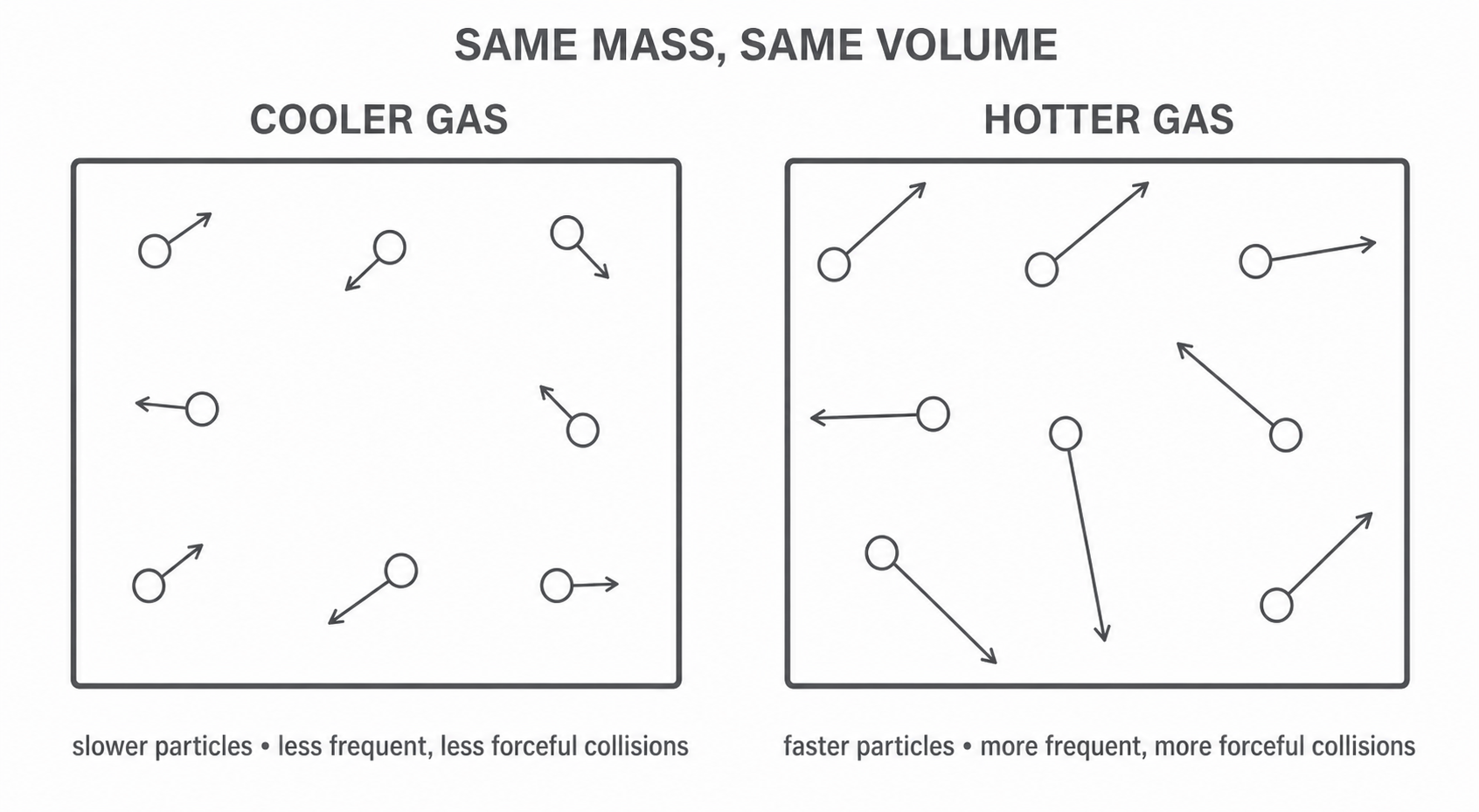
Now compare the gas before and after warming it. The container is sealed, so it holds the same fixed mass of gas and the same number of particles. It is also rigid, so its volume and inside wall area remain constant. These conditions matter: temperature is the only change in the comparison.
Temperature is linked to the average kinetic energy of the particles. When the gas is heated, energy is transferred to the particles' kinetic energy store. The particles move faster on average, so the magnitudes of their velocities increase; they still travel in random directions and do not all have the same velocity.
Faster particles affect the walls in two connected ways:
- They cross the container in less time, so collisions with the walls occur more frequently.
- A typical collision transfers more momentum to the wall. Together with the increased collision rate, this increases the average force on the wall.
The average force on the same wall area therefore increases, so the gas pressure increases. Cooling reverses the chain: particles move more slowly on average, their wall collisions are less frequent and exert smaller forces, and the pressure decreases.
[DIAGRAM: asset_name: 58_1PH0-P2-14E_14.12-14.15 - Gas pressure and temperature - diagram 01; asset_slug: 58_1ph0-p2-14e_14-12-14-15-gas-pressure-temperature_diagram_01; recommended_method: image_gen; description: Two equal sealed rigid containers with the same particle count, comparing shorter random velocity arrows and less frequent, less forceful collisions with longer arrows and stronger, more frequent collisions.]
Continue this lesson.
You’re previewing NovaLearn without an account. Create a free account to read the rest.
Create free account